
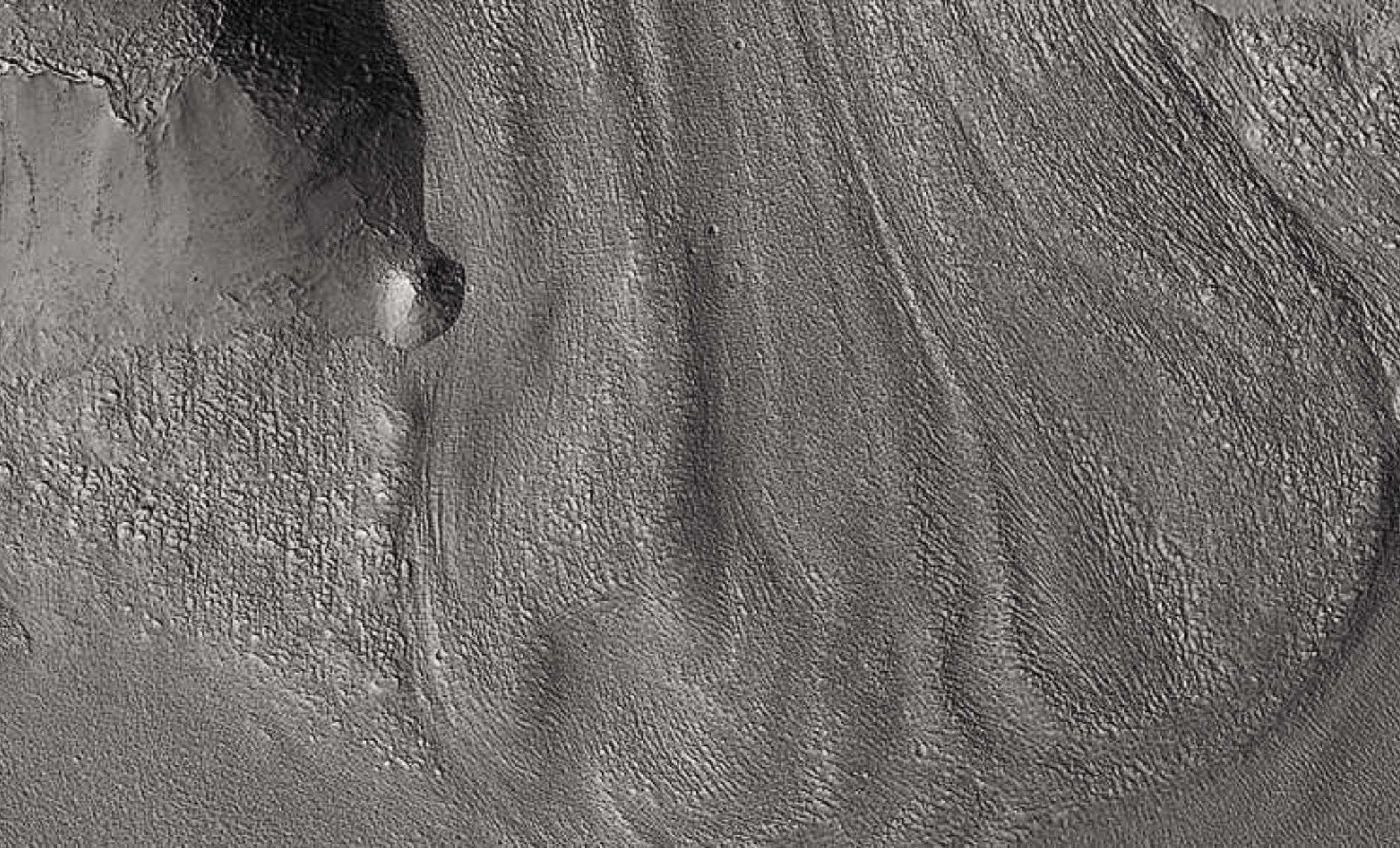
A new publication in Icarus by researchers from the Weizmann Institute of Science and the Planetary Science Institute has transformed what we know about the glaciers on Mars. Once thought to be largely rock and dust with a thin ice layer, these glaciers are now shown to consist of over 80% clean water ice. This breakthrough not only revises earlier beliefs but also enhances our understanding of Mars’ climatic evolution and its water resources, which are critical for upcoming human missions. This discovery builds on years of planetary research, offering fresh perspectives on Martian ice formations.
Unveiling the True Composition of Martian Glaciers
For decades, Mars has been a focal point of planetary science, with its glaciers providing clues about the planet’s environmental past. Located on the slopes of mountains and craters across Mars, these glaciers were assumed to be covered predominantly by thick rock and dust layers, with ice only underlying these deposits. However, Yuval Steinberg, a recent graduate of the Weizmann Institute, led a study revealing that these glaciers are mainly composed of pristine water ice, overturning long-standing assumptions.
Examining glaciers from various latitudes on Mars, the research team discovered that the ice content is not only abundant but surprisingly uniform across different sites. Co-author Oded Aharonson emphasized, “This research underlines how NASA’s programs encourage scientific advancements globally, reaching students worldwide.” The study exemplifies the collaborative spirit fueling international advancements in planetary exploration.

Finding such pure ice within these glaciers significantly affects estimates of Mars’ water reserves. This newfound abundance could prove invaluable as a source for future human expeditions to the Red Planet.
Innovative Techniques Behind the Breakthrough
The researchers’ breakthrough stemmed from applying a systematic set of scientific measurements to evaluate Martian glaciers reliably. Earlier research on debris-covered glaciers employed variable methods, hindering direct comparison of results. To overcome this, the team standardized their approach by focusing on two principal parameters: dielectric properties and loss tangent. These radar-based metrics measure how electromagnetic waves pass through glacier material, enabling precise identification of the ice-to-rock ratios.
Isaac Smith, another contributor to the study, noted, “Different techniques had been used on various sites before, making comparisons challenging. We included a previously unstudied location and completed partial analyses on two other sites, creating a much more thorough overview.” This consistent methodology provided a comprehensive perspective on glaciers previously examined in isolation.
Because Martian glaciers are obscured by dust and rock debris, conventional visual analysis isn’t effective. The use of radar instruments, especially NASA’s Mars Reconnaissance Orbiter’s SHARAD (SHAllow RADar), was vital in penetrating surface layers to reveal the ice deposits beneath.
Mars’ Glaciers Demonstrate Planet-Wide Uniformity
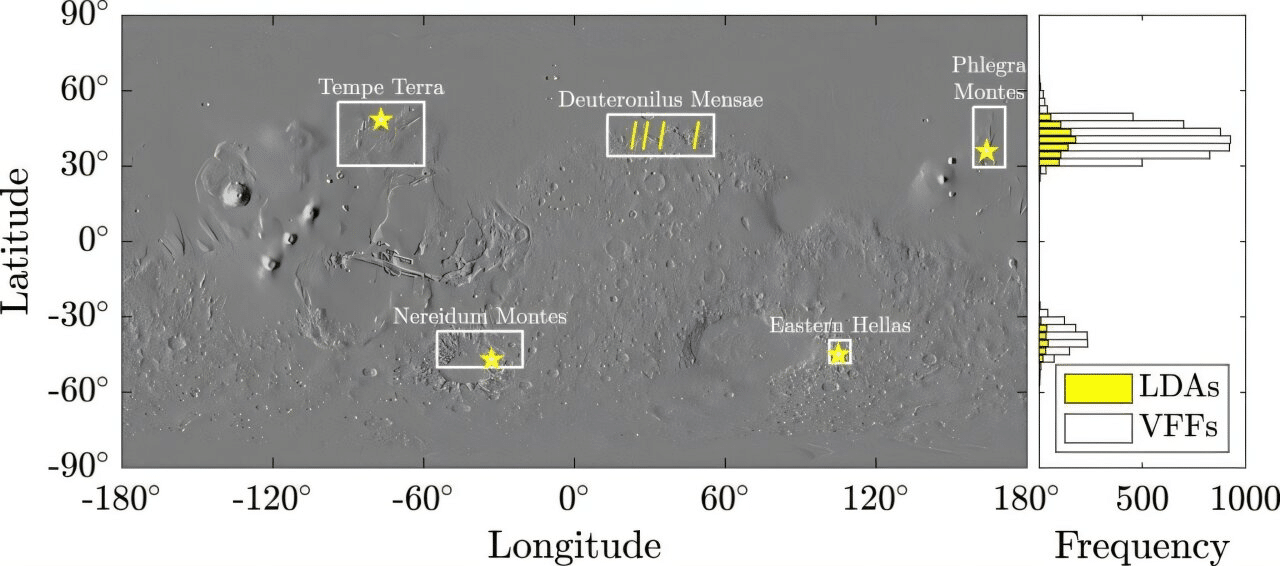
A remarkable aspect of this research is the discovery that glaciers across widely separated regions on Mars share nearly identical properties. Investigating five sites spanning both Martian hemispheres, the scientists found uniform glacier composition despite diverse local conditions. Smith explained, “This finding indicates that the processes governing glacier formation and preservation are consistent globally.”
This global homogeneity points to either a solitary large-scale glaciation or several glaciations with comparable characteristics, contradicting earlier ideas of variable glacier origins. By examining these glaciers collectively using a unified method, the scientists achieved a clearer understanding of Mars’ environmental history.
The study also provides crucial context on how these glaciers have remained intact over billions of years. Grasping their development and longevity is essential not only for scientific insight but also for strategizing future missions that may depend on these ice reserves as in-situ resources.
- Categories:
- News






0 comments
Sign in to Comment