
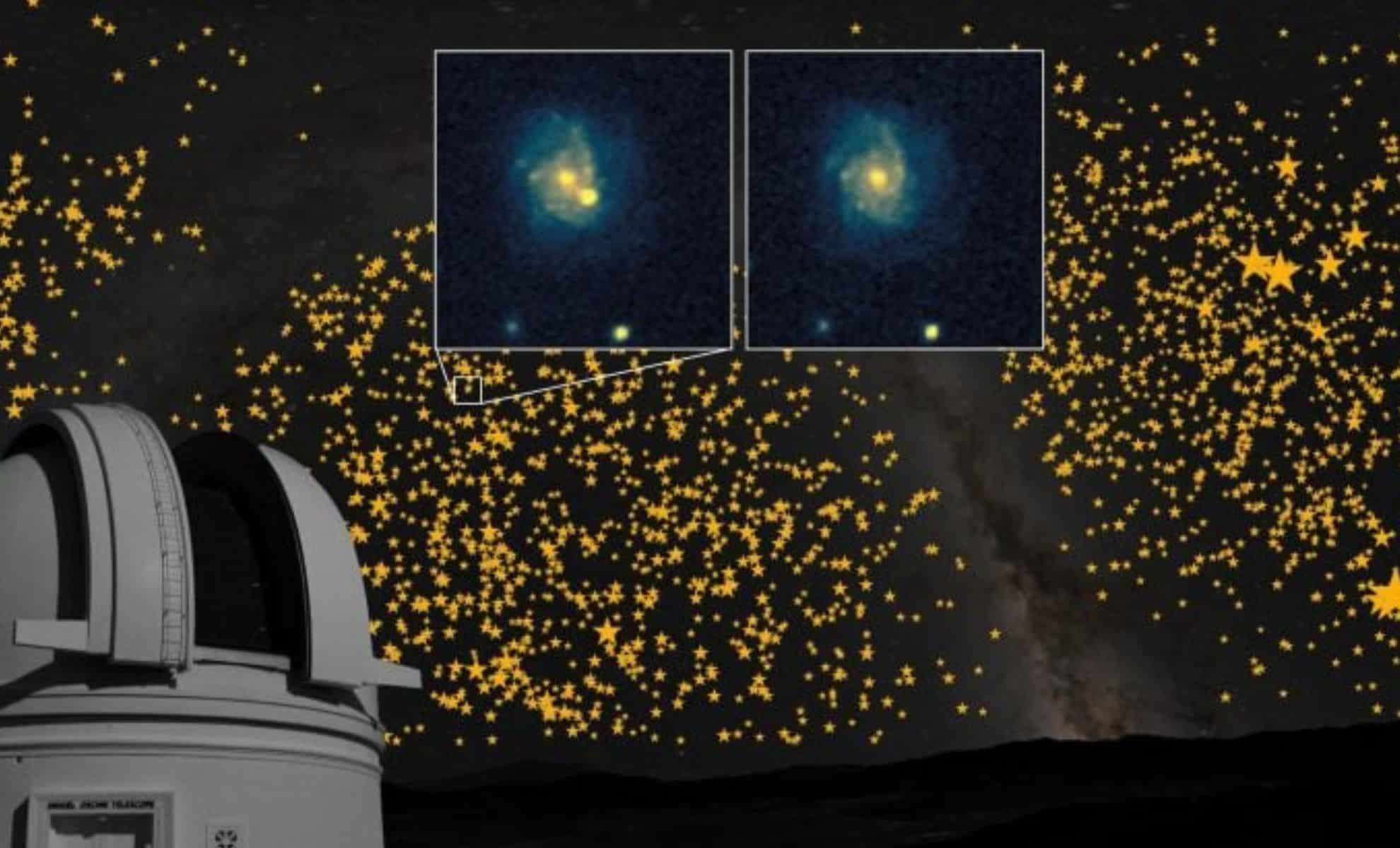
A groundbreaking study analyzing close to 4,000 supernova explosions has unveiled transformative insights about dark energy and the universe’s accelerating expansion. These brilliant stellar explosions, marking the end of a star’s life, have been fundamental in gauging cosmic distances and exploring the universe’s evolution. Yet, the newfound discovery of an unexpected variety among white dwarf supernovae—previously regarded as uniform—challenges their use as consistent markers for measuring the cosmos.
Traditionally, the detonation of white dwarfs has served as trusted standard candles due to their presumed predictable brightness, enabling scientists to map astronomical distances and infer the influence of dark energy on cosmic acceleration. However, this recent extensive survey raises questions about the dependability of these stellar explosions for precise distance measurement, with potential consequences for our grasp of universal expansion.
A Milestone in Decoding Stellar Bursts
The latest findings originate from observations made by the 4,000-supernovae dataset collected via the advanced Zwicky Transient Facility (ZTF). This cutting-edge sky survey captures the cosmos with unmatched speed and depth, uncovering a wide spectrum of explosive phenomena among white dwarf stars. Contrary to the long-held belief in their uniformity, these stellar explosions exhibit a remarkable diversity, ranging from dim, fleeting flashes to extraordinarily luminous outbursts that endure for extended periods.

“ZTF’s unparalleled capability to detect stellar eruptions up to one million times fainter than the faintest naked-eye stars has dramatically broadened our cosmic perspective,” explains Prof. Kate Maguire, a principal investigator in this research. The data suggest that these explosions arise through diverse scenarios—from intense stellar collisions to binary star cannibalism. This variety could affect their reliability as cosmic distance indicators, prompting a reconsideration of their role in astrophysics.
A Complex New View of White Dwarf Supernovae
Published in Astronomy & Astrophysics, the study utilizing ZTF data reveals surprising heterogeneity in how white dwarf stars undergo supernova explosions. Once assumed to detonate uniformly, these stars display a wide array of explosive properties, with some events barely detectable and others shining brightly for months or even years. This underscores the complexity and unpredictability of these cosmic blasts.
“Our results highlight an extensive range in the brightness and duration of white dwarf supernova explosions, overturning previous expectations about their uniformity,” notes Prof. Maguire. Such variability challenges the assumption that these explosions occur via a single standardized mechanism and suggests a need to revisit their application as precise distance benchmarks critical for cosmological studies.
Consequences for Investigating Dark Energy
The implications extend deeply into dark energy research, the mysterious force propelling the accelerating cosmic expansion. For many years, supernova observations have been instrumental in quantifying dark energy’s influence by serving as yardsticks for measuring how fast the universe is stretching. But if the uniformity of these explosions cannot be assured, then the precision of dark energy measurements may be compromised.
This newfound explosion variety introduces fresh uncertainties into the cosmic distance ladder, the foundational approach astronomers use to determine vast interstellar distances. Since white dwarf supernovae have been a cornerstone for estimating the universe’s size and expansion rate, their inconsistent behavior might force scientists to refine existing methods or develop alternative techniques for gauging cosmological distances and expansion.
Opening New Frontiers in Cosmic Exploration
The revelation of this rich diversity in white dwarf supernovae propels scientific inquiry into novel directions, while also presenting challenges for accepted cosmological frameworks. Understanding the multifaceted nature of these stellar explosions may transform how we investigate the universe’s expansion and deepen our comprehension of dark energy. Conducted by a global team of researchers, this work marks a pivotal step toward unraveling the mysteries of the cosmos. As data continue to pour in from the Zwicky Transient Facility and similar observatories, we can anticipate a surge in discoveries illuminating the dynamic character of these explosions and their cosmic significance.
Although the full impact on dark energy theories is still unfolding, one point is certain—the universe exhibits far greater intricacy and unpredictability than previously thought. Each discovery progressively refines our cosmic portrait, challenging long-held assumptions and expanding the frontiers of astrophysical knowledge. With insights from over 4,000 supernovae, we are edging closer to unraveling the true nature of the forces that shape our universe.
- Categories:
- News






0 comments
Sign in to Comment