
For many years, dark energy has been the prevailing explanation for why the Universe’s expansion is speeding up. Yet, a team at the University of Canterbury in Christchurch, New Zealand has introduced a groundbreaking perspective suggesting that dark energy may not be necessary. By applying a novel technique to examine supernovae light data, their research indicates that cosmic expansion is not uniform but instead exhibits a more uneven, 'lumpy' character than previously realized.
Reconsidering How the Universe Expands
The standard cosmological framework, known as the Lambda Cold Dark Matter (ΛCDM) model, depends on dark energy to account for the accelerated growth of the Universe identified through observations of distant supernovae. This model presumes a uniform expansion, an assumption increasingly scrutinized due to phenomena like the Hubble tension, which reveals inconsistencies between early and late Universe expansion rates.
The researchers advocate for the timescape model, which removes the need for dark energy by incorporating spatial and temporal variations in cosmic measurements. Their findings assert that “a simple expansion law consistent with Einstein’s general relativity does not have to obey Friedmann’s equation.”

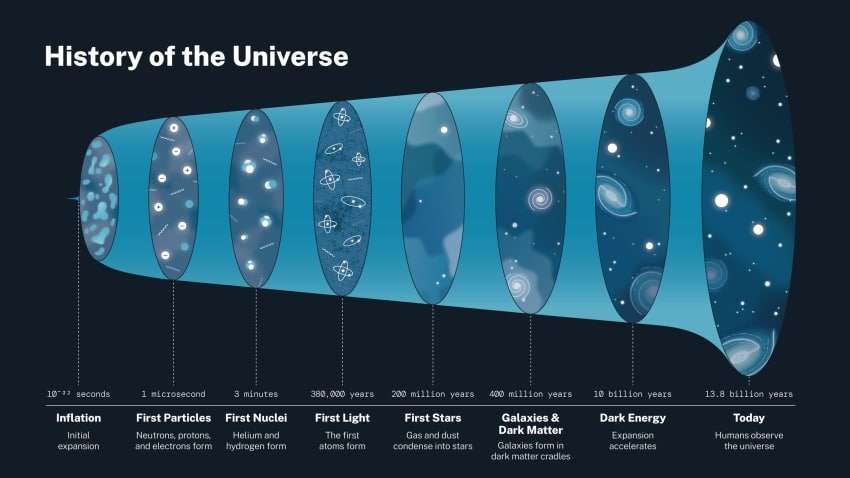
Comparing ΛCDM and Timescape Models
Here’s a breakdown of how these two theories differ in interpreting the cosmic expansion:
Gravitational Time Dilation’s Impact
The timescape hypothesis highlights gravitational time dilation as a fundamental contributor. Time ticks slower within stronger gravitational fields, such as galaxies, compared to enormous cosmic voids. This discrepancy suggests that what appears as accelerated expansion is actually a manifestation of varying rates of time flow. According to the model, “a clock in the Milky Way would be about 35 percent slower than the same one at an average position in large cosmic voids.”
Consequences for Established Cosmology
Lead scientist Professor David Wiltshire argues their results could transform our cosmic perspective: “Dark energy is a misidentification of variations in the kinetic energy of expansion, which is not uniform in a Universe as lumpy as the one we actually live in.” Their framework also offers a promising avenue to resolve the longstanding Hubble tension paradox, which challenges the conventional ΛCDM approach.
Additionally, insights from the Dark Energy Spectroscopic Instrument (DESI) and other precise measurements suggest that alternative models may better align with observational data than the traditional ΛCDM model. These findings imply that the long-held assumption of uniform cosmic expansion, as described by the Friedmann equation, could require revision.
Validating the Timescape Model with Upcoming Observations
With the support of expanding datasets, including the Pantheon+ catalog comprising 1,535 supernovae, the timescape model has gained credibility. However, further observation and analysis are essential for confirming its validity. Missions such as the European Space Agency’s Euclid satellite and the Nancy Grace Roman Space Telescope are poised to provide critical data.
Future Directions in Cosmology
To decisively differentiate the timescape hypothesis from the ΛCDM paradigm, scientists estimate that approximately 1,000 high-quality supernova observations will be necessary. Professor Wiltshire expressed optimism: “With new data, the Universe’s biggest mystery could be settled by the end of the decade.”
This emerging research challenges standard cosmology and has the potential to significantly reshape our fundamental grasp of the Universe in the near future.
Source: Royal Astronomical Society
- Categories:
- Astronomy ,
- Physics







0 comments
Sign in to Comment