

In a Somerset field, a metal detector enthusiast has discovered a remarkable Roman gold ring that had been hidden underground for nearly 1,700 years. Known as the Ilminster Ring, this exquisite artifact dates back to a time when Roman Britain functioned independently from the empire.
Kevin Minto was expecting yet another Roman coin when his metal detector alerted him near Ilminster, having already found numerous coins there before. Instead, he uncovered a substantial gold ring, unique in its heft and artistry compared to previous finds.
Part of a hoard that included coins and other items, the Ilminster Ring is distinguished by its craftsmanship and impressive weight, making it one of the finest pieces of Roman jewelry discovered within Britain to date.

An Exquisite Piece for a Distinguished Owner
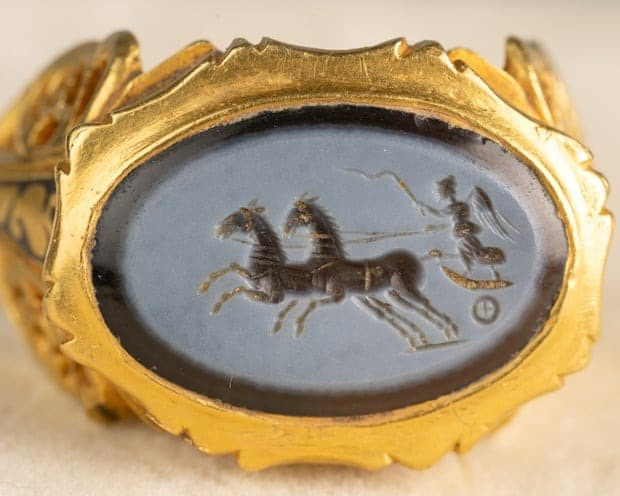
Weighing close to 48 grams and fashioned from solid gold, the ring features a bluish-gray gemstone engraved with a detailed depiction of Victoria, the Roman goddess symbolizing victory.
According to a release from South West Heritage Trust, the image carved using the intaglio technique shows Victoria in a two-horse chariot, wielding reins and a whip. She is adorned with wings and a helmet, emblematic of triumph and military prowess in Roman symbolism.
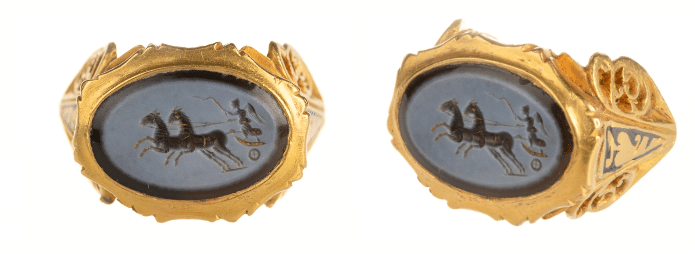
Amal Khreisheh, senior curator at The South West Heritage Trust, highlighted the ring’s considerable size, weight, intricate goldwork, and expert engraving. She commented:
“While other examples are known, these elements combine to create a spectacular ring that is only paralleled by continental discoveries.”
The sheer weight and richness of the ring suggest it was owned by someone of high status, possibly a wealthy landowner, merchant, or local dignitary.
Hidden During a Period of Roman Britain’s Independence
The ring was part of a larger hoard containing 297 Roman coins and various lead and pottery artifacts. Its concealment dates shortly after a dramatic chapter in British Roman history, from 286 to 296 CE, when the province was governed independently by Carausius and later Allectus — an episode often called the Carausian Revolt.
For affluent citizens of the time, political instability and shifting power dynamics made safeguarding valuables essential. Many chose to bury their treasures, hoping to reclaim them later.
Information from The South West Heritage Trust indicates that the ring was likely interred soon after the end of this turbulent period, but the owner never returned. Khreisheh also shared:
“Usually archaeologists handle broken things – such as pieces of pottery or animal bones. Things like this don’t come along very often,”
A Discovery That Changed a Detectorist’s Life
Minto began metal-detecting at the site in 2017, initially uncovering Roman coins. In 2018, he found the gold ring. Reflecting on the discovery with The Guardian, he recalled first mistaking the object for a coin, then a brooch, before recognizing it as a ring.
“It’s hard to explain what if feels like when you find something like that,” he remarked. “It was like being hit by an express train. At first I thought it was a coin, then a brooch, and then realised it was a ring. You’re a little dumbfounded, really. One of the boys I was with was screaming: ‘We’re rich, we’re rich.’”

Ongoing analysis aims to determine whether the ring was crafted locally in Britain or imported from elsewhere within the Roman Empire. Scholars also intend to explore possible connections between the ring’s owner and a lead-lined coffin found by Minto in the same field.
- Categories:
- News












0 comments
Sign in to Comment