

In the English countryside, a young child made an extraordinary find: a golden Tudor pendant uncovered while playing with his dad’s metal detector in a serene Essex meadow. This precious artifact, now part of the British Museum’s collection, is a rare religious locket from the 16th century, buried just below the earth’s surface without the need for any clues.
During a casual stroll in May 2009 near Hockley, a small village about two hours from London, James Hyatt accompanied his father for a relaxed day outdoors. Shortly after starting to wave the metal detector, a series of beeps signaled the presence of something metallic. Within moments, a gleaming piece of gold emerged from the soil.
The Moment a Simple Beep Led to History
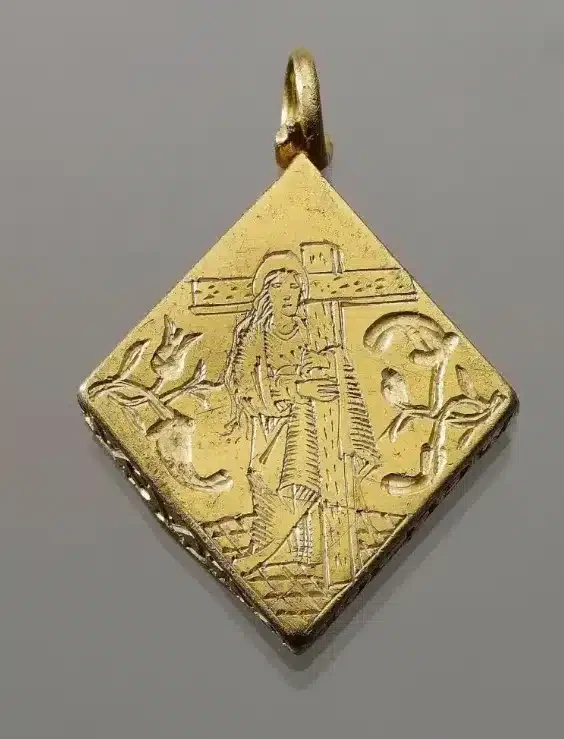
Though not large, the pendant discovered by James holds deep historical and religious importance. As reported by Popular Mechanics, the artifact traces its origins to Henry VIII’s era, likely owned by an affluent individual. Comprising 73% gold and roughly the size of a credit card, the pendant showcases exquisite Tudor craftsmanship combined with rich spiritual symbolism common in personal devotional items of the time.

“It went beep, beep, beep. Then we dug into the mud. There was gold there,” James’s father, Jason Hyatt, told the BBC. “We didn’t have a map — only pirates use treasure maps.” The detector had only been in his son’s hands for a few minutes.
The detector had barely been in James’s possession when the find was made. According to the British Museum’s Google Arts and Culture entry, the locket served dual purposes as a decorative piece and a sacred object.
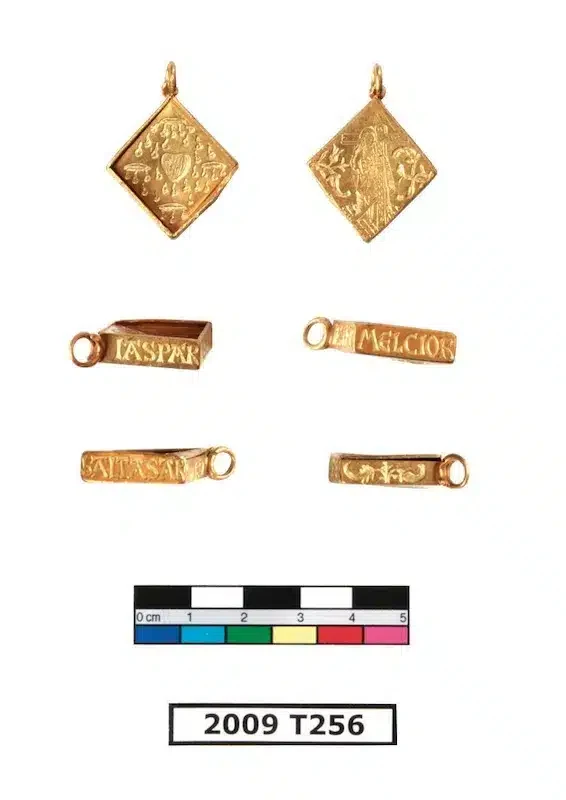
One side likely depicts either the Virgin Mary or Saint Helena clutching a blood-speckled cross. The reverse side displays a heart with four incisions alongside engraved droplets symbolizing Christ’s wounds. A sliding mechanism reveals a hidden compartment, which might have once contained a relic from the True Cross, though after cleaning only soil and root fragments remained.
The Legal Path for a Priceless Find
Once found, the pendant was reported to authorities following UK treasure laws. An Essex coroner officially ruled it a treasure trove, requiring that it be offered to a museum. If the museum accepted, the reward would be shared between the finder and the landowner. Initial guesses valued the pendant at roughly $4 million based on its rarity and historical importance.
However, the UK Treasure Valuation Committee later appraised it at £70,000, equivalent to about $110,000 in 2009. The British Museum acquired the piece, exhibiting it since 2012. Regardless of the lower price, the pendant has maintained its status as a noteworthy artifact from Tudor England.
A Field with Hidden History
This was James’s very first time using a metal detector. His dad shared with the BBC, “He’s the sort of kid who finds lost items everywhere—like pulling out a ten-pound note from the sofa.” Following the remarkable discovery, James continued to enjoy using the detector, even exploring his own backyard.
The British Museum highlights that the pendant was likely both a cherished religious token and a sign of social standing. For enthusiasts, authentic replicas are available, crafted with meticulous attention based on museum research.
- Categories:
- News













0 comments
Sign in to Comment