
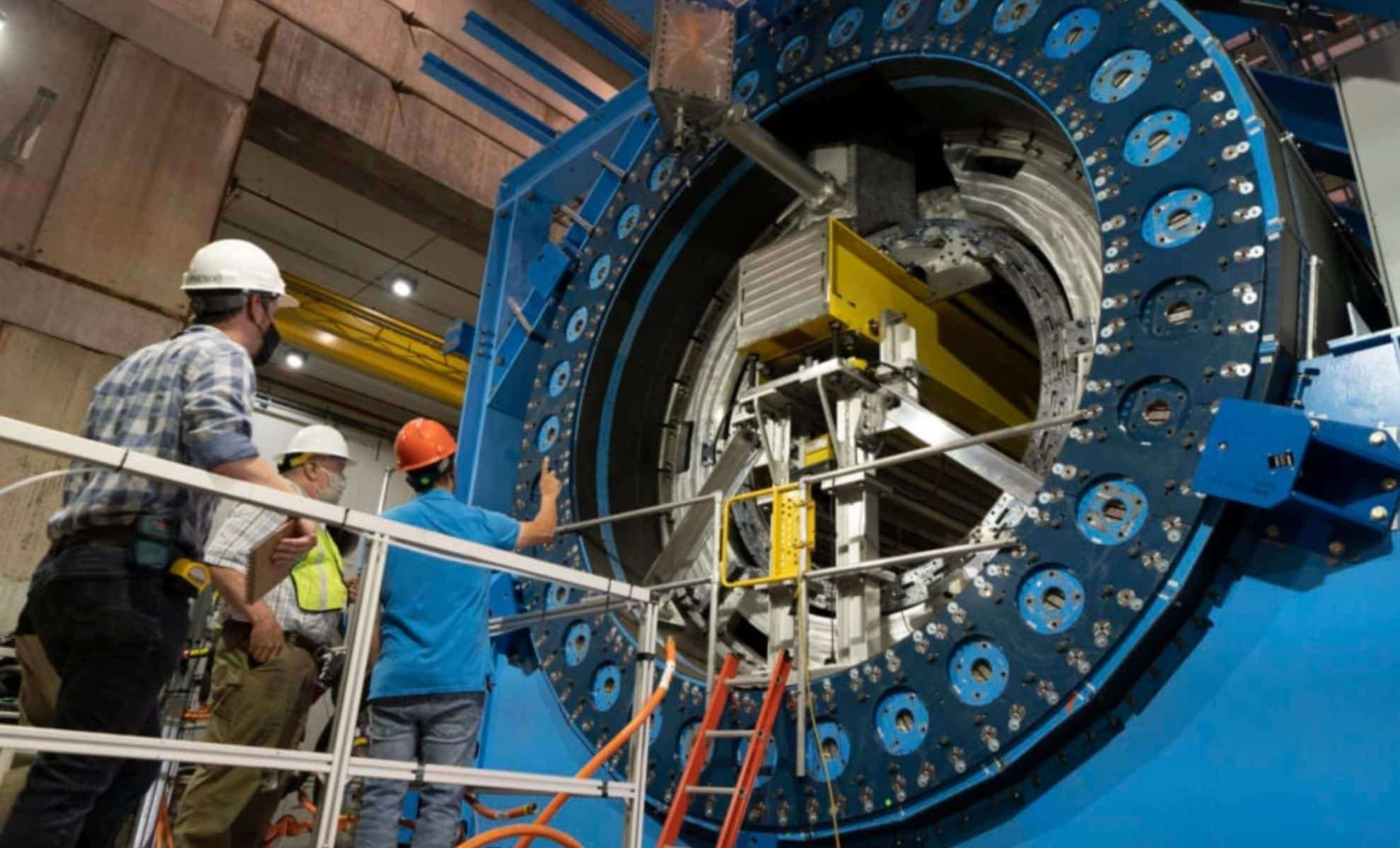
The innovative sPHENIX particle detector at Brookhaven National Laboratory’s Relativistic Heavy Ion Collider (RHIC) in New York has successfully met a critical performance benchmark, signaling its readiness for in-depth investigations of the quark-gluon plasma (QGP). This state-of-the-art instrument marks a transformative step forward in studying the fundamental forces and properties of high-energy nuclear matter. A recent publication in the Journal of High Energy Physics reports that sPHENIX’s initial tests confirm its capability to capture rare particle events with remarkable accuracy.
Shedding Light on the Quark-Gluon Plasma
The quark-gluon plasma, thought to have filled the universe moments after the Big Bang, remains a challenging subject for physicists. Unlike conventional matter made of bound protons and neutrons, QGP consists of liberated quarks and gluons moving at nearly light speed. MIT physicist Gunther Roland, a key member of the sPHENIX Collaboration, explained to MIT News, “The QGP itself can’t be observed directly—you only detect the particles left behind as it dissipates. sPHENIX’s goal is to track these particles to piece together the properties of this fleeting state.”
By precisely analyzing these decay remnants, the detector offers unprecedented insight into the early universe. Reconstructing QGP conditions allows researchers to delve into the strong nuclear force and how matter behaves under extreme heat and density. These studies aim to deepen our knowledge of cosmic evolution within the first instants after the Big Bang.

Cutting-Edge Technology Accelerates Breakthroughs
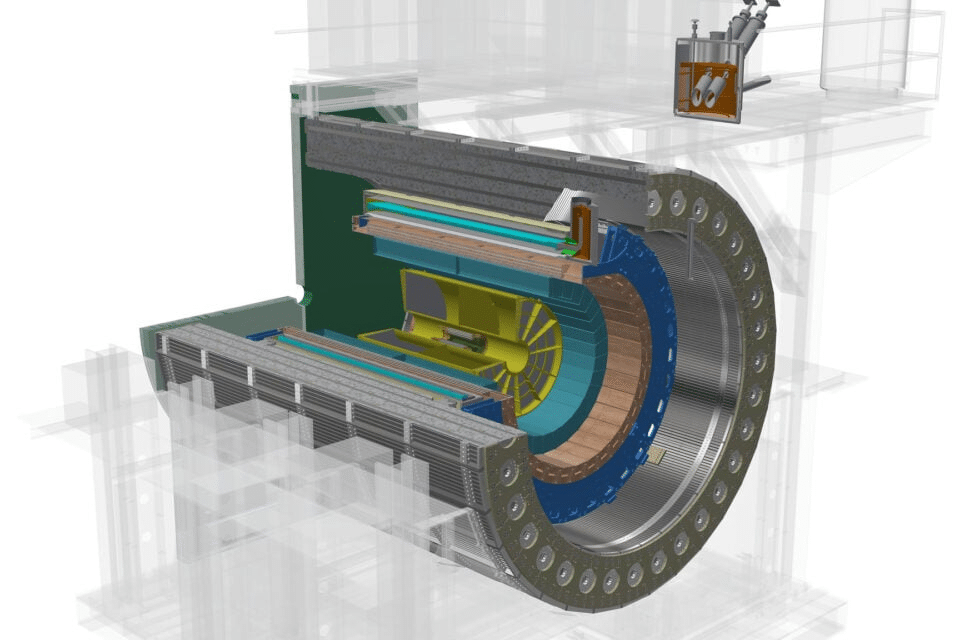
The development of sPHENIX builds on decades of progress in particle detection technology. It employs ultra-fast data collection and sophisticated calorimeters to detect the ephemeral signals produced by ion collisions. Cameron Dean, a postdoctoral researcher at MIT and collaborator on the project, shared, “sPHENIX integrates the latest detector advances since RHIC began operations 25 years ago, enabling us to record data at unprecedented rates and investigate rare interactions.”
High precision timing and measurement are crucial because QGP events last only fractions of a second. The combination of enhanced hardware and advanced software ensures comprehensive data capture during these intense collisions, unveiling details that were once inaccessible to scientists.
Standard Candle Assessments Confirm Detector Accuracy
To validate sPHENIX’s functionality, researchers performed a series of standard candle evaluations—tests designed to verify the detector’s ability to measure known particle events reliably. “Passing these tests shows the detector is performing as intended,” said Gunther Roland. “It’s akin to launching a new space telescope and capturing its first image. While not necessarily novel, it proves the instrument is ready to explore new physics.”
Successfully completing these benchmarks confirms that all critical systems—tracking, calorimetry, and triggering—operate seamlessly. This assurance is vital for trust in upcoming experiments, as any malfunction could skew the interpretation of collision data.
Exploring Rare Nuclear Phenomena
With sPHENIX fully operational, scientists are set to investigate previously inaccessible phenomena such as jet quenching, heavy quark behavior, and collective flow patterns in the QGP. The detector’s high speed and resolution facilitate a detailed understanding of nuclear matter’s response under extreme conditions.
The collaboration aims to map the properties of the QGP in detail while enhancing theoretical models of the strong nuclear force. As measurements amass, these results will be compared with meticulous simulations, advancing predictive models in both nuclear and particle physics.
- Categories:
- News







0 comments
Sign in to Comment