
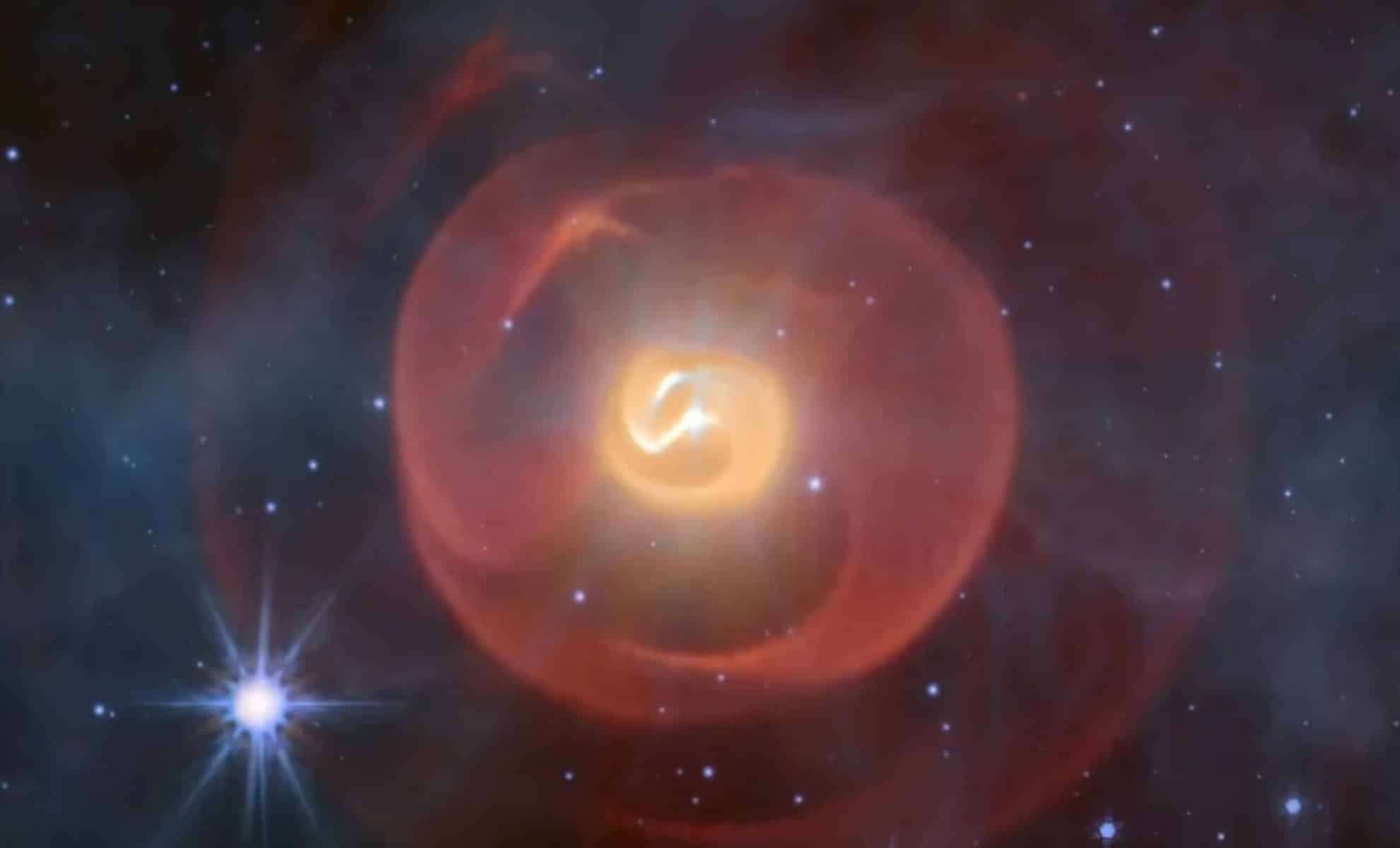
NASA’s James Webb Space Telescope has captured a breathtaking glimpse of a cosmic spectacle: two enormous stars nearing the end of their lives, shrouded in a swirling cloak of dust that twists like entwined serpents. This striking image spotlights the rare Wolf-Rayet binary system known as Apep, marking the culmination of a five-year observational quest to decode one of the universe’s most dramatic stellar finales.
Dynamic Duo Locked in a Stellar Wind Duel
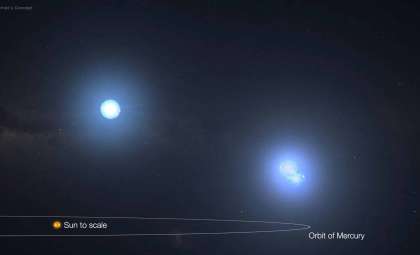
Within the Apep system, both stars are massive Wolf-Rayet stars, notorious for intense stellar winds that strip away their outer hydrogen layers. These stars live brief but turbulent existences, expelling gas at rates and speeds far surpassing our Sun’s solar wind just moments before detonating in a supernova.
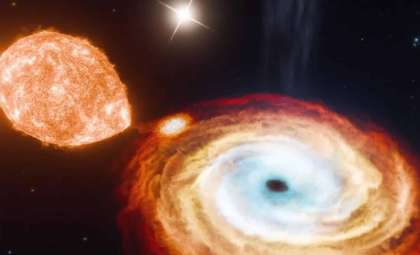
Apep differs from typical Wolf-Rayet pairs by having stars of nearly equal strength, which produce competing winds that collide and compress the gas and dust into a wide, cone-shaped nebula. Unlike the neat spiral arms seen in systems dominated by one star's wind, such as WR104, Apep’s tanlge resembles a windsock-shaped cloud, coiling tightly around its stellar engines, evocative of a serpent consuming its own tail.

A Surprising Third Star Alters the Dust Patterns
Detailed analysis of the infrared data from JWST’s MIRI instrument exposes an additional participant in this cosmic drama. While researchers initially speculated on a distant third star in 2018, the new findings confirm its active presence within the system, as highlighted by two recent preprint papers.
Ryan White, a master's candidate at Macquarie University, developed simulations that map the system’s dust morphology and orbital dynamics. His work revealed an apparent “gap” in the spiraling dust, perfectly aligned with where the third star’s wind would intersect with the outer nebular material. This discovery firmly establishes Apep as a complex, triple-star ensemble, each member shaping the swirling structures seen today.
Shedding Light on Cosmic Dust Creation
Beyond its stunning visual impact, these observations yield vital clues about how carbon-rich dust arises in space. The cool, dense zones produced when powerful stellar winds collide are believed to be the nurseries of primordial carbon grains, elemental ingredients vital to life. In Apep, this formation happens in an unprecedented manner, influenced heavily by the stars’ movements, mass, and the intricate system geometry.
Yinuo Han of Caltech, leading an associated research team, connected the nebula's cooling dust with its actual distance from Earth, which appears farther than previously thought. This shifts our understanding of the stars’ brightness and challenges earlier models of their wind patterns and rotation. The team also identified three concentric expanding shells of dust, growing fainter and cooler outward, indicating past episodic outflows.
Explosive Demise Meets Cosmic Harmony
The creation of Apep’s nebula is dictated by fundamental astrophysical laws. As Benjamin Pope, an associate professor at Macquarie University, explains, “The violence of stellar death carves puzzles that would make sense to Newton and Archimedes.” The system’s intricate yet orderly structure reflects the consistent interplay of mass, movement, and magnetic forces acting upon these stars.
This extraordinary image and its underlying data enrich our understanding of how stars conclude their lives, molding space with enduring patterns that astronomers can unravel to reveal the universe’s deep secrets.
- Categories:
- News




0 comments
Sign in to Comment