
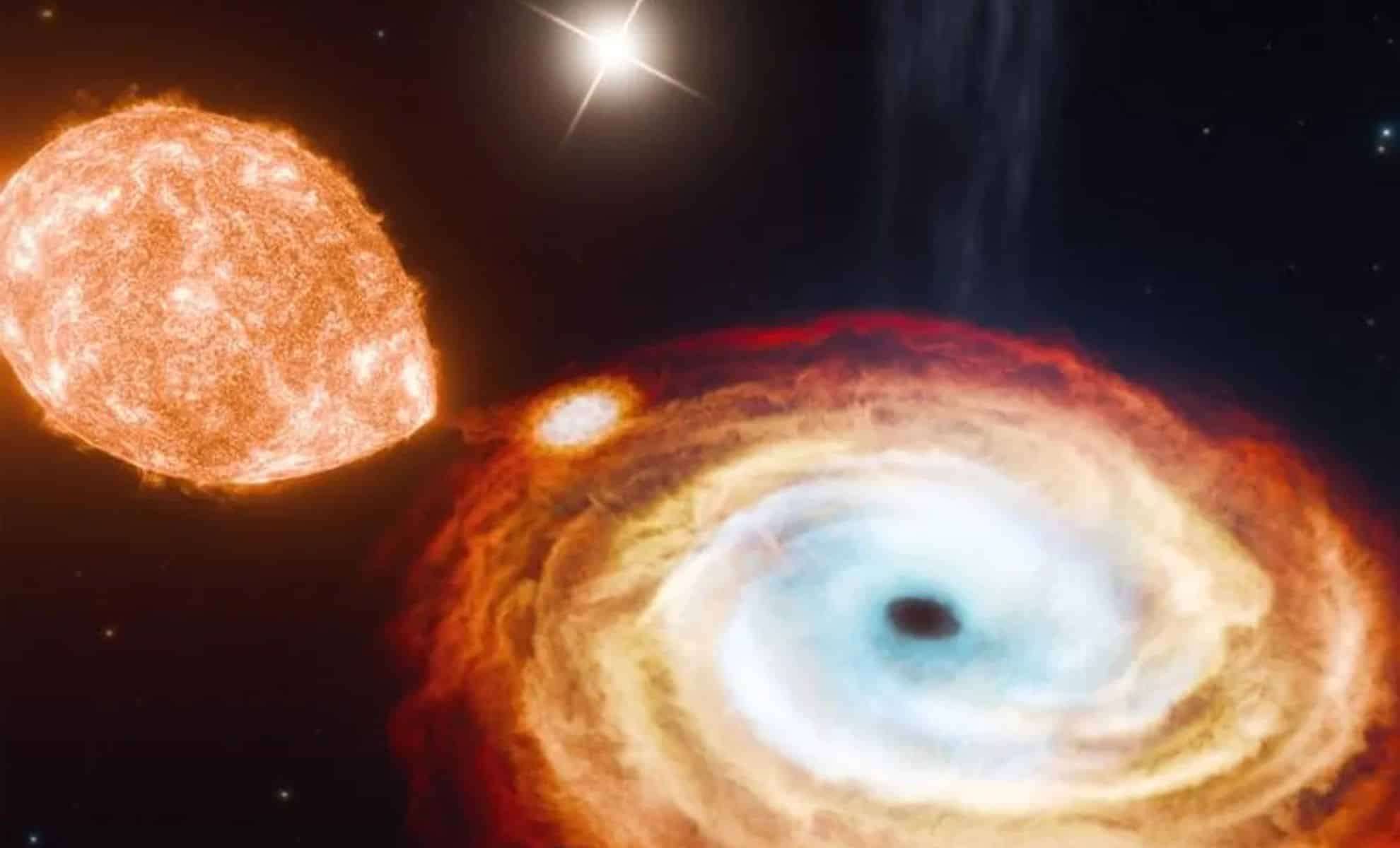
Astronomers have uncovered the galaxy’s first confirmed system containing three black holes, located roughly 8,000 light-years from our planet.
This exceptional arrangement centers on V404 Cygni, featuring a black hole actively drawing matter from a nearby star, while a third, distant star orbits the pair. The finding calls into question prevailing theories about black hole origins, particularly the idea that they arise solely from explosive supernova events.
Inside the V404 Cygni Triple Black Hole System
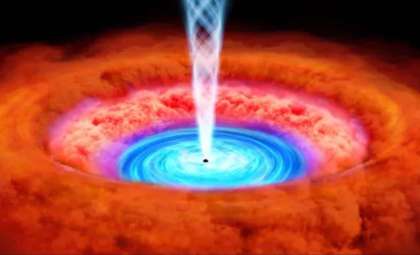
The system is anchored by V404 Cygni, a well-studied X-ray binary known to the scientific community for decades. Here, a black hole with a mass about nine times that of our Sun siphons gas from a companion star in a tight 6.5-day orbit. This transfer of material generates strong X-ray radiation.

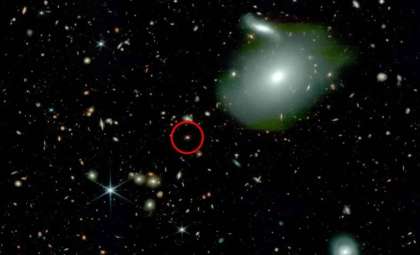
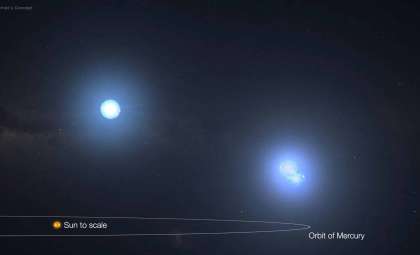
The discovery’s novelty lies in the detection of a third star orbiting at a much larger radius, identified through highly precise data from the Gaia space observatory. This outer companion takes roughly 70,000 years to complete a single orbit around the central black hole. “This was a serendipitous find,” stated Kevin Burdge, MIT astrophysicist and lead on the research. Burdge explained, “While examining an image of V404 Cygni, I realized it actually forms a triple system.” The presence of this third star challenges existing assumptions about black hole system formation and their long-term stability.
Rethinking the Supernova Paradigm for Black Hole Creation
Conventional wisdom holds that black holes emerge after massive stars explode as supernovae. Such cataclysmic blasts often impart a "kick" that can eject nearby stars from the system. This effect is well recognized around supernova remnants containing neutron stars, which usually lose their companion stars. Given their greater mass, stellar black holes should theoretically produce even stronger disruptions.
Yet, this new evidence suggests that the birth of some black holes might be far less violent. Within V404 Cygni, the distant third star remains gravitationally attached, implying a gentler formation—most likely a direct collapse scenario, where a massive star collapses into a black hole without a supernova explosion. Burdge noted, “Any dramatic event in the inner binary would eject the third star, but here it remains bound.”
Supporting this, simulations conducted by the team modeled varied supernova energy releases within triple systems. Only models excluding supernovae and favoring direct collapse could replicate the observed structure of V404 Cygni. As Burdge states, “Our simulations indicate that direct collapse is the simplest route to preserving this triple arrangement.”
Consequences for Black Hole Development and Stellar Dynamics
This triple black hole system sheds new light on black hole evolution and the dynamics within multi-star formations. Though rare, triple star systems do exist, often exhibiting intricate gravitational interactions. The fact that a black hole can cohabitate such a system without disrupting a distant companion star points to the potential prevalence of hidden triple black hole systems. Burdge commented, “This finding is thrilling for our understanding of black hole progression and prompts us to question if more triples await discovery.”
Additionally, the outer star in this system is transitioning into a red giant, enabling scientists to estimate the system’s age at around 4 billion years. This milestone marks the first time an old black hole system’s age has been accurately determined. “This is a breakthrough,” Burdge remarked. “Dating an ancient black hole system like this had never been achieved before.”
Moreover, the third star’s vast orbit—more than 3,500 times the Earth-Sun distance—underscores the delicacy of gravitational balance in this complex system.
Continuing Investigations and Emerging Mysteries
Though much has been revealed about V404 Cygni’s triple black hole nature, essential questions remain unanswered. Scientists are particularly keen to characterize the outer star’s orbit, aiming to determine if it follows a circular path or a more eccentric trajectory. Future observations using the Very Large Telescope (VLT) will focus on revealing these orbital details.
At present, V404 Cygni stands alone as the sole known stellar-mass black hole triple system. Nevertheless, given how fortuitous its discovery was, many more such systems might lie undetected within our galaxy. As Burdge suggests, growing technological capabilities like those of Gaia will improve the chances of finding them.
This revelation also paves the way for reexamining black hole formation and stellar death processes. If direct collapse contributes more broadly to black hole production than previously thought, it could significantly reshape our comprehension of black hole prevalence in the cosmos. Burdge concludes, “While we once believed most black holes formed through violent stellar explosions, this system invites us to reconsider that paradigm.”
Ongoing research combining observations and computational models will be crucial to answering these pressing questions. For now, V404 Cygni’s triple black hole system marks a milestone in unveiling the universe’s most mysterious entities.
- Categories:
- Astronomy ,
- News



0 comments
Sign in to Comment