
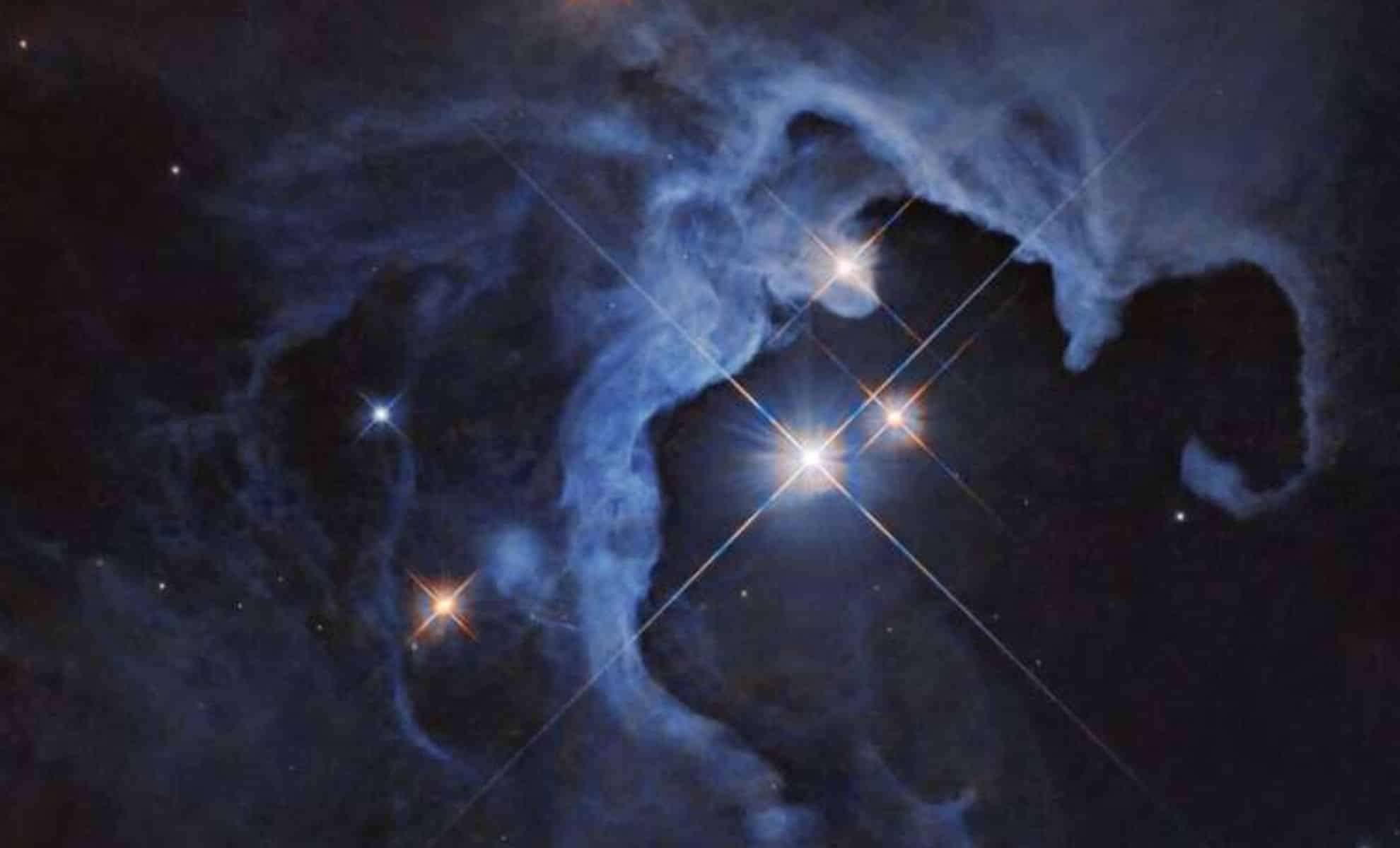
The Hubble Space Telescope has captured a remarkable image showcasing a trio of stars approximately 550 light-years distant within the Taurus constellation.
This striking view features the stars HP Tau, HP Tau G2, and HP Tau G3, highlighting the complexity and allure of young stellar clusters. Their light reflects off a surrounding nebula, offering astronomers a unique look at early stages in star formation and stellar development.
Exploring the Triple-Star Arrangement
NASA's latest imagery reveals the dazzling triple-star system shining from a hollow cavity carved into a reflection nebula. The primary star, HP Tau, belongs to the T Tauri class—young variable stars that have yet to ignite sustained nuclear fusion but are evolving toward becoming stable hydrogen-fusing stars like our sun. Typically under 10 million years old, these stars remain partially enveloped by the gas and dust from their birth clouds.

Illuminating the nebula alongside HP Tau are its companions, HP Tau G2 and HP Tau G3. The luminosity of T Tauri stars like HP Tau can fluctuate both periodically and erratically due to various phenomena, including instabilities in their surrounding accretion disks, infalling material, and surface flares. Regular brightness changes may also be influenced by large starspots rotating in and out of sight.
Understanding the Reflected Glow Captured by Hubble
Reflection nebulae, such as the one enveloping HP Tau, don’t emit their own visible light. Instead, they shine by scattering light emitted by adjacent stars—akin to fog glowing when lit by car headlights, where dust and gas scatter the illumination and create a radiant effect.

This stellar and nebular interplay offers a valuable window into the dynamic environments of star-forming regions.
Hubble’s study of HP Tau contributes to broader research on protoplanetary disks—rings of dust and gas around young stars that may eventually birth planets. By examining these systems, scientists aim to deepen their grasp of planetary formation and early solar system development.
Contributions to Stellar Life Cycle Research
Beyond its aesthetic appeal, this Hubble image provides critical data about stellar evolution stages. T Tauri stars like HP Tau signify a key developmental phase, bridging the gap between a newly born protostar and a mature hydrogen-fusing star. Observations of such stars help scientists trace the path from star birth within dense clouds of gas and dust to the stabilization of main-sequence stars.
Situated in the Taurus constellation—a region rich with star-forming clouds—HP Tau serves as an ideal subject for such investigations. High-resolution imaging from Hubble enables researchers to scrutinize the minute details of these processes, enriching our understanding of star and planetary system formation histories.
Expanding Horizons and Upcoming Studies
Insights derived from the HP Tau observations have significant implications across astrophysics and cosmology. By studying the properties and behaviors of young stars, astronomers can refine evolutionary models and enhance predictions regarding planet formation. This work also informs efforts to identify conditions conducive to habitable worlds, supporting the search for life beyond Earth.
Research into reflection nebulae and their embedded stars remains a priority for the scientific community. Future investigations utilizing next-generation instruments like the James Webb Space Telescope promise to deliver even greater detail and understanding of these extraordinary cosmic structures. As technological capabilities advance, humanity’s ability to probe distant stellar environments will continue to evolve, unlocking new chapters in our exploration of the universe.
- Categories:
- Astronomy ,
- News ,
- Science ,
- Space ,
- Nasa










0 comments
Sign in to Comment