
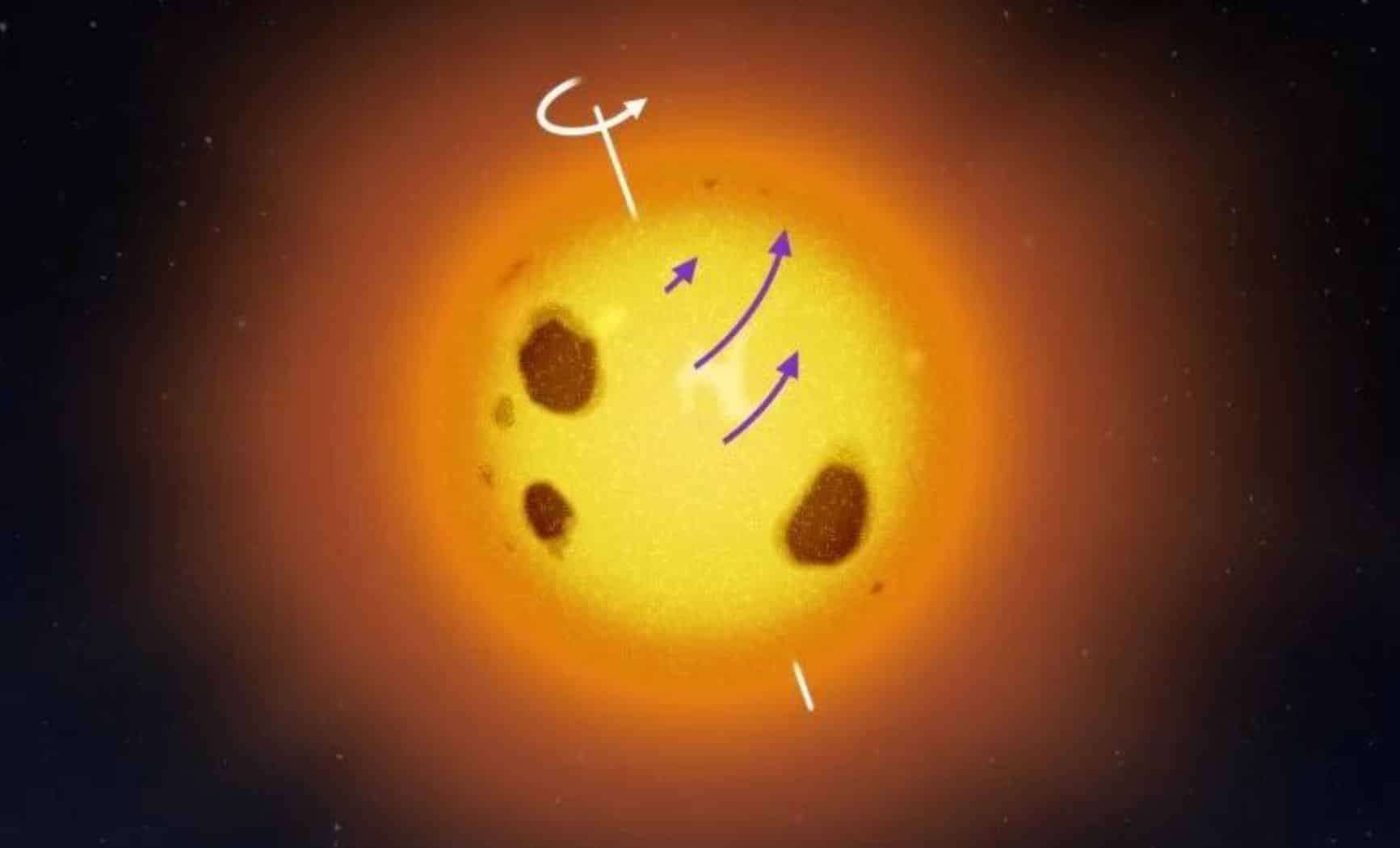
Astronomers have identified an extraordinary rotational behavior in the star V889 Herculis that defies current scientific models of how stars spin.
A research group from the University of Helsinki made this remarkable breakthrough by applying innovative statistical methods to three decades of observational data.
Unveiling the Peculiar Rotation of V889 Herculis
Experts at the University of Helsinki revealed that V889 Herculis, situated roughly 115 light-years away within the Hercules constellation, spins most rapidly not at its equator, but at around 40 degrees latitude. This contrasts starkly with the Sun, which rotates fastest at its equator with slower spin rates near the poles.

This discovery emerged from a cutting-edge statistical approach analyzing brightness fluctuations of the star, tracked consistently over 30 years at the Fairborn Observatory. The method allowed the team to develop a highly detailed model of the star’s rotation.
Through this new analytical technique applied to long-term data, the team uncovered rotational characteristics of V889 Herculis previously unseen in any other star. This achievement highlights the value of persistent, precise astronomical monitoring. It also calls into question existing theories of stellar rotation and signals a need to revise our understanding of such phenomena.
Why This Odd Rotation Matters
The unconventional spinning pattern of V889 Herculis suggests gaps in our knowledge of stellar processes, particularly concerning differential rotation and magnetic dynamo activity. In stars, differential rotation is believed to be driven by the movement of hot plasma within convective zones.
For the Sun, this results in faster rotation at the equator, slowing toward the poles. Yet, V889 Herculis’ distinct spin rate peaking at mid-latitudes implies that additional, unexplored factors influence its rotational dynamics.
This rare rotation profile provides a unique window to revisit the physical mechanisms controlling the spin of stars. Variables such as magnetic field interactions, the star’s internal architecture, or its evolutionary history may exert significant effects. Unlocking these influences could deepen our grasp of star lifecycles, particularly for solar analogs, and enhance predictive models of stellar behavior.
Research Approach and Data Insights
The investigation, spearheaded by Mikko Tuomi, scrutinized extensive brightness records of V889 Herculis alongside the star LQ Hydrae. Utilizing robotic telescopes at Fairborn Observatory for continuous monitoring, the researchers decoded periodic light fluctuations to characterize the stars’ rotational patterns. Advanced statistical models accounted for differences in observable spots across latitudes, yielding detailed rotation profiles.
While V889 Herculis demonstrated this unexpected rotational configuration, LQ Hydrae displayed behavior closer to rigid body rotation, with negligible speed differences between equator and poles. This contrast between similarly aged stars underlines the complexity and diversity of stellar rotation, with the three-decade data set playing a pivotal role in exposing these subtle variations.
Consequences for Stellar Science
The revelation of V889 Herculis’ atypical rotation carries profound consequences for the field of stellar astrophysics. It challenges the validity of present models describing stellar rotation and the generation of magnetic fields. Accurate knowledge of stars’ spin dynamics is key for forecasting solar and stellar phenomena like sunspots and flares, which significantly influence space weather and the reliability of spaceborne technologies on Earth.
These findings hint that the internal magnetic interactions of stars may be far more intricate than previously understood. Detecting similar rotation anomalies in other stars could trigger a fundamental shift in how the scientific community models stellar structures and magnetism, ultimately improving preparedness for space weather effects.
Next Steps in Research
This study highlights the necessity for ongoing exploration into the rotational mechanics of stars. Future work should seek to identify the causes behind the unusual spin profile of V889 Herculis and assess if comparable patterns occur elsewhere. This will likely involve combining ground-based and space telescope observations with refined computational simulations exploring interior stellar processes.
Additional focus on high-resolution spectroscopic measurements would provide greater clarity on magnetic field arrangements and plasma motions within V889 Herculis. Correlating observations with theoretical frameworks can refine current stellar rotation theories. Expanding investigations across a wider array of stars differing in age and composition will help determine whether such rotation traits are rare exceptions or part of a broader stellar phenomenon.
- Categories:
- Astronomy ,
- News ,
- Space




0 comments
Sign in to Comment