
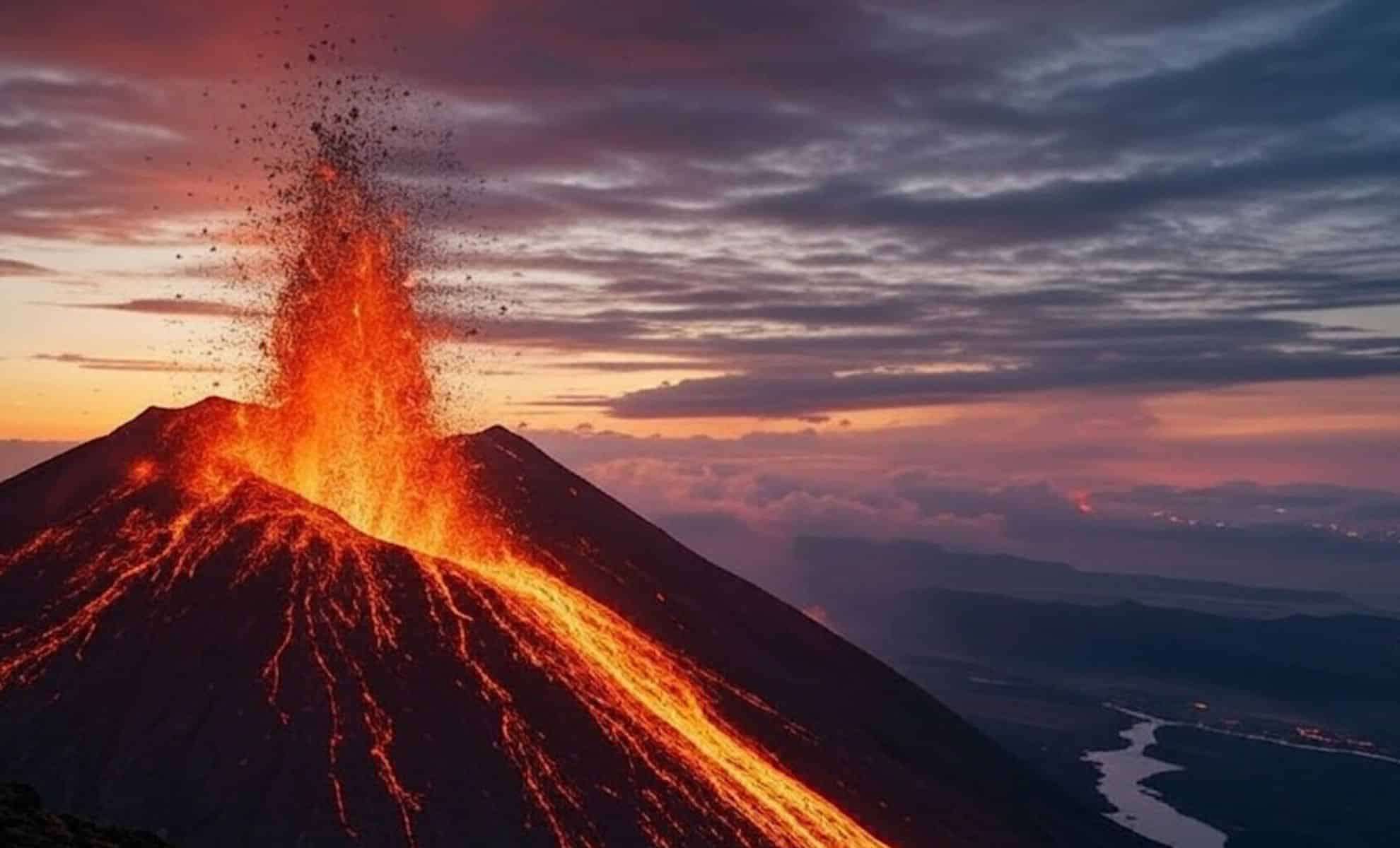
Emerging research reveals that slow shifts in Earth's orbit—such as changes in its tilt, wobble, and orbital shape—could influence the timing of massive volcanic events. These long-term cycles, known as Milankovitch cycles, are well-established drivers of climate fluctuations by modifying the solar energy reaching our planet. New findings now suggest they might also govern the occurrence of large-scale volcanic eruptions.
In a recent Science Advances publication, scientists examined sediment cores and geochemical evidence from the Cretaceous era. Their analysis uncovered that some of Earth's most intense volcanic episodes happened during certain phases of orbital cycles. This remarkable connection sheds light on how celestial mechanics could influence internal Earth processes, including flood basalt volcanism.
Orbital Dynamics as a Trigger for Volcanism
Researchers have long hypothesized that gravitational pull from the Moon and planets, combined with Earth's elliptical path and axial tilt, might subtly affect mantle convection and magma movement. Such forces could slant the timing of when major volcanic eruptions take place by modulating subsurface magmatic systems.

By cross-referencing climate proxies from various ocean basins, the team identified a recurring synchrony between volcanic activity and Milankovitch-driven climate rhythms. "Like a metronome, we applied cyclic changes in solar radiation preserved in geological records to align climate data from the South Atlantic and Northwest Pacific," said lead author Thomas Westerhold.
This approach enabled the researchers to precisely match volcanic events with orbital cycles dating back one million years to the late Cretaceous. "These datasets are finely tuned to within 5,000 years, a geological instant nearly 66 million years ago," Westerhold noted.
Tracing Ancient Eruptions Through Osmium Isotopes
To validate the orbital-volcanism link, osmium isotope ratios from deep-sea sediments in both the South Atlantic and Northwest Pacific were analyzed. These isotopes serve as markers for volcanic inputs, originating from mantle sources, that enter ocean waters during massive eruptions.
"Flood basalt formations and their weathering leave a distinct geochemical signal in seawater," explained Junichiro Kuroda of the University of Tokyo. "By measuring osmium isotope compositions across these regions, we expected to detect simultaneous volcanic fingerprints."
Results showed two notable osmium isotope excursions correlating with major eruptive phases of the Deccan Traps, a vast volcanic province linked to the dinosaur extinction event around 66 million years ago.
Volcanic Eruptions’ Diverse Effects on Ecosystems and Climate
Besides linking eruptions to orbital patterns, the study revealed that these volcanic pulses differently impacted Earth's climate and biosphere. Fossil evidence from ocean core samples indicated contrasting environmental responses to the two key Deccan eruption phases.
"We observed two distinct steps in osmium isotopes across both oceans concurrent with eruptive events," Westerhold stated. "Intriguingly, these shifts corresponded with varying ecological effects documented in fossil records."
This suggests that the timing and magnitude of volcanic events critically shape their climatic outcomes. Some eruptions might have driven sustained global cooling, while others possibly triggered rapid warming and ocean acidification.
- Categories:
- News









0 comments
Sign in to Comment