

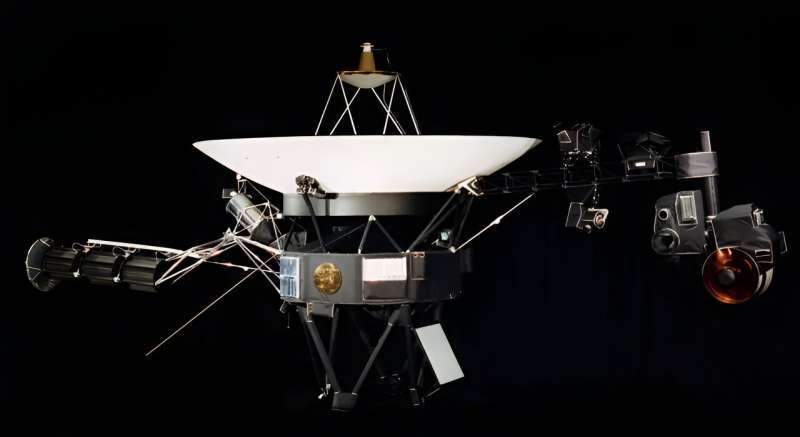
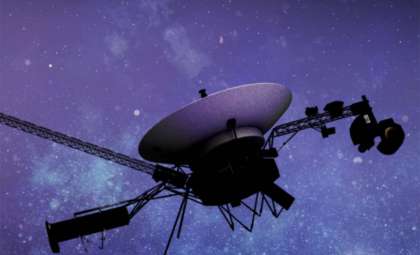
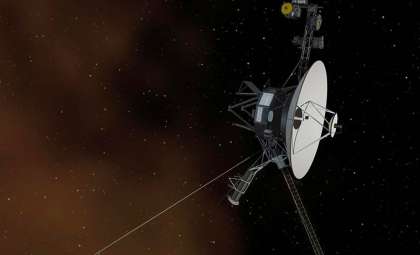
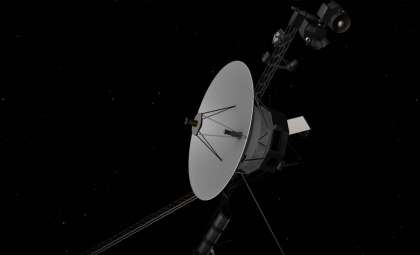
Voyager 1, humanity's most distant spacecraft after nearly five decades in space, continues its voyage through the vast expanse of interstellar space.
Although aging, the probe is still functional, but recent complications with its thruster system threatened its ability to remain aligned with Earth. Engineers at NASA’s Jet Propulsion Laboratory (JPL) managed to activate a backup thruster set, guaranteeing that Voyager 1 can keep relaying information from beyond 24 billion kilometers away.
Thruster Fuel Line Blockage Endangers Spacecraft Orientation
Among Voyager 1’s vital components are the hydrazine-fueled thrusters, which emit small gas jets to fine-tune its positioning. Maintaining orientation toward Earth is essential for communication, despite the spacecraft being over 24 billion kilometers distant. The thrusters are pulsed roughly 40 times daily to sustain this alignment. Over time, however, the primary thruster fuel lines have become obstructed, reducing their effectiveness.

The blockage arises from silicon dioxide buildup, a result of the aging rubber elements within the thruster system. Fuel lines have constricted to a mere 0.0015 inches (about 0.035 millimeters), hampering thrust output. Consequently, the mission team switched to reserve thrusters last employed during Voyager 1's planetary flybys decades ago. Following meticulous planning, these thrusters were successfully brought online in late August 2024.
Suzanne Dodd highlighted the thrusters’ significance: “These thrusters enable Voyager to maintain its Earth-pointing orientation. Without them, communication would be lost.” The switch to backup thrusters secures continued data transmission for the foreseeable future.
Managing Power and Cold Thruster Challenges
Reactivating the backup thrusters was complex. Years of dormancy had caused them to become extremely cold. As Voyager 1’s limited power supply has declined, many non-essential systems, including heaters, were powered down to save energy. This cooling risked damaging components if the thrusters were engaged without warming.
NASA teams formulated a plan to cautiously heat the thrusters by activating some non-essential heaters temporarily. Due to limited power, they had to switch off another system briefly to allocate enough energy. After detailed analysis, a primary heater was turned off momentarily to safely raise the thrusters’ temperature. On August 27, 2024, the backup thrusters were confirmed operational and able to maintain Voyager’s Earth alignment.
“Balancing power usage was critical,” explained Dodd. “Every watt counts at this phase, so we had to carefully choose which systems to run.”
Voyager 1’s Expedition into Interstellar Space
In 2012, Voyager 1 crossed the heliopause, marking its entry into interstellar space—the realm beyond the Sun’s influence—becoming the first spacecraft to achieve this feat. It continuously transmits data about this uncharted environment, granting valuable insights to researchers about the space between stars.
Despite being situated over 24 billion kilometers from Earth, Voyager 1 still sends information, though radio signals take more than 21 hours to arrive here. Its observations provide crucial clues to the makeup and structure of the interstellar medium—areas never explored by prior missions.
“Voyager 1 is a pioneering presence at the edge of human knowledge,” Dodd remarked. “No other mission offers this unique perspective on the distant cosmos.”
Prolonging Voyager’s Mission Amid Declining Power
NASA must carefully manage Voyager 1’s dwindling energy, generated by decaying plutonium, expected to sustain the spacecraft until approximately 2030. To extend its operational life, non-essential instruments and systems will continue to be shut down, a process already underway, while keeping vital instruments active as long as possible.
The recent thruster switch is one of multiple technical hurdles the Voyager team has tackled in recent years. A similar maneuver occurred in 2018 when clogging issues forced a shift to the trajectory correction thrusters, which had not been used since Voyager’s planetary encounters. These adaptive solutions have remarkably stretched the spacecraft's operational lifespan far beyond initial expectations.
Dodd stressed the caution needed for future steps: “Every action now demands intense scrutiny because the spacecraft’s components are aging. We must carefully evaluate all decisions.”
- Categories:
- Astronomy ,
- News ,
- Space ,
- Nasa






0 comments
Sign in to Comment