
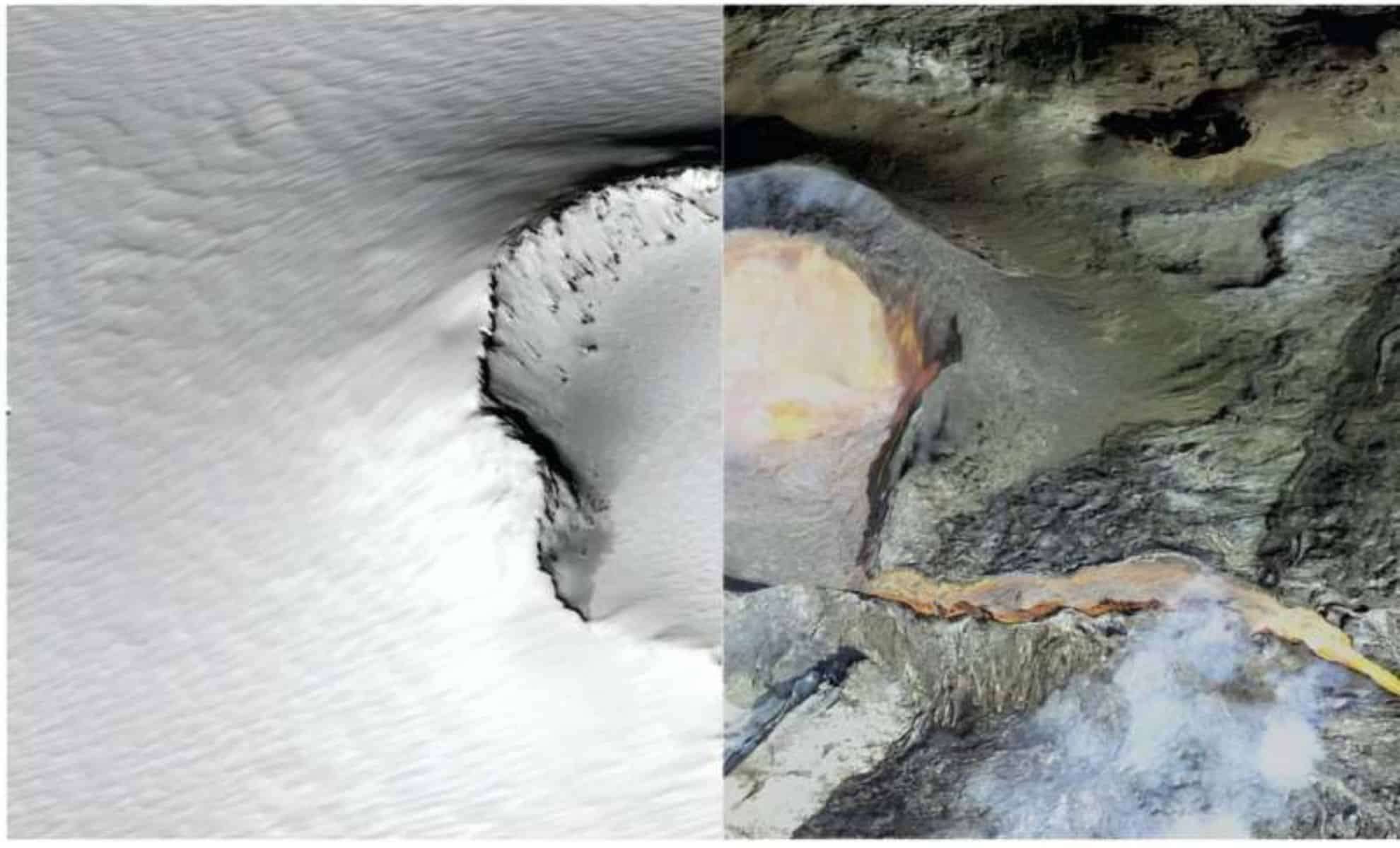
Scientists have, for the first time, verified the existence of a volcanic spatter cone on Mars, a breakthrough that enhances our comprehension of the planet’s volcanic past and establishes intriguing links to volcanic phenomena observed on Earth.
Under the leadership of postdoctoral researcher Ian Flynn and with guidance from Erika Rader, an assistant professor in the Department of Earth and Spatial Sciences, the research uncovers a feature on Mars long predicted by scientists, broadening our knowledge of Martian geology.
Understanding Spatter Cones and Their Importance
Spatter cones develop during violent volcanic eruptions when molten lava fragments are flung into the air and settle around the volcanic opening. These structures are common in volcanic regions on Earth such as Iceland and Idaho, notably at the Craters of the Moon National Monument. Discovering a similar formation on Mars suggests analogous volcanic behavior, enriching our perspective on how Mars’s volcanic activity has unfolded.

By employing a thorough morphological analysis alongside ballistic trajectory modeling, the team identified a vent on Mars strikingly similar to spatter cones created during Iceland’s 2021 Fagradalsfjall eruption. Flynn highlighted the relevance, saying, “The similarity between the Mars and Icelandic spatter cones indicates that the eruption dynamics occurring in Iceland, over the last several years, also occurred on Mars.” This points to Mars experiencing extended episodes of lava fountaining, with molten material being ejected and accumulating near volcanic vents as on Earth.
Insights into Martian Volcanic Activity
This confirmed spatter cone supplies more than just proof of a suspected geological feature; it also reveals crucial details about the environmental conditions of Martian eruptions. The formation of spatter cones depends on explosive volcanic activity, the availability of volcanic gases, and factors like temperature and atmospheric pressure. Pinpointing such a structure enables researchers to analyze how Martian volcanism compares to terrestrial processes.
Flynn’s work suggests that the mechanisms shaping spatter cones on Mars are akin to those on Earth, shedding light on the role of and eruption environments. As Flynn explained, “This expands the range of volcanic eruption styles possible on Mars,” offering valuable data that can enhance simulations of Martian volcanic behavior. Such models may clarify the nature of volcanic activity on Mars and conditions during its active periods.
Advancing Knowledge of Mars’s Volcanic Features
The discovery of spatter cones on Mars marks a critical advance in understanding the planet’s volcanic history. Assistant Professor Erika Rader underscored the finding’s importance, noting that although spatter cones are widespread on Earth, confirming their presence on Mars had remained elusive. Rader stated, “Spatter cones are so common on Earth that it seemed extremely unlikely that they simply didn’t exist on Mars. Their presence gives us a benchmark to shoot for when simulating Martian volcanoes.”
This benchmark proves invaluable by affirming that explosive volcanic eruptions took place on Mars and by setting a foundation for future research into the volcanic shaping of Mars’s surface. The discovery has sparked enthusiasm for the search for additional spatter cones or related volcanic formations, which could expand understanding of Mars’s geological evolution.
Both Rader and Flynn conveyed enthusiasm about forthcoming studies made possible by this discovery. Flynn remarked, “We are thrilled about this discovery because it fills a distinct observational gap in Martian volcanology, and it lays the groundwork for future investigations of spatter features on Mars,” encouraging ongoing exploration of volcanic phenomena on the Red Planet to further clarify Mars’s volcanic history.
Wider Impact on Planetary Science
This breakthrough not only enriches our knowledge of Martian geology but also opens new avenues to explore volcanic activity across different planets. By comparing Earth’s volcanic features with those found on Mars, scientists gain insights into the similarities and diversities of volcanic processes under varying planetary conditions. The identification of spatter cones on Mars reinforces the idea that volcanism has been a key factor sculpting its landscape and raises questions about the possibility of ongoing volcanic activity.
Directly comparing volcanic occurrences on Mars and Earth enhances our grasp of planetary formation and the geological forces that mold planetary surfaces over time. This discovery, alongside future investigations, will contribute to developing detailed models to understand how Mars and planets like it have evolved and might continue to change geologically.
- Categories:
- Astronomy ,
- News ,
- Science ,
- Physics





0 comments
Sign in to Comment