

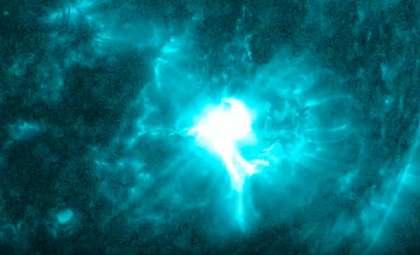
On June 3, 2024, a remarkable solar flare graced astronomers and space observers with a vivid plasma eruption.
NASA’s Solar Dynamics Observatory (SDO) documented the phenomenon in impressive detail, showing how much of the expelled solar material was drawn back by the sun’s immense gravity, resulting in the plasma being reabsorbed into the solar surface.
Decoding the Solar Flare Phenomenon
The flare, originating from sunspot AR3691, was rated as an M4.8 event. Solar flares represent intense bursts of electromagnetic energy unleashed from the sun’s surface, categorized by strength with X-class as the most intense, followed by M-class, C-class, B-class, and A-class, each category decreasing in power by a factor of ten. This M4.8 flare signifies a moderate release of energy, notable yet less intense than an X-class event.

Such flares can significantly influence space weather by triggering coronal mass ejections (CMEs), enormous releases of charged plasma and magnetic fields from the sun’s outer atmosphere, the corona.
If CMEs reach Earth, they can trigger geomagnetic storms that may disturb satellite functions, navigation, electrical grids, and create dazzling auroral displays. However, the June 3 flare released little plasma into space; instead, most of it spiraled back to the sun’s surface.
M-Class Flares and Plasma Ejections
M-class flares like this one release considerable energy and plasma flows, yet are less extreme than X-class flares. NASA’s SDO observed this flare across various wavelengths, capturing the plasma plume as it ascended and subsequently descended. This event beautifully demonstrated solar magnetic field lines guiding the plasma’s return to the surface, despite the flare’s vigor.
Solar astrophysicist Ryan French shared his excitement via X (formerly Twitter), emphasizing the plasma’s mesmerizing motion along magnetic pathways.
A gorgeous #SolarFlare on the Sun today! Just look at how the falling plasma impacts and flows down the magnetic field – physics in action. #astronomy pic.twitter.com/1YAG9YHCSg
— Dr. Ryan French (@RyanJFrench) June 3, 2024
This event highlights the delicate balance of gravitational forces and the sun’s magnetic fields. Sara Housseal, a meteorologist and space weather expert, explained that although the flare was visually striking, it did not launch a powerful CME capable of sparking geomagnetic storms on Earth. Instead, a minor release of plasma was observed in coronagraph imagery.
Consequences for Earth's Space Environment
The June 3 flare offers valuable knowledge about solar activity and its effects on space weather. While it disappointed those hoping for vivid auroras, it underscores the unpredictable nature of our star. Since no major CME followed, Earth was spared from electronic disturbances or geomagnetic storms from this eruption.
This case also illustrates the challenges of forecasting space weather. Anticipating how solar flares behave and their potential terrestrial impacts demands extensive solar physics expertise and continuous observation. The complexity of these solar events highlights the importance of ongoing study and refined predictive tools.
The Role of Solar Maximum
The sun is nearing its "solar maximum," a phase occurring roughly every 11 years characterized by increased solar flares and CMEs. This active period provides frequent opportunities to examine solar behavior. The June 3 incident offers crucial information helping scientists unravel the mechanisms fueling solar activity during these peak times.
Solar maximum significantly influences Earth's space environment, affecting satellites, communication systems, and power infrastructure. Observing flares like the one on June 3 allows researchers to improve solar behavior models and better prepare for future space weather impacts.
Enhancing Our Grasp of Solar Activity
The plasma fallback observed after the June 3 flare highlights the importance of further investigation into why some solar eruptions fail to produce large CMEs while others succeed. Understanding the factors controlling the release and reabsorption of solar material is vital for improving forecast accuracy.
Upcoming studies will focus on magnetic field intensities, plasma characteristics, and interactions among solar phenomena that dictate these different flare outcomes. Increasingly detailed observations will aid the development of enhanced models forecasting solar events and their impact on Earth.
Advances in technology and observational methods, such as those provided by NASA’s Solar Dynamics Observatory, are essential for capturing high-resolution solar data. This information is key to deciphering the sun's complex activity and improving space weather predictions.
Continued exploration of solar processes grants insights into the forces shaping our solar system. The striking plasma display and subsequent reabsorption from the June 3, 2024 solar flare spotlight not only the sun’s dynamic nature but also the critical need for ongoing research and readiness against space weather challenges.
- Categories:
- Astronomy ,
- News ,
- Science ,
- Space ,
- Nasa








0 comments
Sign in to Comment