

SpaceX has set a target date of June 5, 2024, for its next critical Starship test flight. This mission represents an essential phase in the company’s pursuit of a fully reusable spacecraft capable of lunar and Martian exploration.
The Importance of Starship
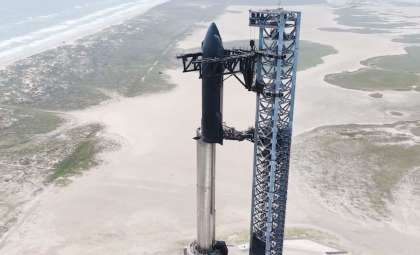
The Starship vehicle, consisting of the Super Heavy booster and the Starship spacecraft, is engineered for complete reusability. This system plays a vital role in CEO Elon Musk’s plan for interplanetary voyages. Towering at 394 feet, Starship produces 16.7 million pounds of thrust, almost double that of NASA’s Space Launch System (SLS).
Starship’s primary objective is to drastically cut space travel costs through repeated use of the same spacecraft, akin to commercial airliners. This breakthrough in reusability aims to democratize space access and enable substantive missions to the Moon, Mars, and beyond.

Lessons from Earlier Flights
This test follows three previous attempts, each ending in vehicle loss but delivering critical performance data. SpaceX employs an iterative approach, rapidly testing and refining the design based on real-world test outcomes.
The prior flights achieved substantial altitude but faced challenges during descent and landing phases. Despite the fiery conclusions, every test has contributed insights to enhance Starship’s capabilities.
This method of continuous improvement has been instrumental in SpaceX’s advancement of cutting-edge spaceflight technology.
Goals for the Upcoming Flight
The fourth mission aims to confirm a successful launch and validate key reusability features. The plan includes a controlled splashdown of the Super Heavy booster in the Gulf of Mexico, along with a managed atmospheric entry for the Starship upper stage to demonstrate recovery techniques.
Proving these recovery operations are vital to transitioning Starship into routine launches, reducing costs, and increasing turnaround times.
Technical Obstacles Ahead
Key difficulties involve harnessing the power of Starship’s engines and ensuring stable flight control throughout all stages. Previous tests confirmed the vehicle’s ability to reach high speeds and altitudes, while descent and landing remain complex challenges.
Engineers are focusing on optimizing landing controls, strengthening heat shields, and improving propulsion reliability during critical flight moments. Resolving these issues is essential for achieving full system reusability, a cornerstone of SpaceX’s cost-saving approach.
NASA Partnership and Artemis Missions
Starship’s progress is closely linked to NASA’s Artemis program, which targets a lunar return by 2026. NASA plans to use a customized Starship variant as the lunar lander, highlighting the tech’s strategic role in upcoming human spaceflight.
The collaboration underscores NASA’s evolving reliance on commercial partners to deliver innovative space technologies. A successful test on June 5 would reinforce SpaceX’s position as a key contributor to NASA’s long-term exploration goals.
Looking Ahead
The results from this June launch will shape SpaceX’s timeline for turning Starship into an operational vehicle. Success could accelerate plans for Mars colonization and other deep-space initiatives.
Additionally, the mission is pivotal for future commercial and scientific use cases, as reusability promises to transform the economics of space travel. SpaceX’s vision of humanity becoming a multi-planetary species depends heavily on mastering this reusable rocket technology.










0 comments
Sign in to Comment