
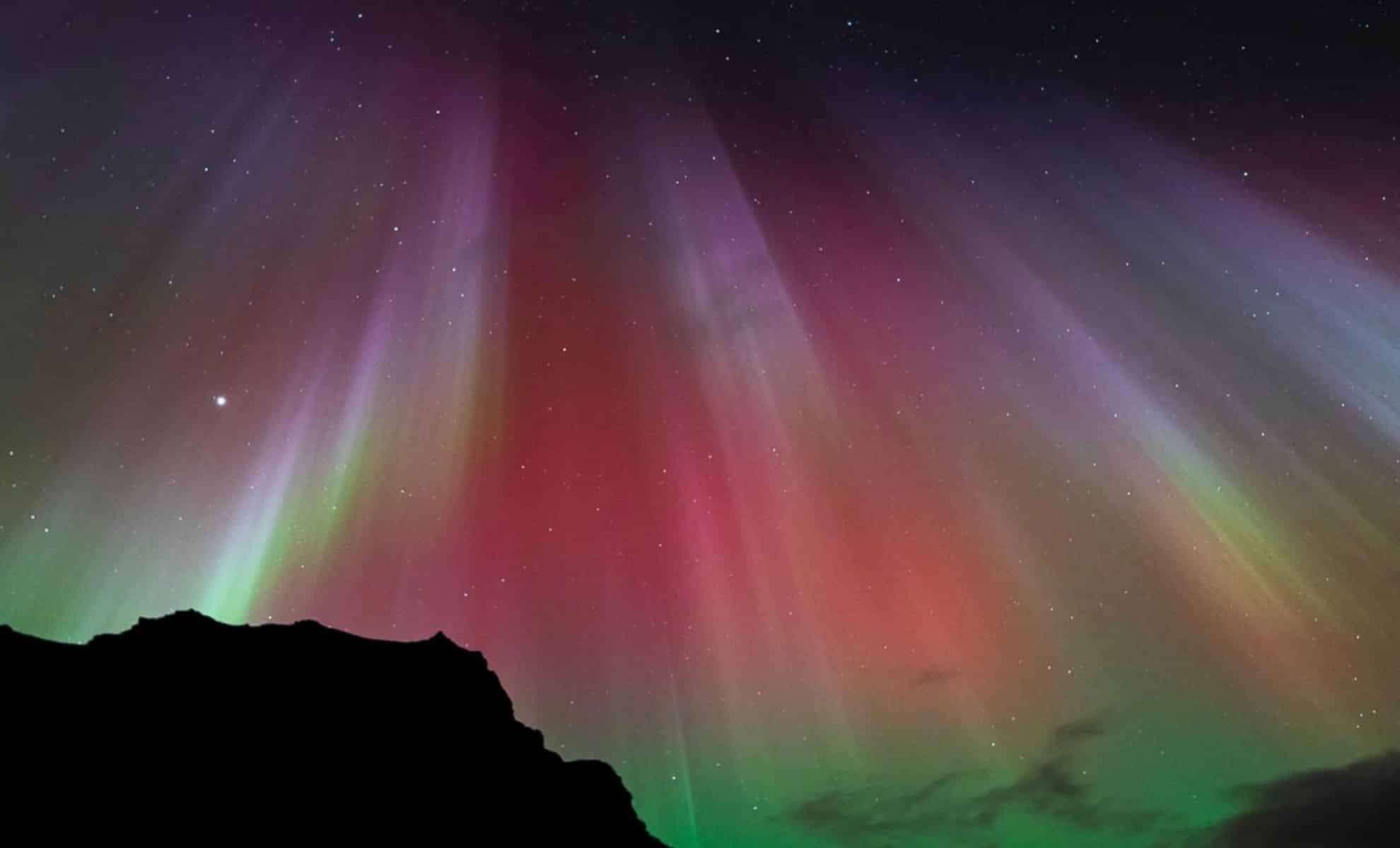
Once again tonight, residents of Canada and parts of northern United States have an opportunity to catch a glimpse of the northern lights, a stunning display following May’s extraordinary solar geomagnetic event.
This mesmerizing spectacle, known as the aurora borealis, could illuminate the night sky with vivid hues for viewers positioned in ideal locations.
The aurora borealis, commonly called the northern lights, is a natural luminous show mainly visible in Arctic regions. It arises when charged particles from solar winds interact with atmospheric gases, creating swirling colors that grace the heavens.

Where to Expect the Aurora Tonight
The Space Prediction Center (SPC) forecasts that the northern lights may be visible throughout much of Canada and eastern Alaska. Similarly, the Geophysical Institute at the University of Alaska Fairbanks extends this range to include northern North Dakota, Montana, Minnesota, and Michigan.
These projections rely on current levels of geomagnetic activity, which directly impact the strength and spread of the auroral displays. People in these regions are advised to look for dark, clear areas far from artificial lighting to fully enjoy the spectacle.
The forecast factors in solar wind patterns and the configuration of Earth’s magnetic field, both of which influence how spectacular and widespread the auroras might appear. With such a large area predicted to experience the lights, many stargazers could witness this natural marvel.
Auroral displays appear best under skies free from light pollution, making rural locations and protected natural areas prime spots to observe their vivid movements. Given the variable nature of the northern lights, those who consistently track forecast updates and remain patient have the best chance of catching a display.
Prime Time for Northern Lights Viewing
The ideal window to observe the northern lights is between 10 p.m. and 2 a.m. According to the Space Weather Prediction Center, this timeframe corresponds with peak geomagnetic activity, enhancing the brightness and clarity of the aurora.
Geomagnetic activity tends to reach its zenith during these hours, producing stronger and more vivid auroral light. For the best experience, skywatchers should also monitor local weather reports to avoid cloud cover and choose locations shielded from urban light sources.
Though 10 p.m. to 2 a.m. is generally optimal, strong enough geomagnetic events can make the auroras visible outside this range. The displays can range from subtle glows on the horizon to grand curtains of color enveloping the sky.
Colors can vary widely—from green to pink, red, yellow, and blue—depending on which types of gases in the atmosphere are excited. This ever-shifting spectacle’s unpredictability adds to its allure and excitement for observers.
Overview of Recent Solar Activity
In May, a massive solar geomagnetic storm drew attention from the National Oceanic and Atmospheric Administration (NOAA) with a rare alert. This intense event allowed the northern lights to be seen much farther south than usual.
This storm was the strongest in nearly twenty years, creating extraordinary auroral displays visible as far south as California and Florida. It showcased how dynamic the interaction is between Earth and solar activity, offering dramatic night sky shows.
Solar flares and coronal mass ejections from the sun propel charged particles toward Earth, causing geomagnetic storms. When these energetic particles interact with Earth’s magnetosphere, they amplify the auroras.
May’s event demonstrated that auroras can extend well beyond typical zones, exciting both casual observers and researchers. It also emphasized the importance of tracking space weather, since these solar phenomena can disrupt satellite signals, GPS, and power infrastructure. Scientists continue investigating these storms to improve predictions and reduce their effects.
- Categories:
- Astronomy ,
- News




0 comments
Sign in to Comment