
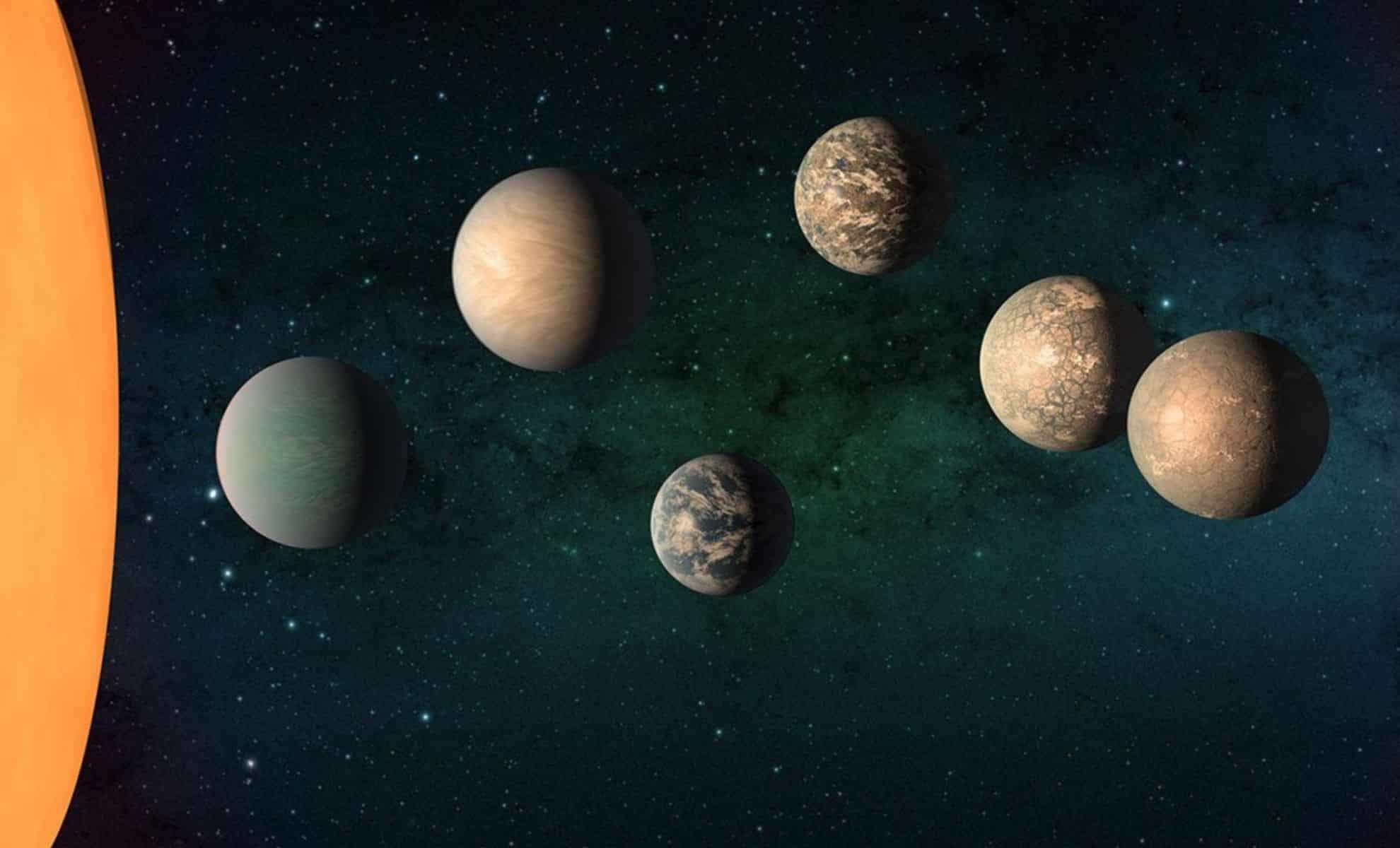
Recent findings reveal that super-Earths—planets larger than Earth but smaller than Neptune composed primarily of rock—could be more widespread across the cosmos than scientists previously estimated. Leveraging data from a gravitational microlensing event, researchers have detected a small planet orbiting its host star at a distance comparable to Saturn’s orbit, overturning the assumption that super-Earths predominantly exist close to their stars. As highlighted by Space.com , this breakthrough may transform our perspective on planetary development and the potential for habitable worlds outside our solar system.
Published on April 24 in Science, the study utilized observations gathered by the Korea Microlensing Telescope Network (KMTNet), a system of three telescopes in Chile, South Africa, and Australia, enabling nonstop surveillance of the southern hemisphere’s sky.
Identifying a New Class of Super-Earths in Wider Star Orbits
Previously, super-Earths were commonly identified in tight orbits—within 1 astronomical unit (AU) from their stars, similar to Earth's distance from the Sun. However, the newly identified planet connected to the microlensing event OGLE-2016-BLG-0007 reveals a super-Earth orbiting much farther out, around 10 AU, akin to Saturn’s orbital radius.

“Discovering a small planet with an orbit like Saturn’s confirms that super-Earths residing between Earth and Saturn’s distances are plentiful,” stated Jennifer Yee from the Center for Astrophysics | Harvard & Smithsonian. “This prevalence of super-Earths was quite surprising.”
These results imply that prior predictions may have undervalued the quantity of distant rocky planets, mainly due to detection challenges faced by methods such as transit photometry or radial velocity measurements.
Consequences for How Planets Form and Potential for Life
The findings support a model where planetary populations split into two groups: one encompassing super-Earths and Neptunes, and the other consisting of gas giants. This division likely reflects differing formation mechanisms, with terrestrial-like planets accumulating more slowly in less dense regions of the protoplanetary disk while gas giants form more rapidly in denser zones.
Super-Earths located in orbits similar to Jupiter’s could have significant ramifications for habitability. Although these orbits lie outside our solar system’s traditional habitable zone, they may fall within the temperate zone of stars hotter than the Sun, where liquid water could persist.
“The zone where we expect to find life in exoplanetary systems is extraordinarily narrow,” Yee explained. “Our understanding has been shaped by Earth alone, which is the only planet confirmed to host life. Nature often defies our expectations.”
Emerging data points to the possibility that habitable conditions may extend farther from stars than once thought, broadening the search for life-supporting exoplanets.
Planet Detection Through Microlensing: A Legacy of Einstein’s Theory
This discovery hinged on gravitational microlensing—a technique that utilizes gravitational lensing, predicted by Albert Einstein’s general relativity. When a massive object, such as a star, aligns with a distant light source, its gravity bends and amplifies the light. The presence of a planet creates an additional subtle signal in this lensing effect.
“Microlensing excels at detecting planets near the Einstein radius,” Yee noted. “It’s a fascinating coincidence in physics.”
This sensitivity makes microlensing particularly suited to finding small, cool planets in distant orbits that other methods commonly miss. KMTNet’s success here showcases its potential for routinely uncovering smaller planets, which is essential for properly assessing the diversity and distribution of exoplanets.
- Categories:
- News






0 comments
Sign in to Comment