

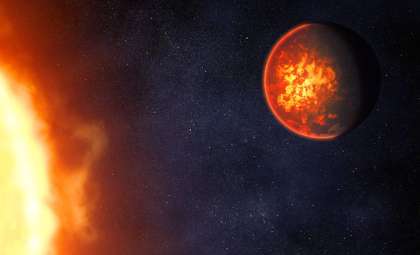
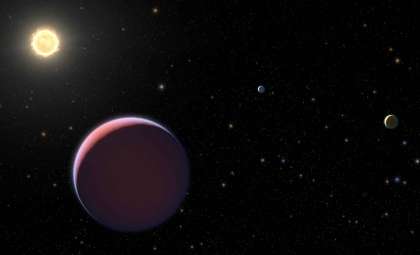
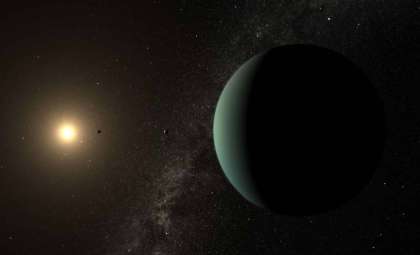
For many years, exoplanets have been sorted into clear groups: rocky terrestrial planets like Earth, massive gas giants akin to Jupiter, and smaller, gas-filled mini-Neptunes prevalent within our galaxy. However, a recent breakthrough has challenged these conventional categories. Enaiposha (GJ 1214 b), orbiting approximately 47 light-years away, was previously considered a typical mini-Neptune. But new data from the James Webb Space Telescope (JWST) reveal something exceptional. Instead of fitting into established planetary classes, Enaiposha stands out as a “super-Venus,” boasting a dense, haze-engulfed atmosphere made up of hydrogen, helium, water vapor, methane, and carbon dioxide.
The findings, featured in The Astrophysical Journal Letters, propose that this fascinating world may serve as a crucial link in understanding how planets evolve, shedding light on how some exoplanets shift between atmospheric types. Its substantial haze, metal-rich air, and distinctive chemistry prompt fresh inquiries about planetary formation, atmospheric retention, and evolution.
Enaiposha: A Super-Venus Challenging Our Expectations
Initially, Enaiposha appeared to be a standard sub-Neptune—a category of planets smaller than Neptune but larger than Earth, which are among the most common exoplanets identified in the Milky Way, though absent from our solar system. Yet when JWST focused its infrared vision on Enaiposha, astronomers discovered a warm, heavily clouded planet whose atmospheric traits resembled Venus more than Neptune.

Scientists detected carbon dioxide, water vapor, and complex metal-laden molecules within Enaiposha’s atmosphere, revealing a chemical complexity greater than earlier anticipated. This finding underscores that mini-Neptunes aren't homogeneous; some may lose their thick hydrogen layers over time and evolve into entirely different atmospheric classes.
“The CO₂ signal in our initial study is subtle, requiring meticulous statistical verification to confirm its reality,” said Kazumasa Ohno, who leads the theoretical efforts in the research team. This implies Enaiposha’s atmosphere could be in a more advanced evolutionary state, possibly bridging gas-rich planets and rocky super-Earths.
What Makes Enaiposha So Unusual
One of the most striking aspects of Enaiposha is its thick, opaque haze layer. While Venus is known for dense cloud coverage that hides its surface, Enaiposha’s atmosphere seems even more impenetrable. Using JWST’s transmission spectroscopy — analyzing starlight filtered through planetary atmospheres — researchers found Enaiposha’s upper atmosphere loaded with aerosols and complex chemicals, obscuring deeper atmospheric layers.
Unlike most mini-Neptunes with relatively transparent atmospheres, Enaiposha’s sky is heavily veiled by clouds and haze, likely influencing how heat is trapped and spread across the planet. Such an intense atmospheric veil may hint at ongoing phenomena like volcanic activity or chemical processes not yet fully understood.
The simultaneous presence of carbon dioxide and methane is particularly compelling. On Earth, these gases relate to biological and volcanic activity. Although Enaiposha is far too hot to host life, examining these gases in such extreme conditions can offer valuable insights into atmospheric evolution on other planets, including those that might support life.
Implications for the Evolution of Planets
The atmospheric makeup of Enaiposha raises an important question: is this planet a permanent super-Venus, or is it in transition? Some models of planetary development propose that sub-Neptunes can slowly lose their hydrogen envelopes, leaving behind rocky cores resembling super-Earths or Venus-like worlds. Enaiposha might represent such an intermediate stage, providing clues about planetary transformation over billions of years.
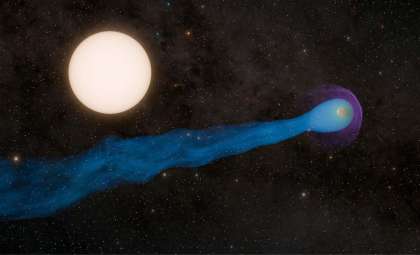
One theory suggests that Enaiposha started off more like Neptune but has experienced atmospheric erosion, where intense stellar radiation strips away outer layers. This could account for its reduced hydrogen and helium while retaining heavier gases such as carbon dioxide and methane.
If accurate, planets like Enaiposha could be more widespread than currently recognized, concealed among the multitude of exoplanets discovered so far. Detecting and analyzing these transitional worlds will deepen our understanding of planet formation, atmospheric dynamics, and the factors influencing planetary habitability.
- Categories:
- News







0 comments
Sign in to Comment