
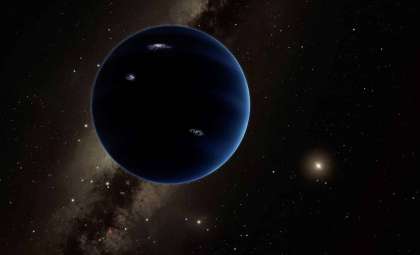
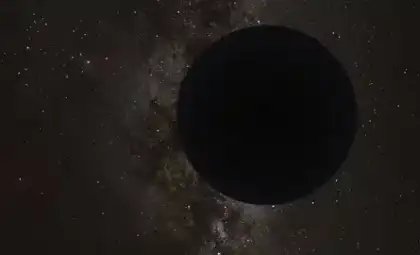
Scientists have long theorized about a concealed massive planet lurking on the outskirts of our solar system, far beyond Neptune. This hypothesized world, estimated to be several times the size of Earth, could be responsible for influencing the orbits of distant celestial bodies. Referred to as planet nine, this enigmatic entity continues to puzzle researchers and drive investigations within the astronomical community.
An Enduring Proposal
The notion of an undiscovered outer planet traces back to the early 20th century, prior to Pluto’s discovery. At the time, astronomers coined the term planet X to explain peculiar variations in Uranus’s orbit. Although adjustments to the estimated mass of Neptune in the 1990s resolved these anomalies, the idea was revitalized in 2016. Researchers Konstantin Batygin and Mike Brown from Caltech proposed that the strange orbital alignments seen among objects in the Kuiper Belt might be caused by the gravitational influence of a massive, yet unseen, planet.
Their hypothesis rests on gravitational effects observed in multi-body systems. Much as Earth’s gravity governs the moon’s trajectory around the sun, an unobserved giant planet could be exerting forces that shape the orbits of numerous trans-Neptunian objects (TNOs). These objects follow paths inconsistent with the sun’s gravity acting alone.

Mike Brown reinforced his conviction about planet nine in 2024, stating, “I find it highly improbable that Planet Nine does not exist. At present, no alternative hypotheses adequately explain the range of phenomena we observe, all consistent with Planet Nine’s influence.”
Clues from the Outer Solar System
A compelling clue emerged in 2018 when astronomers identified 2017 OF201, an object about 700 kilometers across—significantly smaller than Earth—but following a highly elongated orbit. Its unusual trajectory implies a history shaped either by a significant impact or the gravitational pull of a large, distant planet.
Adding to the evidence, the Subaru Telescope in Hawaii spotted 2023 KQ14, a sednoid known for spending nearly its entire orbit far beyond Neptune’s reach, between 71 astronomical units (AU) and an impressive 433 AU. With Neptune itself orbiting at approximately 30 AU, this vast separation hints that if planet nine exists, it might reside even further out, possibly beyond 500 AU.
Interestingly, 2023 KQ14 and three other sednoids exhibit exceptionally stable orbits. This has led scientists to speculate that planet nine’s true location could be much farther away and likely more elusive than initially thought.
Obstacles in the Quest
The hunt for planet nine faces significant hurdles due to both observational limits and the vast time scales involved. Some researchers argue that current Kuiper Belt data is insufficient to definitively confirm the planet’s existence, while alternative explanations such as a debris ring or even a small black hole have been proposed.
Moreover, the immense distances complicate detection. For instance, 2017 OF201 completes an orbit roughly every 24,000 years. Detecting its gravitational perturbations requires monitoring multiple orbits—an impossibility within a human lifetime.
Even if Planet Nine is real, dispatching a probe to reach it remains a tremendous challenge. Missions like NASA’s New Horizons would require over a century—at least 118 years—to cover the distances involved and approach the predicted orbital zone of this distant giant.
- Categories:
- News







0 comments
Sign in to Comment