
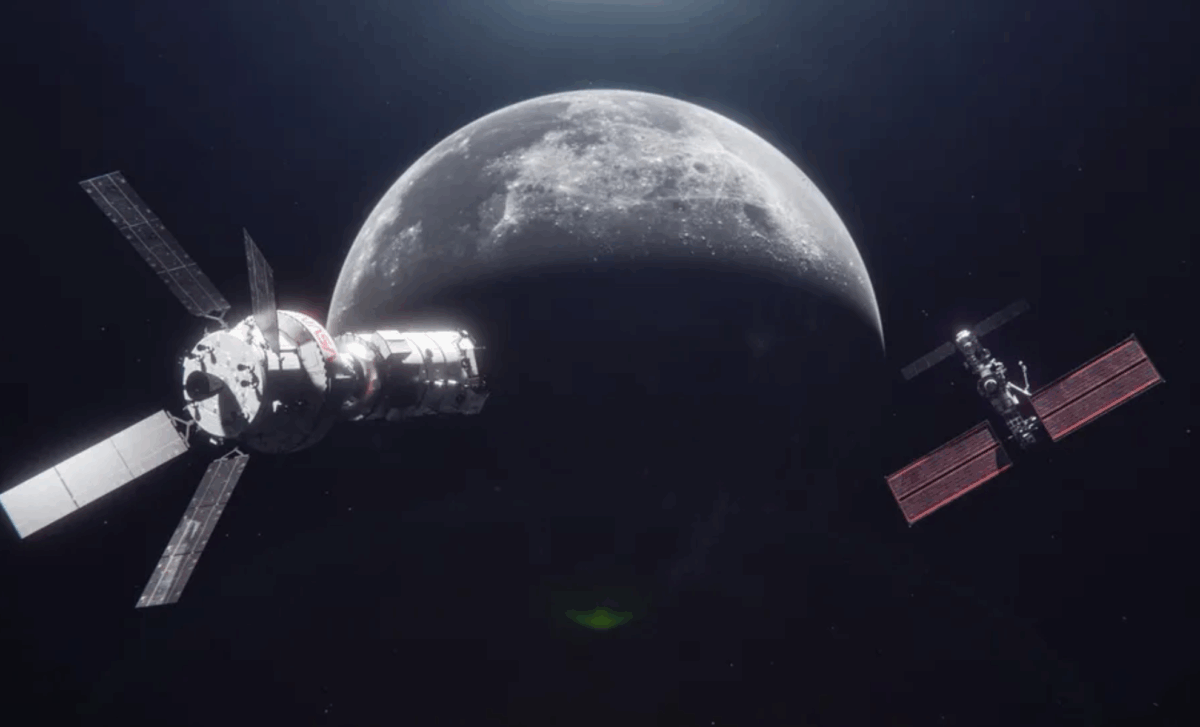
As nations intensify their focus on lunar ventures, the US military is expanding its vigilance well beyond our planet’s immediate environment. The Defense Advanced Research Projects Agency (DARPA) has launched a cutting-edge program aiming to identify and monitor objects navigating through cislunar space — the extensive region between Earth and the Moon. This initiative underscores mounting security concerns tied to the growing activity around the lunar vicinity.
Monitoring Uncharted Territories in Cislunar Space
Per Space.com, DARPA’s program, called Tactical Boost Demonstration 2 (TBD2), marks a major advancement in the military’s ability to oversee emerging threats within the space corridor stretching from Earth to the Moon. Historically, US tracking systems have concentrated on low Earth orbit (LEO) and geosynchronous orbit (GEO), where the majority of satellites are stationed. As other countries extend their spacecraft further out, DARPA seeks to close what defense specialists term a “blind spot” in space security.
The strategy involves deploying sophisticated optical sensors integrated with onboard computing for autonomous signal processing. These instruments will be capable of detecting small objects, roughly 10 to 20 centimeters in size, at distances reaching up to 250,000 miles. By placing sensors at key Lagrange points— gravitationally stable locations amid the Earth, Moon, and Sun — the program aims to sustain continuous monitoring of the so-called “Earth-Moon corridor.”

The Moon: A New Arena for Geopolitical Rivalry
The renewed interest in lunar missions goes beyond scientific discovery, focusing increasingly on asserting control, securing valuable resources, and gaining strategic advantages. Collaborative efforts involving the U.S. Space Force and the Air Force Research Laboratory (AFRL) are currently testing novel propulsion technologies to enable continuous surveillance in cislunar space. These initiatives reflect a shared understanding that lunar dominance could influence the establishment of regulations governing the use of off-world assets.
Earlier this year, former NASA Administrator Jim Bridenstine warned the U.S. Senate: “Unless something changes, it is highly unlikely the United States will beat China’s projected timeline.” China aims to send astronauts to the Moon by 2030 and stands out as a significant competitor. At the same time, NASA’s Artemis 3 mission, originally planned for 2027, is experiencing delays that heighten the sense of urgency in the United States.
Looking Ahead: Security in the Moon’s Neighborhood
DARPA’s project goes beyond mere technological progress; it signals an emerging military presence in space’s next vast frontier. With governments and private enterprise accelerating their lunar agendas, the complexities of ensuring transparent and safe operations in this region are intensifying. TBD2’s tracking capabilities may serve dual roles — as a defensive mechanism and as a strategic asset providing critical insight into activities hundreds of thousands of miles from Earth.
The expanse of cislunar space, historically seen as a domain of exploration and inspiration, is fast transforming into a contested environment where defense, technology, and exploration collide. The future of lunar engagements—whether cooperative or competitive—will hinge on how global powers monitor, communicate, and respond within this silent cosmic space.
- Categories:
- Space






0 comments
Sign in to Comment