
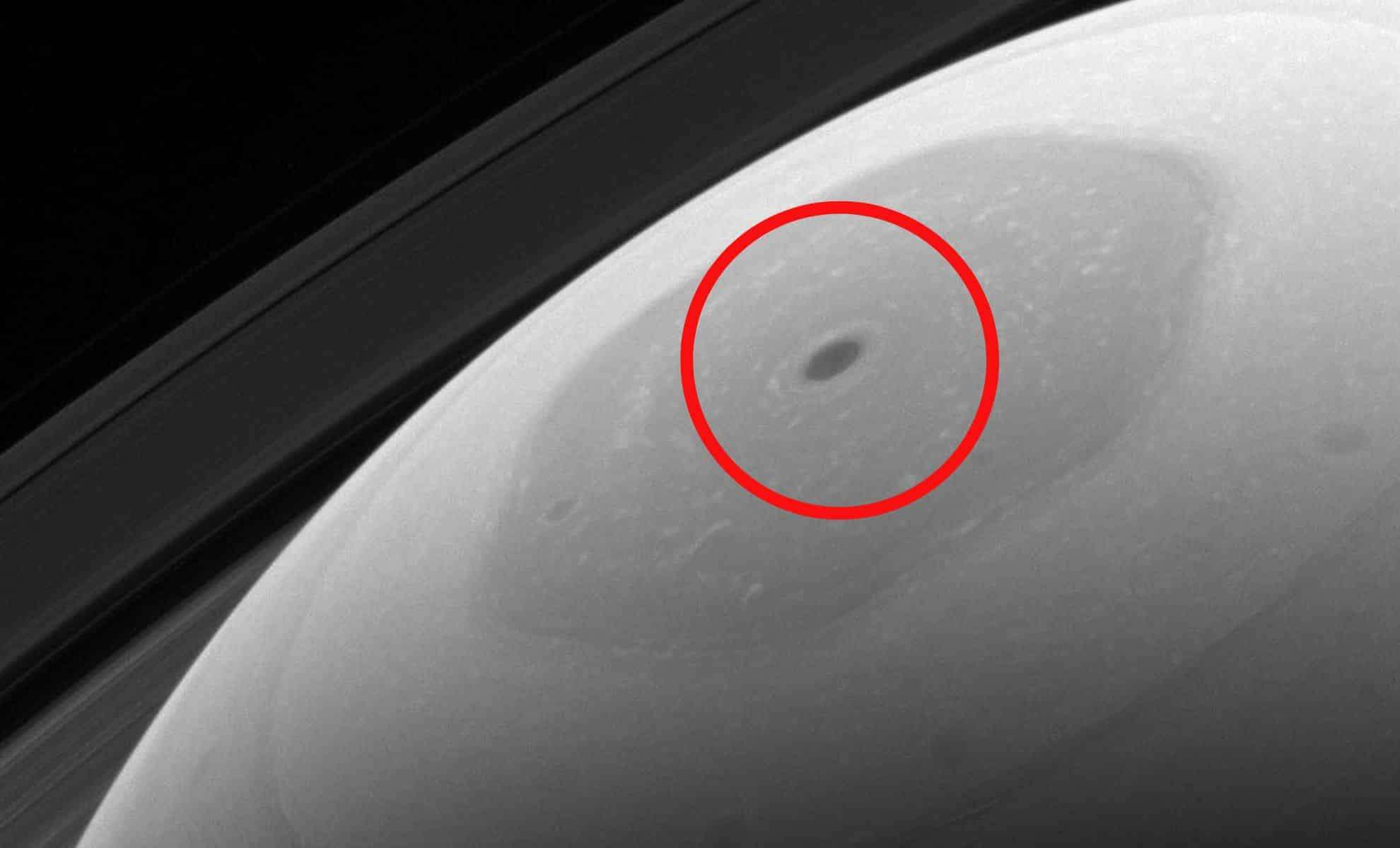
NASA’s James Webb Space Telescope (JWST) has uncovered an extraordinary and unfamiliar anomaly above Saturn’s north pole. Researchers have detected dark, bead-like formations suspended high within the planet’s ionosphere, paired with an unusual, asymmetrical star-shaped design embedded deeper in the atmosphere.
Published in Geophysical Research Letters, these discoveries raise intriguing new questions about Saturn’s upper atmospheric behavior and how its magnetosphere influences these perplexing formations.
An Unexpected Find in Saturn’s Polar Region
Using its Near Infrared Spectrograph (NIRSpec), JWST concentrated on the region surrounding Saturn’s north pole, famous for its giant hexagonal jet stream. This immense, six-sided atmospheric phenomenon, stretching roughly 18,000 miles across, has fascinated scientists since it was initially observed by NASA’s Voyager probes in 1980 and later explored extensively by the Cassini spacecraft from 2004 to 2017.

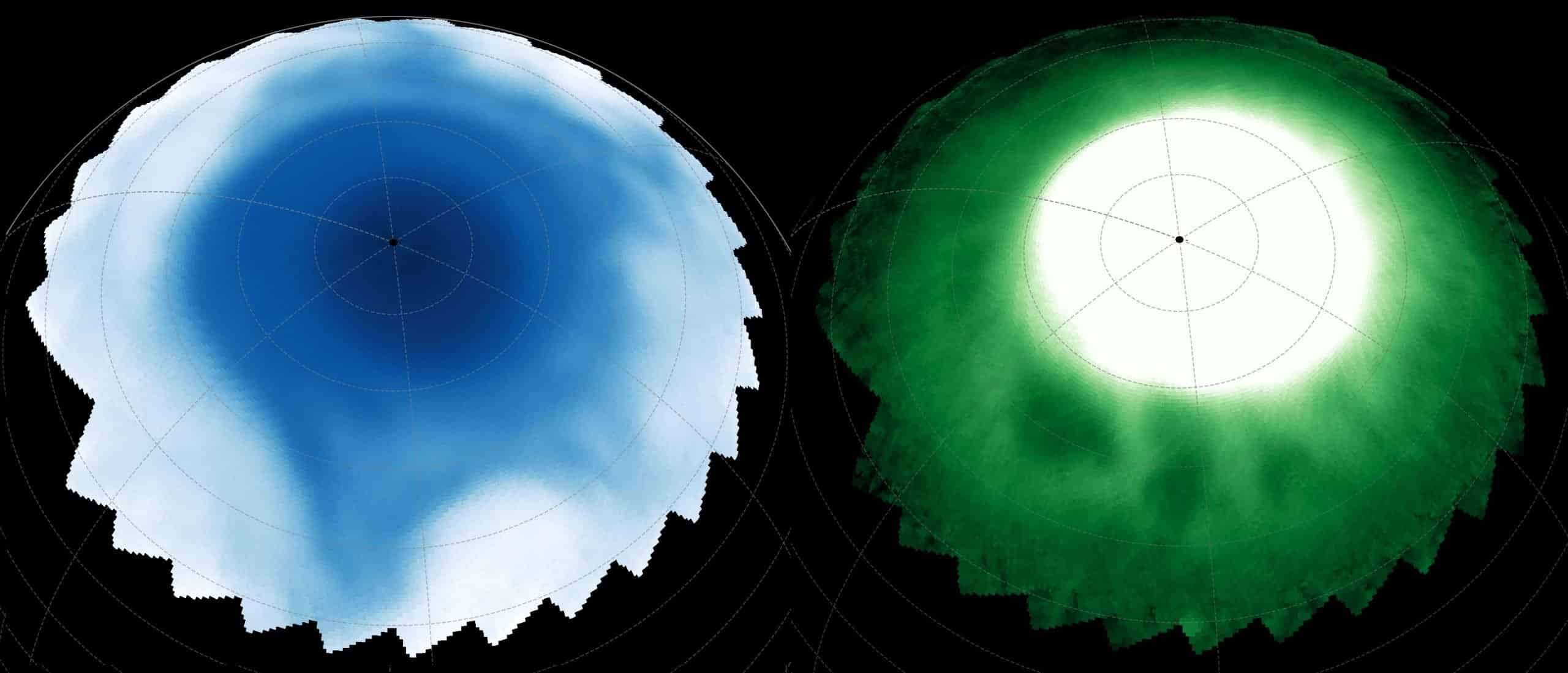
Expecting broad, uniform infrared signals from the ionosphere, the team instead discovered isolated, dark, bead-like spots scattered perhaps with a subtle connection, hovering in the charged plasma above Saturn. Beneath this, an irregular four-armed star pattern emerged in the stratosphere, defying straightforward explanation.
Probing Saturn’s Atmosphere Through Infrared Mapping
The August 28 report reveals that Webb observed molecular interactions for about ten hours, focusing on H3⁺ ions—charged hydrogen molecules integral to Saturn’s auroras—as well as methane levels. This enabled detailed atmospheric mapping and sharp detection of the dark beads.
Measurements concentrated on altitudes near 1,100 kilometers (684 miles) for the ionosphere and approximately 600 kilometers (373 miles) for the stratosphere, regions typically challenging to study due to their faint emissions, making this one of the most precise glimpses into Saturn’s upper atmospheric layers yet obtained.
Possible Connection Between Beads and Star Pattern
Although these structures appear in distinct atmospheric layers, scientists noticed a curious alignment: the darkest beads in the ionosphere seem to correspond with the most prominent arm of the star shape below. Whether this is mere coincidence or evidence of a shared underlying mechanism remains unclear.
Tom Stallard, an astronomy professor at Northumbria University, acknowledged the unexpected nature of the discovery:
“These features were completely unexpected and, at present, are completely unexplained.” He also suggested a possible cause: “We think that the dark beads may result from complex interactions between Saturn’s magnetosphere and its rotating atmosphere.”
If this hypothesis holds, it could enhance our understanding of how energy circulates on Saturn and the triggers behind its spectacular auroral displays.
Timing Aligns with Seasonal and Orbital Events
This unexpected discovery comes during Saturn’s equinox, when the sun’s rays strike its equator directly—a rare and brief phase that often triggers dramatic atmospheric shifts. The observed features might be transient, possibly vanishing as conditions evolve.
Additionally, Saturn’s current proximity to Earth is the closest it will be this year, providing astronomers an exceptional window to observe these phenomena with both ground and space-based instruments. The team intends to keep studying Saturn’s upper atmosphere using JWST to witness any changes or the disappearance of these fascinating structures.
While the root cause behind the dark beads and star pattern remains elusive, this finding confirms Saturn continues to surprise scientists. Nearly four decades after the iconic hexagonal jet stream captivated researchers, the planet has unveiled an even stranger atmospheric puzzle.
- Categories:
- News









0 comments
Sign in to Comment