

Lia Siegelman, a physical oceanographer at UC San Diego’s Scripps Institution of Oceanography, has uncovered that the gigantic cyclones swirling near Jupiter’s poles operate via atmospheric mechanisms resembling those on Earth.
By examining detailed infrared data gathered by NASA’s Juno mission, researchers identified convection and other familiar Earth-based atmospheric phenomena as key contributors to the persistence of Jupiter’s enormous storms.
This breakthrough advances our comprehension of how atmospheric dynamics function across different planets, despite their distinct compositions and environments.

Jupiter and Earth’s Atmospheric Parallels
Back in 2018, Siegelman observed surprising resemblances between Jupiter’s polar cyclone patterns and turbulent ocean flows on Earth. Since air and water both behave as fluids under physical laws, such parallels provided a meaningful analogy.
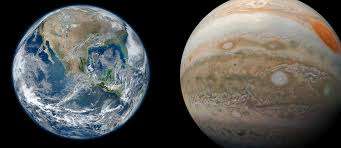
This insight led to a 2022 study recognizing convection as a fundamental driver sustaining Jupiter’s storms, which can span thousands of miles and endure for years. On Earth, convection shapes weather systems and ocean currents, and this research confirms similar underlying dynamics operate in Jupiter’s mostly hydrogen-helium atmosphere.
Filaments and Front-Like Structures on Jupiter
Published on June 6, 2024, in Nature Physics, Siegelman’s newest paper explores Jupiter’s atmospheric dynamics in detail. It reveals that thin, filamentary structures weaving between cyclones act much like atmospheric fronts on Earth—sharp transitions in temperature and density analogous to cold or warm fronts.
On our planet, fronts frequently trigger significant weather changes and play vital roles in storm formation. Similarly, on Jupiter, these fronts coupled with convection channels heat and energy from the planet’s interior up to the upper atmosphere, driving the scale and longevity of the polar cyclones.
Decoding Infrared Data from Juno’s Observations
Siegelman and collaborator Patrice Klein analyzed infrared snapshots of Jupiter’s north pole, taken every 30 seconds by the Juno spacecraft. These images distinguished between warmer, less dense clouds and cooler, denser cloud formations that restrict heat escape from the planet’s core.
Through measuring temperature variations and tracking filament movement, the team calculated horizontal wind speeds and vertical air motions. Their findings establish that Jupiter’s filaments behave like atmospheric fronts, with significant vertical winds at their boundaries fueling the planet’s atmospheric energy balance.
Implications for Understanding Cosmic Atmospheric Activity
The enduring cyclones near Jupiter’s poles, observable since 2016, appear sustained by these Earth-like atmospheric mechanisms, hinting this phenomenon might be common in other dynamic fluid systems across the cosmos.

This finding suggests that core weather and oceanographic processes might be universal, applicable to a variety of planetary atmospheres.
By studying Jupiter’s atmospheric mechanics, researchers gain valuable tools to anticipate weather phenomena on exoplanets and other worlds, broadening our understanding of planetary climates and how giant storms can be sustained over long periods.
Advancing Earth and Space Oceanography Visualizations
Siegelman’s work celebrates the interconnection of terrestrial physics and cosmic phenomena. The expansive scale of Jupiter and the clarity of Juno’s data offer a rare, detailed view of dynamics which are often subtle or fleeting on Earth.
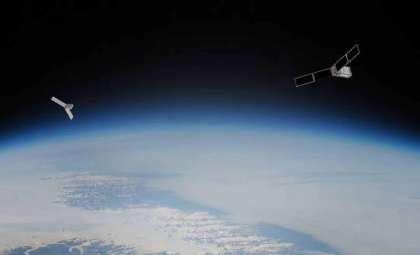
The soon-to-launch Surface Water and Ocean Topography (SWOT) satellite will revolutionize ocean observation on Earth, delivering high-resolution data on water elevation and currents. This will enhance our capability to compare Earth’s oceanic processes with those observed on afar planetary bodies.
- Categories:
- Astronomy ,
- News ,
- Science ,
- Space



0 comments
Sign in to Comment