
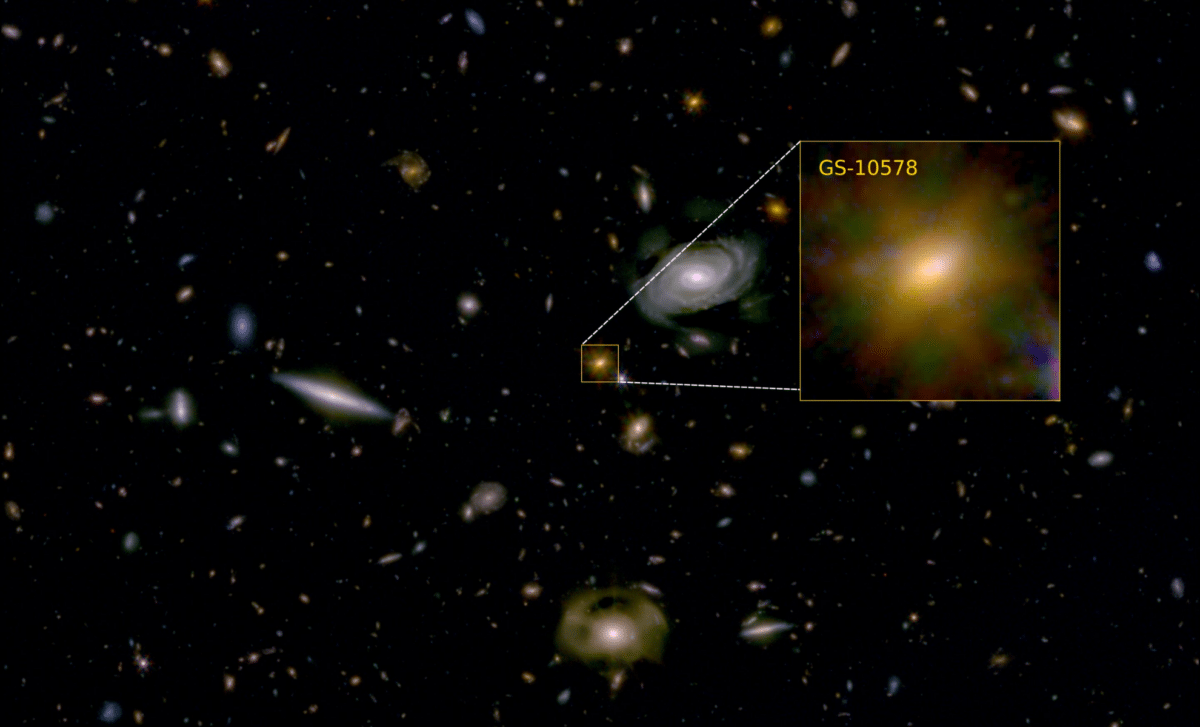
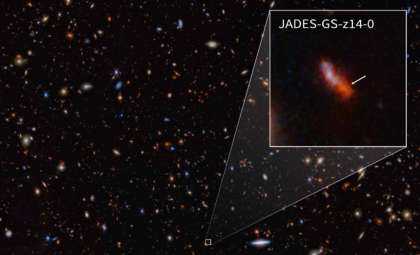
Scientists have identified a colossal galaxy that ceased star formation over 12 billion years ago, revealing a surprising end to its life cycle. Published in Nature Astronomy, the research illustrates that instead of meeting a sudden demise, this galaxy experienced a protracted fading phase. Utilizing the Atacama Large Millimeter/submillimeter Array (ALMA), the team captured a remarkable snapshot of a galaxy that burned bright briefly before gradually exhausting its star-forming gas.
The Remnants of a Cosmic Giant
For years, astronomers have debated why some early massive galaxies abruptly halt star production while others continue to flourish. The galaxy under scrutiny, observed as it appeared roughly 1.5 billion years post-Big Bang, provides new insights into this puzzle. Led by researchers from the University of Cambridge, ALMA’s detailed observations revealed the internal workings of this ancient cosmic structure.
Their article in Nature Astronomy suggests a slow depletion, rather than a sudden shutdown, as the mechanism behind the galaxy’s demise. Dr. Jan Scholtz from Cambridge’s Cavendish Laboratory and Kavli Institute for Cosmology described the findings:

“What surprised us was how much you can learn by not seeing something. Even with one of ALMA’s deepest observations of this kind of galaxy, there was essentially no cold gas left. It points to a slow starvation rather than a single dramatic death blow.”
This ‘starvation’ model implies that the galaxy initially contained ample cold gas necessary for star formation but lost its ability to renew this supply. Contrary to theories involving disruptive events like collisions or black hole eruptions, the galaxy quietly ran out of fuel and faded into cosmic obscurity.
A Serene Rotating Disk Amidst Early Chaos
ALMA’s data also uncovered a surprising feature: the galaxy maintains a stable, orderly rotating disk. Unlike the chaotic, disturbed appearances typical of many early galaxies, this structure resembles the calm disk of our Milky Way.
Co-lead author Dr. Francesco D’Eugenio from the Kavli Institute for Cosmology noted, “The galaxy looks like a calm, rotating disk. That tells us it didn’t suffer a major, disruptive merger with another galaxy. Yet it stopped forming stars 400 million years ago, while the black hole is active yet again. So the current black hole activity and the outburst of gas we observed didn’t cause the shutdown; instead, repeated episodes likely kept the fuel from coming back.”
This suggests a cyclical feedback process where the galaxy’s own central black hole sporadically blows out or heats the gas, preventing it from cooling enough to foster new stars. Over time, this self-regulating mechanism starved the galaxy, leaving behind a dormant relic drifting in the young universe.
Rethinking Galactic Life Cycles
This discovery challenges traditional views on how galaxies stop forming stars. Earlier beliefs held that cataclysmic events like galaxy collisions or intense supermassive black hole activity abruptly expelled star-forming material. However, the researchers propose a gentler, cumulative shutdown instead.
“You don’t need a single cataclysm to stop a galaxy forming stars, just keep the fresh fuel from coming in,” explained Dr. Scholtz. Many galaxies may simply fade away slowly by losing their gas supply, effectively suffocating over billions of years.
The study also reveals that such galaxies are surprisingly common. “Before Webb, these were unheard of,” Scholtz added. “Now we know they’re more common than we thought — and this starvation effect may be why they live fast and die young.”
With the ongoing observations from the James Webb Space Telescope (JWST), astronomers anticipate uncovering many more galaxies experiencing this gradual star formation halt, providing deeper understanding of galaxy evolution and cosmic history.
- Categories:
- Space




0 comments
Sign in to Comment