
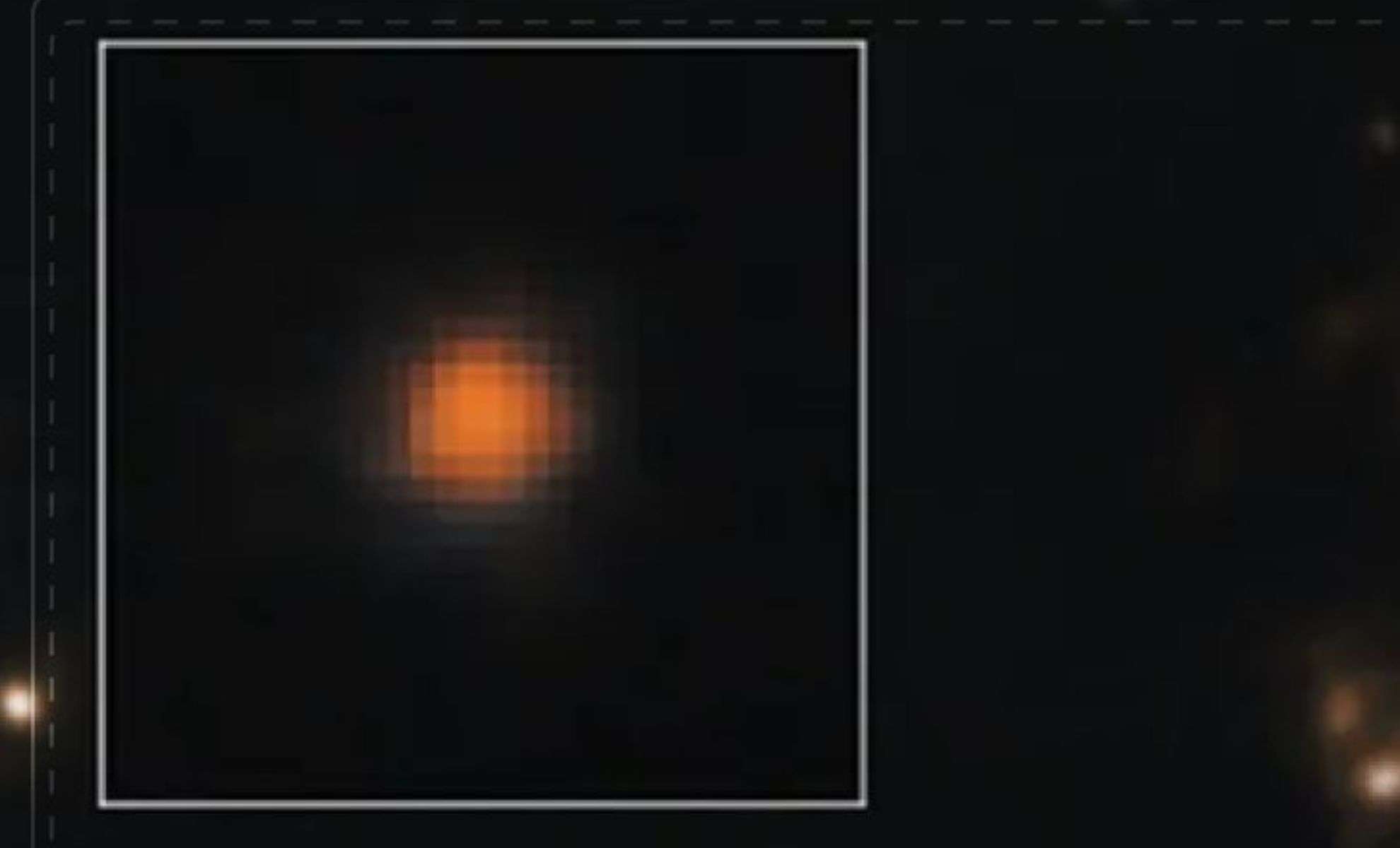
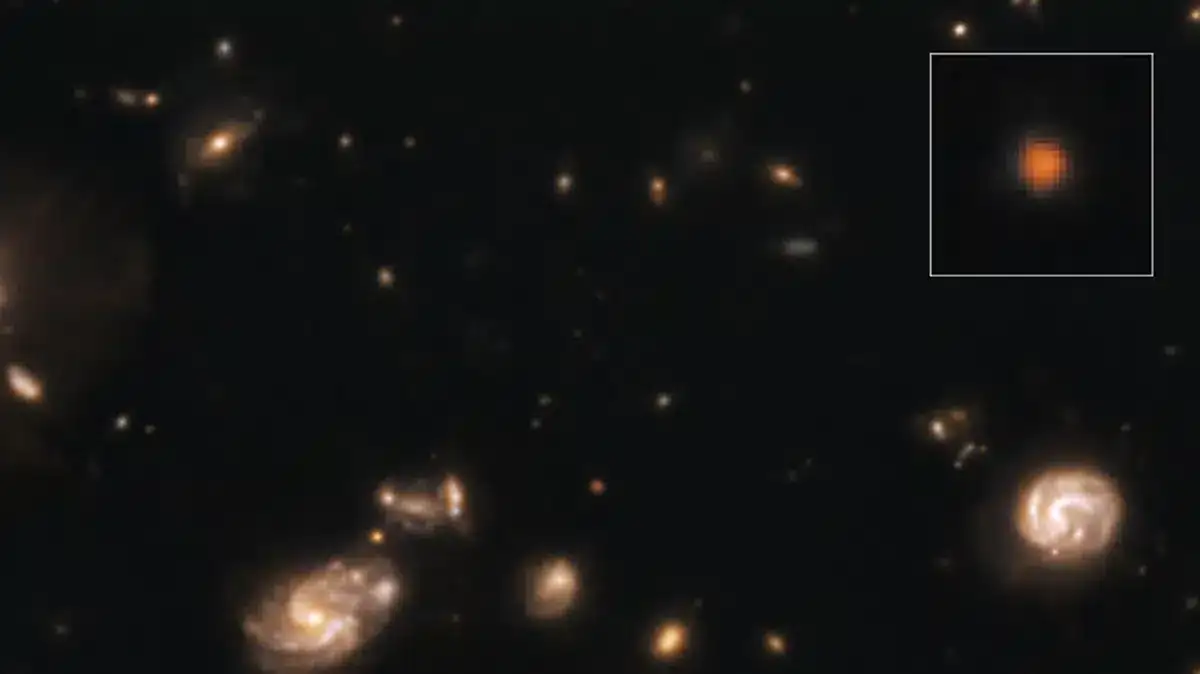
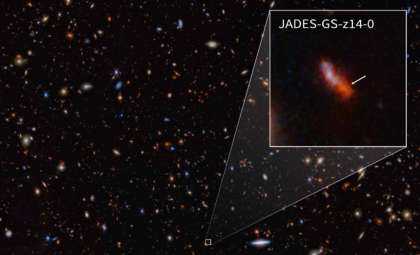
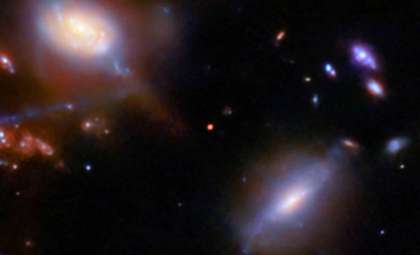
A dim, orange-hued speck observed by the James Webb Space Telescope (JWST) may represent the farthest galaxy ever observed. The object, informally called Capotauro, could have formed only 90 million years after the Big Bang, positioning it as a contender for the oldest known galaxy in the cosmos.
This finding emerged from the Cosmic Evolution Early Release Science (CEERS) project, which focuses on revealing the earliest phases of galaxy assembly. Although confirmation is needed, the estimated age of Capotauro pushes back the timeline well before previously identified galaxies like MoM-z14, which dates to about 280 million years after the Big Bang.
Scientists have traditionally thought that it took several hundred million years for proto-galaxies to coalesce after the universe’s initial expansion. Observing an object this ancient could revise current models about the speed and mechanisms governing early star and galaxy formation.

An Ancient Galaxy From The Dawn of Time
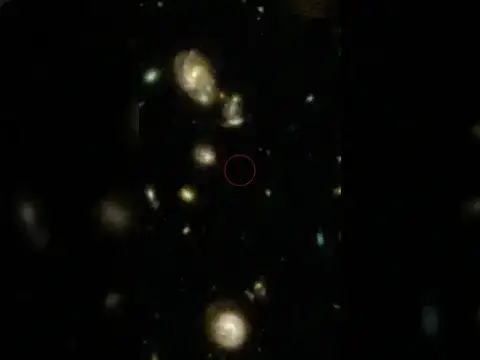
Registering officially as CEERS ID U-100588, the discovery team affectionately named the galaxy Capotauro, referencing a mountain at the crossroads of Tuscany and Emilia-Romagna. As reported by IFLScience, the light detected from this object appears to have originated just 90 million years following the Big Bang, corresponding to the epoch referred to as the “Cosmic Dawn.”
To better grasp this, researchers often employ the Cosmic Calendar, compressing the universe's 13.8-billion-year history into a single year. Within this analogy, Capotauro would have formed on January 3, mere days after the universe’s conception on January 1. By contrast, the formation of our Milky Way is mapped to March 1, and human beings arrive only at 11:52 PM on December 31.
Previously, the record-holder MoM-z14 was thought to have appeared around January 8 on this scale. Should Capotauro's distance be validated, it would precede MoM-z14 by several days — equating to nearly 200 million years earlier in real cosmic time.
Uncertainties Surrounding the Identity of Capotauro
Despite enthusiasm over the find, scientists urge caution in definitively labeling Capotauro as a galaxy. Its reddish color and brightness might alternatively be explained by other sources. According to IFLScience, some hypotheses propose it could be a dense cloud of dusty stars, with dust causing the altered light signature, or even a cooler body within our own galaxy, such as a brown dwarf or a free-floating planet.
Another intriguing possibility is that Capotauro may be a black hole star — a theoretical entity composed of a black hole shrouded in a thick envelope of hydrogen gas. Though never observed directly, such an object could potentially produce the compact, highly luminous signal detected here.
The findings were detailed in a manuscript submitted to the journal Astronomy & Astrophysics and released on the preprint server arXiv. Pending peer review, the astronomical community continues to approach these results with both curiosity and prudent skepticism.
Reevaluating Early Cosmic Star Formation
If Capotauro is verified as a genuine galaxy, its properties would challenge prevailing theories about early cosmic structure formation. It would imply that not only did such a galaxy emerge remarkably early, but it also assembled stars at a rate unlike anything previously documented.
As noted by IFLScience, to shine so vividly a mere 90 million years after the Big Bang, this cosmic entity must have converted gas into stars with extraordinary efficiency.
This discovery prompts fresh inquiries into how matter behaved in the infant universe as well as the role dark matter and other phenomena played in shaping the earliest galaxies. The ongoing CEERS survey, led by principal investigator Steven Finkelstein, is anticipated to reveal more breakthroughs in the near future.
- Categories:
- Space







0 comments
Sign in to Comment