
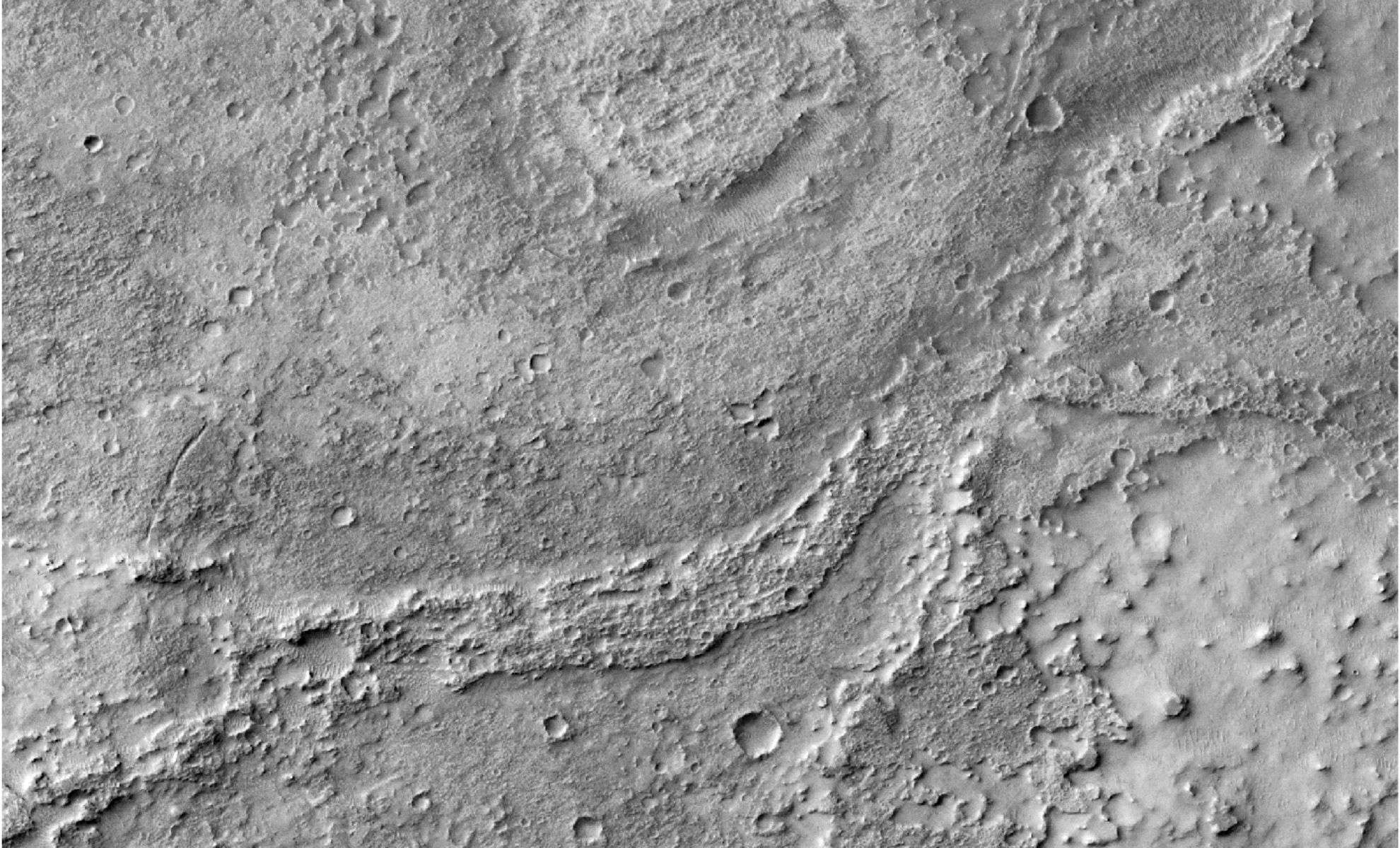
New research reveals that Mars was far wetter in its ancient past than previously believed. Investigations into inverted river channels in the Noachis Terra area shed light on a period when the Red Planet could have had environmental conditions resembling Earth’s, complete with rainfall and running water.
Revealing Noachis Terra’s Water Secrets
Scientists have known for decades that Mars once possessed lakes and rivers. The Mariner 9 mission during the 1970s initially identified dry riverbeds on the surface, thought to be over 3.5 billion years old, proving that water once moved extensively across Mars. A recent investigation into the Noachis Terra region further strengthens the evidence supporting Mars’ once wetter environment.
Adam Losekoot, a doctoral researcher at the Open University in the UK, spearheaded the study of these inverted channels. Utilizing imagery from NASA’s Mars Reconnaissance Orbiter alongside data from the Mars Global Surveyor, his team mapped an extensive network of inverted riverbeds spanning over 9,000 miles (14,484 kilometers). These formations, created by sedimentary deposits from ancient waterways, illustrate a Mars far more hydrologically active than previously thought.

What Are Inverted Channels?
Inverted channels form when sediment laid down by flowing water hardens over time. While the softer ground around erodes away, the hardened river sediment remains elevated, creating ridges that record past water flow. These geological features, dating back millions of years, reveal a time when Mars experienced precipitation events such as rain, hail, or even snowstorms. The collection of inverted channels in Noachis Terra showcases a dynamic era when Mars maintained a wetter and more engaging environment.
Unlike tributaries carved by short-lived floods, the inverted channels in Noachis Terra probably formed under longer-lasting climatic stability. This period aligns with the shift between Mars’ Noachian and Hesperian epochs, roughly 3.7 billion years ago.
Signs of Ancient Rainfall
This discovery is particularly intriguing because it implies rainfall—be it as rain, hail, or snow—was the main source feeding these rivers. Today’s Mars is frigid and dry, but in the distant past, the climate may have been warmer and wetter. The vast scale of inverted river channels across Noachis Terra points to a landscape with frequent precipitation.
“Since the Mariner 9 mission documented dried riverbed networks, it’s been clear Mars once hosted liquid water,” Losekoot explained. “Our findings add new proof that Mars was a vastly more complex and active planet in its early history.”
These revelations help build the case that Mars could have nurtured life. With enduring liquid water and a climate supportive of sustained precipitation, ancient Mars might have provided suitable conditions for microbial organisms to develop.
A Geological Archive from Mars’ Early Era
The long-preserved terrains in places like Noachis Terra are like natural history books, recording ancient geological processes for billions of years. As Losekoot states, “They offer a unique window into planetary evolution that Earth’s constantly changing surface cannot.” This positions Mars as an exceptional laboratory for understanding planetary history, including Earth’s own development.
The inverted channels in Noachis Terra remain a vital snapshot of Mars’ wetter epoch. They invite us to imagine a time when rainstorms swept across the landscape and life might have found a foothold on the Red Planet.
- Categories:
- News








0 comments
Sign in to Comment