
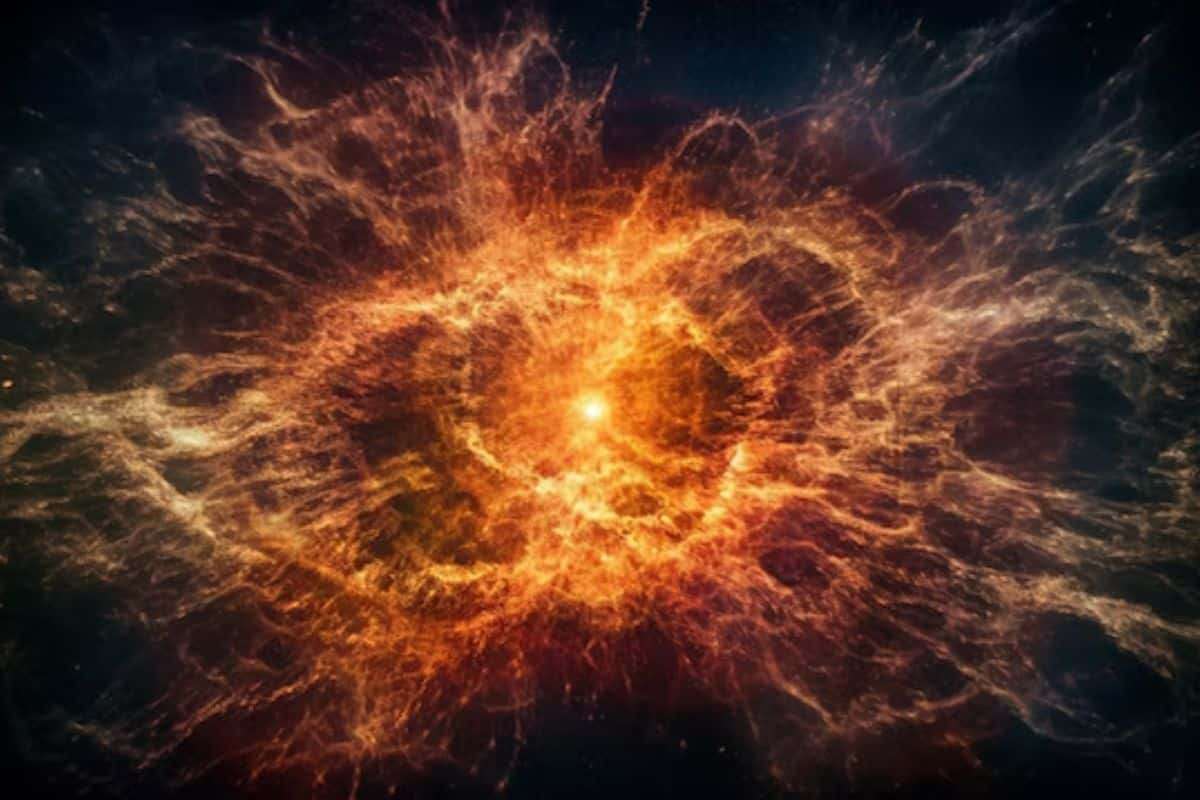
Recent research indicates that water molecules might have formed much earlier in the cosmos than previously believed—possibly just 100 to 200 million years following the big bang.
This discovery challenges traditional beliefs by suggesting water existed well before galaxies took shape, reshaping our understanding of the earliest habitats that could support life.
The Role of Exploding Stars in Water Formation
In the universe's infancy, only the lightest elements such as hydrogen, helium, and traces of lithium were present. Oxygen, essential for water, hadn't yet been synthesized. The earliest stars, emerging from gravitational collapses of hydrogen gas, initiated the production of heavier elements through nuclear fusion, oxygen included.
When these stars concluded their lives in supernova explosions, they released these heavier elements into space. This process allowed oxygen atoms to combine with abundant hydrogen, giving rise to water molecules.
Modeling the Origin of Cosmic Water
The Nature Astronomy publication by astrophysicist Daniel Whalen and his team at the University of Portsmouth employed advanced computer models to simulate the formation and explosive demise of the first stars. They analyzed two groups: stars approximately 13 times the Sun’s mass and giants up to 200 times that mass.
The simulations showed that these stellar explosions could produce enormous clouds of vapor, with smaller stars generating an amount of water comparable to Earth's mass, while the largest stars yielded vapor clouds equivalent in mass to Jupiter.

“You need detailed simulations to truly grasp what happens,” Whalen noted, highlighting the necessity of modeling supernovae within accurate cosmic frameworks.
Water Predating Galaxy Formation
According to the models, water formation could have started within 3 million years after a supernova and continued over spans up to 90 million years, implying water might have existed as early as 100 million years post-big bang.
Moreover, gravity drove the accumulation of this water and accompanying heavy elements into denser zones, which likely served as nurseries for second-generation stars and possibly the earliest planetary bodies.
“The gravitational gathering of water and heavy elements was a significant finding,” Whalen emphasized.
Reconsidering the Timeline for Life’s Origins
Astronomers now evidence that water vapor appeared in the universe far earlier than once believed, perhaps even preceding galaxy formation. This shifts the perspective on when conditions conducive to life’s beginnings may have first emerged in the cosmos.
“Discovering that water formed before galaxies overturns long-held assumptions about the earliest epochs capable of supporting life,” Whalen explained.
Team member Muhammad Latif from United Arab Emirates University shared plans to investigate whether early water vapor endured the harsh radiation during galaxy formation, aiming to see if these primordial molecules persist today—possibly even on Earth.
“Since life’s chemistry depends on liquid water, which requires a planetary surface with an atmosphere, this has profound implications,” said Avi Loeb from Harvard University.
If verified, the existence of ancient water vapor could redefine not only the timeline of chemical evolution in the universe but also the origins of life itself.
- Categories:
- News









0 comments
Sign in to Comment