
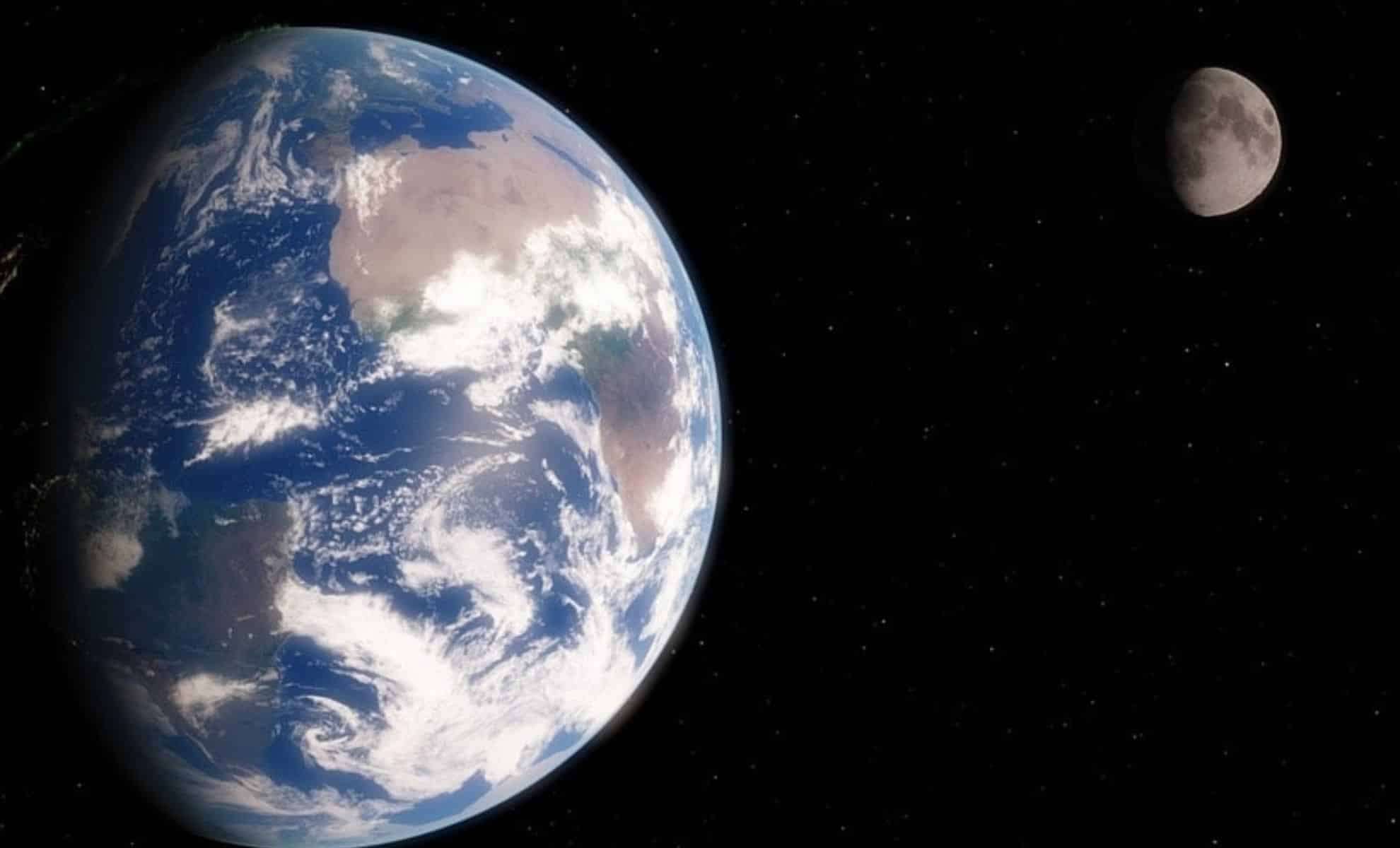
For decades, the prevailing explanation for the Moon's origin has centered on a cataclysmic collision between early Earth and a protoplanet-sized object.
This event was thought to have ejected vast amounts of debris into orbit, which eventually merged to form the Moon. Yet, revolutionary recent findings from Penn State researchers propose a daring new idea: the Moon may have been gravitationally captured by Earth from a binary companion in space, rather than forming solely from Earth's own material. This fresh perspective challenges established narratives about lunar formation, offering new insights into planetary evolution and solar system dynamics.
A Fresh Perspective on How the Moon Originated
The enduring giant impact hypothesis, solidified since the Kona Conference in 1984, relied heavily on lunar samples brought back by Apollo missions, which showed similarities in composition between Earth and Moon. This led to the accepted idea that a Mars-sized impactor collided with young Earth, creating the Moon from the resultant debris. For nearly forty years, this explanation has dominated scientific thought.

However, the latest work from Darren Williams, an astronomy and astrophysics professor at Penn State Behrend, along with Michael Zugger, a senior research engineer, introduces an alternative scenario. They suggest the Moon was originally part of a binary system, where two bodies orbited each other before Earth's gravity disrupted the pair. In this binary-exchange capture model, Earth snatched one of these objects, which became the Moon, while the other was flung into space. Williams points out that "The moon is more in line with the sun than it is with Earth’s equator," highlighting the Moon’s unusual tilt that doesn't align with expectations from a collision-based origin, prompting exploration of such alternative explanations.
Solar System Clues: Triton’s Capture as Evidence
Although capturing a moon might seem unlikely, similar events have precedents within our solar system. The team highlights Triton, Neptune’s largest moon, as a key example. Triton is thought to have been captured from the Kuiper Belt—a distant zone populated by numerous icy bodies, often found in binary pairs. Triton's orbit is retrograde and highly inclined, indicating it was not formed with Neptune but gravitationally ensnared instead. Drawing a parallel, Williams and Zugger propose Earth could have grabbed its Moon in a comparable manner, with the Moon beginning on an elongated elliptical orbit before tidal interactions gradually circularized it.
These tidal forces between Earth and the Moon, the study notes, would have smoothed the Moon's path over millennia. Williams explains, "High tide accelerates the orbit. It gives it a pulse, a little bit of a boost." This continual adjustment shaped the Moon’s orbit into the familiar near-circular trajectory observed today. The process remains active, as the Moon retreats approximately three centimeters farther from Earth every year.
Repercussions for Planetary Formation Theories
The concept of a captured Moon broadens possibilities for understanding the formation of natural satellites throughout the cosmos. If Earth’s Moon was indeed acquired from space, other moons, especially around gas giants, might have similarly complex histories. This view challenges the conventional idea that moons mainly emerge from planetary collisions or co-formation, suggesting some may be interlopers ensnared by gravitational forces during close encounters.
The researchers emphasize how the Moon’s current orbital alignment strengthens this theory. Williams notes that if the Moon had originated from collision debris, it would orbit close to Earth’s equator. Instead, "The moon is more in line with the sun than with Earth’s equator," hinting at a captured origin and motivating further investigation into capture scenarios.
Charting the Path Ahead in Lunar Research
Accepting that the Moon might have been gravitationally captured could transform strategies in future lunar expeditions. Scientists might focus not only on understanding the Moon’s surface and geology but also on unraveling clues about its unique beginnings. Should the binary-exchange capture model hold true, it would spark fresh lines of inquiry into the origins of moons throughout the solar system, shedding light on satellites like Jupiter’s Europa or Saturn’s Enceladus.
Williams acknowledges that, while compelling, the capture theory remains hypothetical. "No one knows how the moon was formed," he says, underlining how this new approach opens exciting avenues for research into the Moon’s early evolution, internal structure, and ongoing orbital relationship with Earth. As the Moon continues to slowly drift away, scientists remain eager to deepen our understanding of its dynamic past.
A Cosmic Puzzle Awaiting Resolution
Ultimately, this groundbreaking research brings us closer to deciphering the enigmatic story behind Earth’s lone natural satellite. The prospect that Earth gravitationally acquired its Moon instead of creating it from a planetary collision challenges decades-old assumptions. As the study by Williams and Zugger garners attention, it promises to ignite fresh scientific debate and inspire new explorations, not only of our Moon but also the broader origins of moons in the solar system.
While the collision hypothesis continues to be a leading explanation, the binary-exchange capture concept adds a riveting new dimension to lunar science. As Williams remarks, "For the last four decades, we have had one possibility for how it got there. Now, we have two." The true genesis of the Moon remains one of planetary science's most enduring mysteries, with this study setting the stage for future discoveries.
- Categories:
- Astronomy ,
- News ,
- Science ,
- Physics







0 comments
Sign in to Comment