

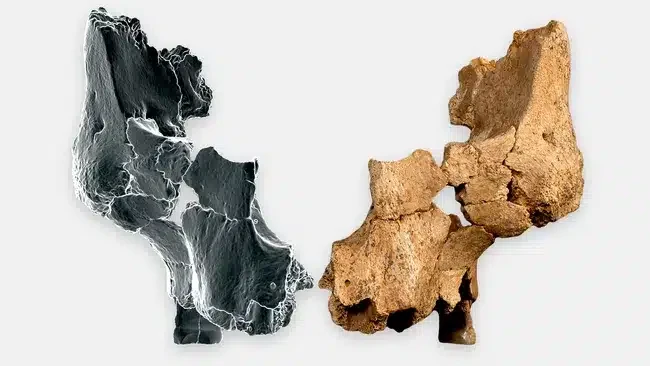
Discovered in 2022 at the Sima del Elefante site located in the Atapuerca mountain range, this fossil, attributed to Homo erectus or a close ancestor, provides vital insights into the early migration of humans across Europe. This remarkably preserved face, dated to 1.1 million years ago, significantly extends the timeline for human presence on the continent, an area where evidence of human activity was previously scarce before 800,000 years ago.
A Discovery That Redefines Human History
The breakthrough moment occurred on the initial excavation day by archaeology student Edgar Téllez in 2022 when he found a bone partially embedded in mud. Initially, fellow researcher Rosa Huguet questioned whether the specimen was human. However, after thorough cleaning and assessment, the team confirmed it belonged to an archaic human.
With tooth roots clearly preserved, the fossil is the oldest human-associated remain uncovered in Western Europe to date. The Nature publication highlights this as the earliest documented human face across the continent.

Crucially, the find demonstrates that Homo erectus—a species traditionally linked with Africa and Asia—also inhabited Europe. The skull exhibits both characteristic traits of Homo erectus, such as a primitive nasal structure, and some unique features like a more slender mid-facial region than those found elsewhere. Researchers have tentatively labeled this specimen H. erectus “affinis”, indicating its close relation but not definitive classification within the species.

Reevaluating Europe’s Early Human History
Prior to this discovery, Western Europe’s early Pleistocene fossil record was notably sparse. Apart from sparse isolated teeth and tools dating roughly 1.4 million years back, this new facial fossil offers the most concrete proof of early humans in the region. According to José María Bermúdez de Castro, this specimen might explain the origins of some stone tools discovered at the site, likely crafted by either Homo erectus or a similar group.
Unexpectedly, this finding disputes the traditional narrative of sequential human species succession in Europe. It suggests that the specimen uncovered at Sima del Elefante may represent the earliest human arrival on the continent.
Environmental shifts such as advancing glaciers possibly forced these initial settlers to abandon the area, paving the way for replacement by Homo antecessor, a hominin species that appeared approximately 860,000 years ago. Maria Martinón-Torres theorizes that several human species coexisted in Europe, separated by intervals of 200,000 to 300,000 years.
Tracing Early Human Movements in Europe
The dating of this fossil at 1.1 million years old offers a crucial perspective on the spread of early humans across the European landscape. It suggests Homo erectus might have been the continent’s first human inhabitant, though glacial periods likely caused temporary withdrawals. The later Homo antecessor, arriving from Eastern Europe or Africa, possibly expanded westwards following glacial retreats.
Researchers such as Mirjana Roksandic from the University of Winnipeg interpret this evidence as an indication that early humans not only endured the Ice Ages but actively tracked migrating animals into new environments.
Although this discovery advances our comprehension of early human dispersal, paleontologist Katerina Harvati from the University of Tübingen emphasizes that:
“Going forward it would be important to explore … the relationship of these populations with the early fossil humans of northern Africa, as [that] region represents an obvious, if not necessarily straightforward, potential place of origin for the Iberian groups.”
- Categories:
- Science










0 comments
Sign in to Comment