

The asteroid 2024 MT-1, comparable in size to the Statue of Liberty, is expected to make its nearest pass to Earth on July 8, 2024.
Traveling at speeds exceeding 40,000 miles per hour (65,215 km/h), this space rock will come within roughly 936,000 miles (1.5 million kilometers) of our planet — about four times the distance separating Earth and the Moon.
Although this is a relatively close encounter by cosmic standards, NASA has assured there is no danger posed to Earth by this asteroid's approach.

Details on Discovery and Physical Attributes
Measuring approximately 260 feet (79 meters) across, asteroid 2024 MT-1 was initially identified by NASA’s Near-Earth Object Observations Program, which monitors and analyzes celestial bodies that pass near Earth. This program combines data from ground telescopes and radar to track such objects. Despite the asteroid's large size and swift velocity, experts confirm no imminent collision risk exists.
The asteroid’s orbit has been continuously tracked by NASA’s Jet Propulsion Laboratory (JPL) located in Pasadena, California. JPL maintains an Asteroid Watch dashboard providing up-to-date information on the asteroid's trajectory, velocity, and distance.
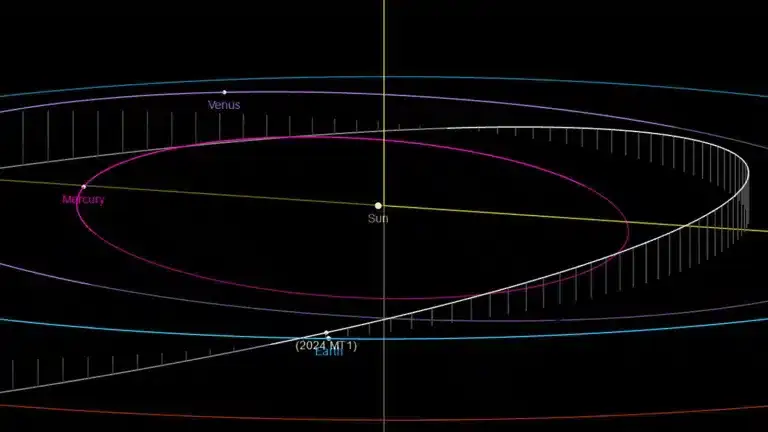
JPL confirms that 2024 MT-1 will remain at a safe distance as it flies by Earth on July 8, 2024, posing no immediate threat.
Asteroid 2024 MT1 is a near-Earth object approximately 260 feet (about 79 meters) in size. It is classified as a potentially hazardous asteroid due to its significant size and the relatively close distance at which it will pass by Earth. The closest approach of 2024 MT1 is… pic.twitter.com/B5ilYyMNnY
— Astro_Insights 🔭🪐 (@AstroInsights_) July 2, 2024
Hazard Potential and Defense Measures
Asteroids of this size are labeled as potentially dangerous since an impact could trigger enormous destruction, including powerful blasts, widespread fires, and massive tsunamis. Such an event would be catastrophic for populated regions, causing tragic loss of life and vast property damage.
Nevertheless, NASA’s Planetary Defense Coordination Office (PDCO) spearheads global efforts to identify threats and develop methods to prevent impacts. This includes collaborating with international agencies and scientists to create technologies to either divert or destroy hazardous asteroids.
A prime example is the Double Asteroid Redirection Test (DART) mission, designed to assess the feasibility of changing an asteroid's path by collision with a spacecraft. Launched in November 2021, DART successfully collided with asteroid Dimorphos in September 2022, validating this method as a viable planetary defense strategy. Although DART targeted a different asteroid from 2024 MT-1, the mission underscores significant progress in defending Earth.
Viewing Prospects and Scientific Insights
The flyby of 2024 MT-1 has garnered considerable excitement among astronomers and enthusiasts alike. Observatories worldwide are gearing up to document this encounter. Facilities such as the Goldstone Deep Space Communications Complex in California and the Arecibo Observatory in Puerto Rico will employ radar and optical instruments to thoroughly examine the asteroid’s size, shape, rotation, and surface makeup.
Researchers aim to study 2024 MT-1's composition and internal structure to gain a better understanding of the early solar system and planetary formation. Insights from these observations will improve predictions involving the movement and behavior of future near-Earth objects.
Significance for Global Planetary Defense
NASA's continued vigilance in tracking near-Earth objects is crucial in safeguarding our planet and expanding our cosmic knowledge. Through detailed monitoring of asteroids like 2024 MT-1, agencies can refine mitigation strategies to address potential impact risks proactively.
Such encounters emphasize the necessity of international cooperation and ongoing investment in space exploration and defense technologies to protect Earth from extraterrestrial hazards.
The upcoming passage of asteroid 2024 MT-1 offers a valuable chance for scientific study and public engagement, highlighting the importance of preparedness and research in planetary safety.
- Categories:
- Astronomy ,
- News ,
- Space ,
- Nasa






0 comments
Sign in to Comment