
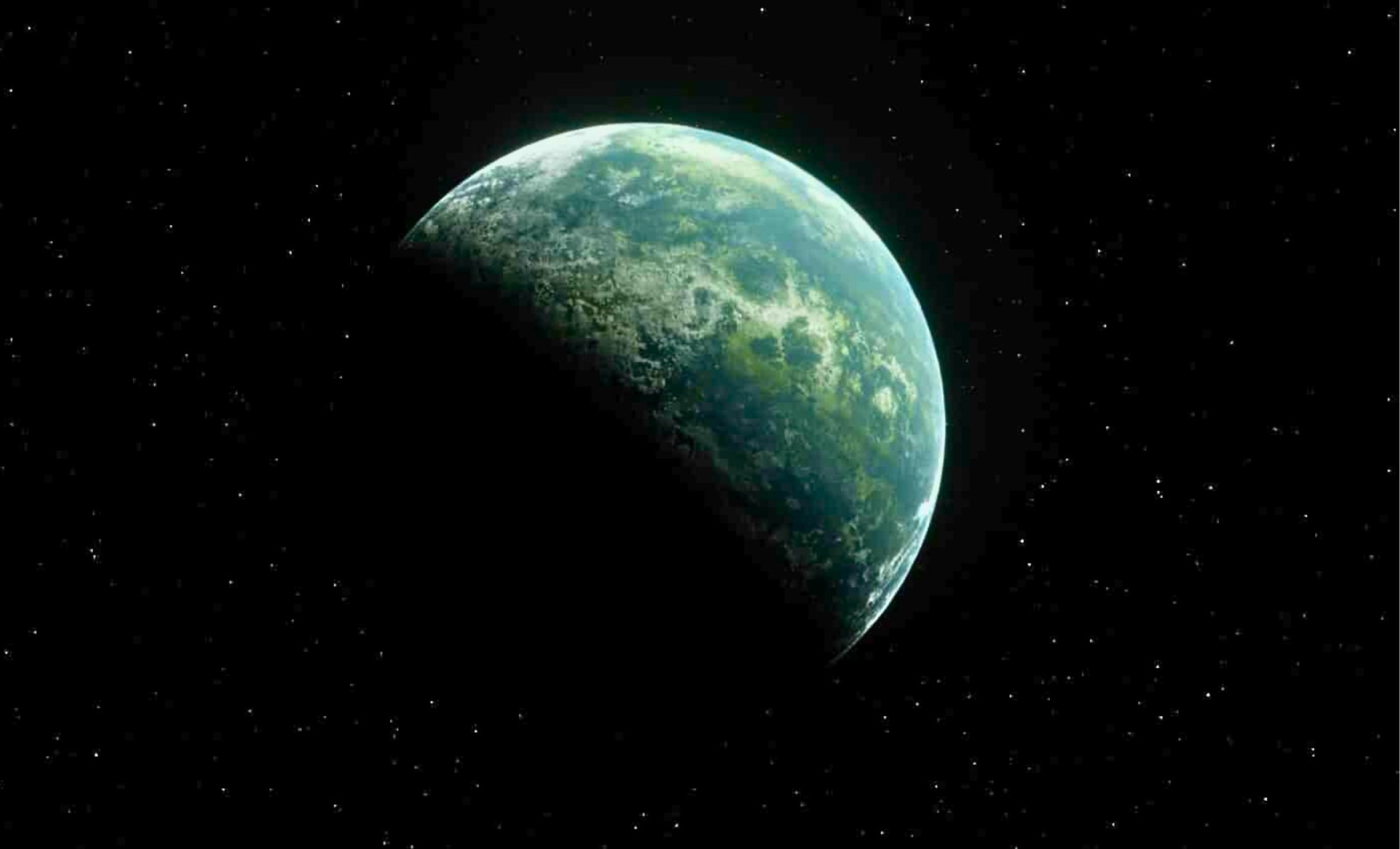
HD 20794 d travels through contrasting stellar environments along its extensive orbit. At its farthest, it distances itself similarly to Mars from our Sun, while at its closest approach, it moves inward near the orbit of Venus. This distinctive trajectory makes envisioning the planet as a typical habitable world more complex, despite its placement within the region where liquid water could exist.
In a study published on January 28, 2025, in Astronomy & Astrophysics, scientists from several countries confirmed HD 20794 d’s existence. They analyzed over two decades of data for HD 20794, a nearby star resembling our Sun just 20 light-years away. This system comprises three verified planets, with the outermost planet drawing particular attention for its passage through the stellar habitable zone.
The so-called habitable zone denotes a region around a star where liquid water might persist, yet HD 20794 d highlights why this term can be misleading. Habitability depends on many factors beyond mere distance—including atmospheric composition, surface conditions, pressure, and climate. On this planet, even the stellar energy it receives likely fluctuates significantly during each orbit.

A Unique Neighbor with an Eccentric Orbit
HD 20794 shines brightly enough to be seen unaided by the naked eye, providing an excellent target for exoplanet researchers. Its brightness enhances the detection of subtle signals and could make it a valuable candidate for upcoming telescope missions. Located in the Eridanus constellation, the star’s three planets orbit with markedly different periods: HD 20794 b completes an orbit every 18.3 days, planet c orbits in 89.7 days, and planet d circles the star over a lengthy 647-day cycle.
HD 20794 d’s orbit is notably elliptical rather than circular, causing it to traverse the habitable zone rather than remain confined within it. This dynamic path results in varying stellar distances and irradiance throughout its year.
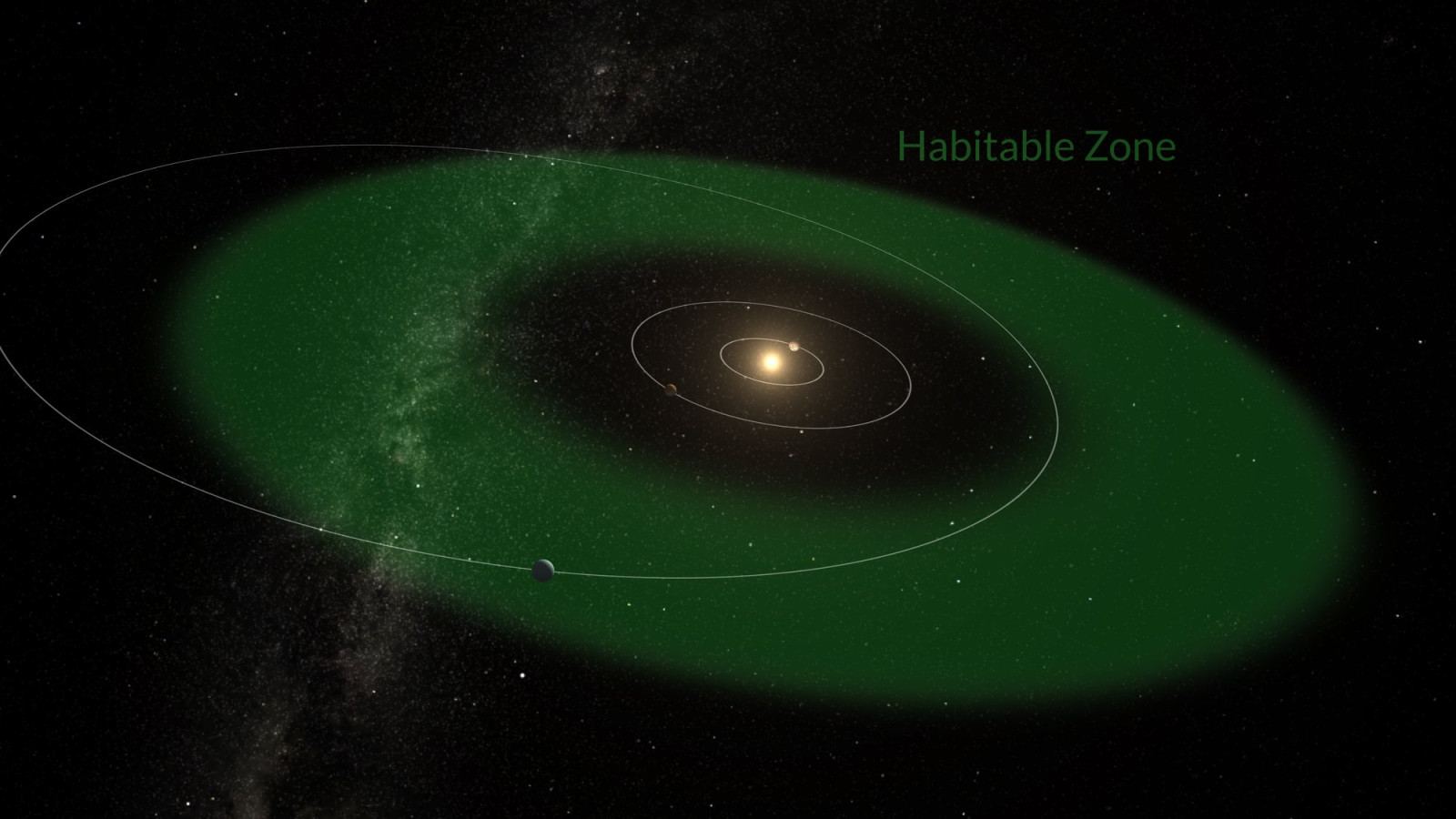
As HD 20794 d moves farther away, any surface or subsurface water could face freezing conditions. In contrast, when the planet approaches closer to its star, increased heat might dominate. This fluctuation has led to its description as a “world of fire and ice,” due to the extreme differences in stellar energy it receives.
Detecting the Planet Through Subtle Star Wobbles
No direct images of HD 20794 d exist. The planet’s presence first emerged in 2022 when Dr. Michael Cretignier identified a potential signal within archived observations from HARPS, a spectrograph at Chile’s La Silla Observatory. The planet was inferred indirectly via slight shifts in the star’s radial velocity, reflecting its gravitational influences rather than being visually observed.
This radial velocity technique detects the minute stellar motions caused by the tug of orbiting planets. For HD 20794 d, the velocity shifts were under one meter per second, persisting nearly two Earth years, making the signal challenging to disentangle from stellar activity or instrumental effects.
The research team combined data from HARPS with measurements from ESPRESSO, another high-precision spectrograph in Chile. According to a University of Oxford press release shared by Astrobiology, the scientists spent extensive time verifying the signal’s authenticity by excluding noise and contamination sources before confirming the planet.
As reported by Scientific American, the YARARA software, developed under Cretignier’s leadership, was instrumental in distinguishing planetary signals from stellar and instrumental noise. This refined analysis reinforced the existence of HD 20794 d, bolstered the case for the two inner planets, and cast doubt on a previously suggested additional companion.
Understanding Super-Earth’s Characteristics
While HD 20794 d is classified as a super-Earth, this term indicates a planet with a mass larger than Earth’s, rather than guaranteeing Earth-like characteristics. Studies estimate its mass at about six to 6.5 times that of Earth. However, this figure alone does not indicate surface features, atmospheric properties, or whether the planet has oceans, continents, or an extended gaseous envelope.
Radial velocity data provides only the minimum mass, lacking information about the planet’s size or density. Hence, HD 20794 d could be a large rocky planet, an ocean world, or possess a thick atmosphere similar to Neptune. NASA’s Jet Propulsion Laboratory researcher Renyu Hu, not involved in the study, remarked to Scientific American that definitive evidence of the planet’s rocky composition is still absent.
The orbit’s pronounced eccentricity further complicates predictions. Water on the planet, if present, might transition between frozen, liquid, or vapor states depending on its varying proximity to the star. Co-author and University of Geneva astronomer Xavier Dumusque noted that if deep oceans exist, pressure effects could alter water’s behavior, adding complexity to habitability discussions.
Prospects for Future Observations
HD 20794 d’s significance lies in its proximity and unusual orbit, making it a compelling subject for upcoming observational efforts. At roughly 20 light-years away, it is accessible for planned missions designed to isolate faint planetary light from the glare of host stars and conduct detailed studies of nearby exoplanets. Dr. Cretignier expressed optimism that future space telescopes might eventually capture direct images of this intriguing planet.
Forthcoming instruments include the Extremely Large Telescope, NASA’s anticipated Habitable Worlds Observatory, and the proposed Large Interferometer For Exoplanets (LIFE). These projects aim to explore Earth-like worlds in the solar neighborhood, analyze their atmospheres, and seek potential biosignatures—chemical indicators of life. Scientific American noted that both NASA and ESA have considered HD 20794 among potential candidates for future observations.
The key takeaway from this discovery is that although HD 20794 d is nearby, detectable, and resides within the potential habitable zone, crucial details defining its true habitability remain unknown. For now, it stands as a confirmed, massive planet orbiting a Sun-like star about 20 light-years from Earth on a highly elliptical path repeatedly crossing its star’s habitable zone.
- Categories:
- Science










0 comments
Sign in to Comment