

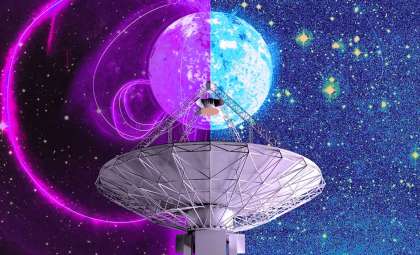
Scientists at Curtin University’s International Centre for Radio Astronomy Research (ICRAR) have achieved a groundbreaking discovery in cosmic phenomena. Associate Professor Natasha Hurley-Walker and undergraduate researcher Csanád Horváth detected an extraordinary burst of intense radio energy streaming from distant space.
Captured using archival low-frequency measurements from the Murchison Widefield Array (MWA), this cosmic signal shows some extraordinary features:
- Repeats every three hours
- Spans 30 to 60 seconds per pulse
- The longest-duration radio transient recorded to date
This striking event, named GLEAM-X J0704-37, provides an exciting new opportunity to unlock cosmic mysteries. Much like how the James Webb Space Telescope reveals feeding supermassive black holes, this finding sheds light on the universe’s hidden processes.

Unraveling the cosmic riddle
Long-period radio transients are a fairly recent astrophysical enigma, with their exact emission mechanisms still unclear. Yet this discovery gives scientists a promising clue to solve the puzzle.
Previous detections of such transients mostly came from within our crowded Milky Way, complicating efforts to identify their origins. As Associate Professor Hurley-Walker remarked, “It’s like 2001: A Space Odyssey. ‘My god, it’s full of stars!’”
Fortunately, GLEAM-X J0704-37 is positioned near the edge of the galaxy, in a quiet zone within the Puppis constellation, roughly 5,000 light-years from Earth. This helped scientists pinpoint its radio source to a specific stellar system.
Identifying the cosmic source
Using sophisticated instruments including South Africa’s MeerKAT telescope and Chile’s SOAR observatory, researchers made a surprising connection. The radio emission originated from a small star classified as an ‘M dwarf.’
However, this finding sparked further questions. Associate Professor Hurley-Walker noted, “An M dwarf by itself can’t produce the energy levels we observe.” This suggested the M dwarf is paired in a binary system, likely with a white dwarf — the dense remnant core of a dead star.
This rare star pair is thought to be the source of the powerful radio signals, potentially explaining the mysterious long-period radio transients that have baffled astronomers for years.
Looking ahead: New directions in research
The uncovering of GLEAM-X J0704-37 has sparked many new research possibilities. Scientists are currently combing through MWA’s archival data, which spans over a decade, in hopes of identifying similar events previously missed.
Professor Steven Tingay, Director of the MWA, highlighted the importance of this massive data collection: “The MWA archive holds 55 petabytes of observations that chronicle ten years of our Universe’s activities. It is a treasure trove for revealing new cosmic phenomena.”
As investigations continue into this remarkable discovery, it marks a pivotal moment for astrophysics. This milestone enhances our understanding of the cosmos and underscores the remarkable capabilities of today’s astronomical technology in probing the universe’s secrets.
https://www.sciencedaily.com/releases/2024/11/241126135731.htm
- Categories:
- Astronomy











0 comments
Sign in to Comment