

A team of astronomers has identified the slowest rotating neutron star known to date, named ASKAP J1935+2148, situated roughly 16,000 light-years away from our planet.
In contrast to most neutron stars, which can spin hundreds of times each second, this star takes almost an entire hour to complete one full rotation.
The discovery challenges established scientific views on neutron star dynamics and has ignited lively discussions among experts. Using the ASKAP radio telescope in Australia, researchers detected a neutron star featuring an unprecedented pattern of radio wave emissions.

What Sets ASKAP J1935+2148 Apart from Other Neutron Stars
Neutron stars are compact remnants left behind after massive stars explode as supernovae. Typically around 12 miles wide, they are famous for their rapid rotation and intense magnetic fields. ASKAP J1935+2148’s exceptionally slow spin and its continued radio emission confound conventional models.
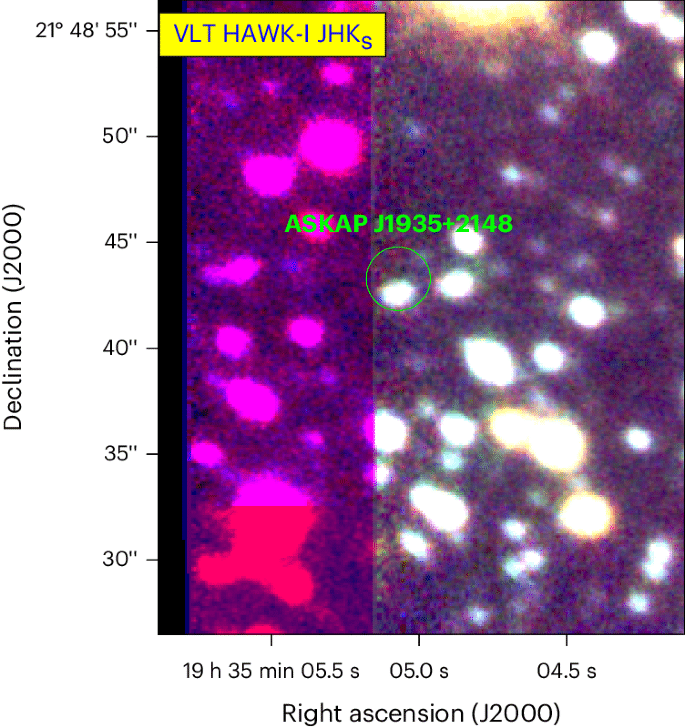
Prevailing theories predict that radio waves should fade as the neutron star’s spin slows markedly. Dr. Manisha Caleb from the University of Sydney’s Institute of Astronomy commented, “Finding a neutron star candidate with radio pulsations occurring this slowly is quite extraordinary.”
“The repetition of signals on such a long timescale is truly remarkable.” This finding suggests that the physics governing neutron stars may be more complex than previously thought.
Capturing the Radio Emission Patterns
ASKAP J1935+2148 produces radio pulses roughly every 53.8 minutes, exhibiting three distinct states of emission. At times, intense bursts lasting between 10 and 50 seconds are detected, while on other occasions, the emissions are faint, circularly polarized, and last just under half a second.
Between these pulses, the star goes silent. These fluctuations hint at intricate processes possibly involving magnetic fields and plasma behavior. Caleb stated, “If these signals did not originate from the same location, it would be hard to believe they come from one source.” The unusual variability challenges existing ideas on how neutron stars generate radio waves, indicating there could be undiscovered phenomena at work.
Investigating the True Identity of the Radio Source
Given the star’s slow rotation and peculiar emissions, researchers have pondered whether ASKAP J1935+2148 might actually be a white dwarf, a dense stellar remnant from smaller stars such as the Sun, which can rotate slowly enough to match the observed timing.
Nevertheless, white dwarfs generally do not create radio emissions like those recorded from this object, making that explanation unlikely. “An isolated white dwarf would need an exceptionally strong magnetic field to produce signals observed with ASKAP and MeerKAT telescopes,” Dr. Caleb explained, emphasizing the rarity of this discovery. This inconsistency casts new light on our understanding of magnetic fields and emission mechanisms in dead stars.
Broader Impacts on Theories of Star Evolution
The identification of ASKAP J1935+2148 poses intriguing challenges to astrophysics, as neutron stars are believed to lose their radio wave patterns as they spin down with age. This object’s sustained emissions defy that expectation.
Findings published in Nature Astronomy propose that unknown processes may influence the later stages of stellar remnants. Caleb observed, “This could force us to rethink long-standing ideas about neutron stars and white dwarfs, their radio emission capabilities, and their presence within the Milky Way.” These insights could prompt revisions in theoretical frameworks relating to neutron star behavior and radio wave production.
- Categories:
- Astronomy ,
- News ,
- Space











0 comments
Sign in to Comment