

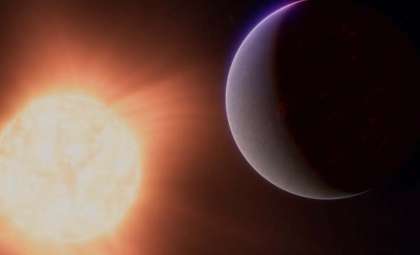
Scientists have identified an atmosphere rich in water vapor enveloping the exoplanet GJ 9827 d, situated 98 light-years away within the constellation Pisces. Observations from the James Webb Space Telescope (JWST) reveal a significant presence of water vapor around this small world, which measures roughly twice Earth’s size.
The research, overseen by Caroline Piaulet-Ghorayeb at the Université de Montréal’s Trottier Institute for Research on Exoplanets (IREx) and published in Astrophysical Journal Letters, represents a breakthrough in the study of smaller exoplanets. It positions GJ 9827 d as a candidate “steam world,” unveiling fresh details about planetary atmospheres.
Discovering an Uncommon Atmosphere on GJ 9827 d
A remarkable aspect of the James Webb Space Telescope’s observation is the distinct atmospheric makeup of GJ 9827 d. Unlike the hydrogen-heavy atmospheres typical of gas giants and mini-Neptunes, this exoplanet displays a thick atmosphere abundant in heavier molecules, most notably water vapor. This finding deviates sharply from common exoplanet trends and has led scientists to classify it as a “steam world.”

Employing transmission spectroscopy, researchers analyzed starlight filtering through GJ 9827 d’s atmosphere during its transit. By combining data from both the JWST and the Hubble Space Telescope (HST), the team confirmed water vapor’s presence and excluded stellar interference. Piaulet-Ghorayeb noted, “Up to now, all detected planetary atmospheres belong to giant planets or mini-Neptunes, predominantly composed of hydrogen, resembling gas giants rather than terrestrial planets like Earth.”
The results imply that GJ 9827 d harbors either a hazy, hydrogen-rich atmosphere with some water vapor or, more plausibly, a dense atmosphere saturated with water vapor, possibly existing as steam because of its closeness to its star. This marks the inaugural detection of heavy molecules in the atmosphere of a relatively small exoplanet, distinguishing GJ 9827 d from others.
Advancing Atmospheric Studies of Small Worlds
The ability to detect a water-rich atmosphere on GJ 9827 d underscores the revolutionary power of the James Webb Space Telescope in probing smaller and more challenging planets. Earlier atmospheric research primarily targeted gas giants and mini-Neptunes, whose larger sizes and hydrogen-rich envelopes make them easier to study. Conversely, atmospheres around smaller, Earth-sized planets tend to be thin and difficult to detect with prior instrumentation.
Utilizing JWST’s NIRISS instrument, the team observed light passing through GJ 9827 d’s atmospheric layer as it crossed its star. Integrating these observations with previous Hubble data allowed for confident differentiation between atmospheric compositions. Detecting water vapor here provides compelling evidence that small planets can maintain thick atmospheres dominated by heavier elements.
Although GJ 9827 d is too close to its star to sustain life—surface temperatures hover around 350°C—this “steam world” finding is a landmark in understanding planetary environments. Piaulet-Ghorayeb emphasized, “This result supports the possibility that other small, rocky exoplanets might also have similar atmospheres, encouraging further inquiries and eventual assessments of potentially habitable worlds.”
Implications for the Search for Life Beyond Earth
Identifying a water-rich atmosphere on GJ 9827 d stands as a key accomplishment in examining small exoplanets, augmenting the prospect that some rocky planets might host atmospheres favorable for life. Despite GJ 9827 d’s inhospitable heat, its dense, water-laden atmosphere enriches our comprehension of planetary development and chemical makeup.
Looking ahead, astronomers anticipate that additional JWST studies will elaborate on the characteristics of GJ 9827 d’s atmosphere and potentially disclose fresh traits that deepen understanding of steam worlds. The capability to scrutinize atmospheres of small planets is crucial in refining the quest for Earth analogs that could support life.
This discovery also highlights the exceptional prowess of the James Webb Space Telescope, which is transforming the exploration of smaller exoplanets with unmatched detail. As efforts to unravel the mysteries of distant worlds advance, uncovering atmospheres on planets like GJ 9827 d will be vital in pinpointing candidates for future missions and broadening the search for extraterrestrial life.
- Categories:
- Astronomy ,
- News ,
- Science ,
- Nasa ,
- Physics





0 comments
Sign in to Comment