
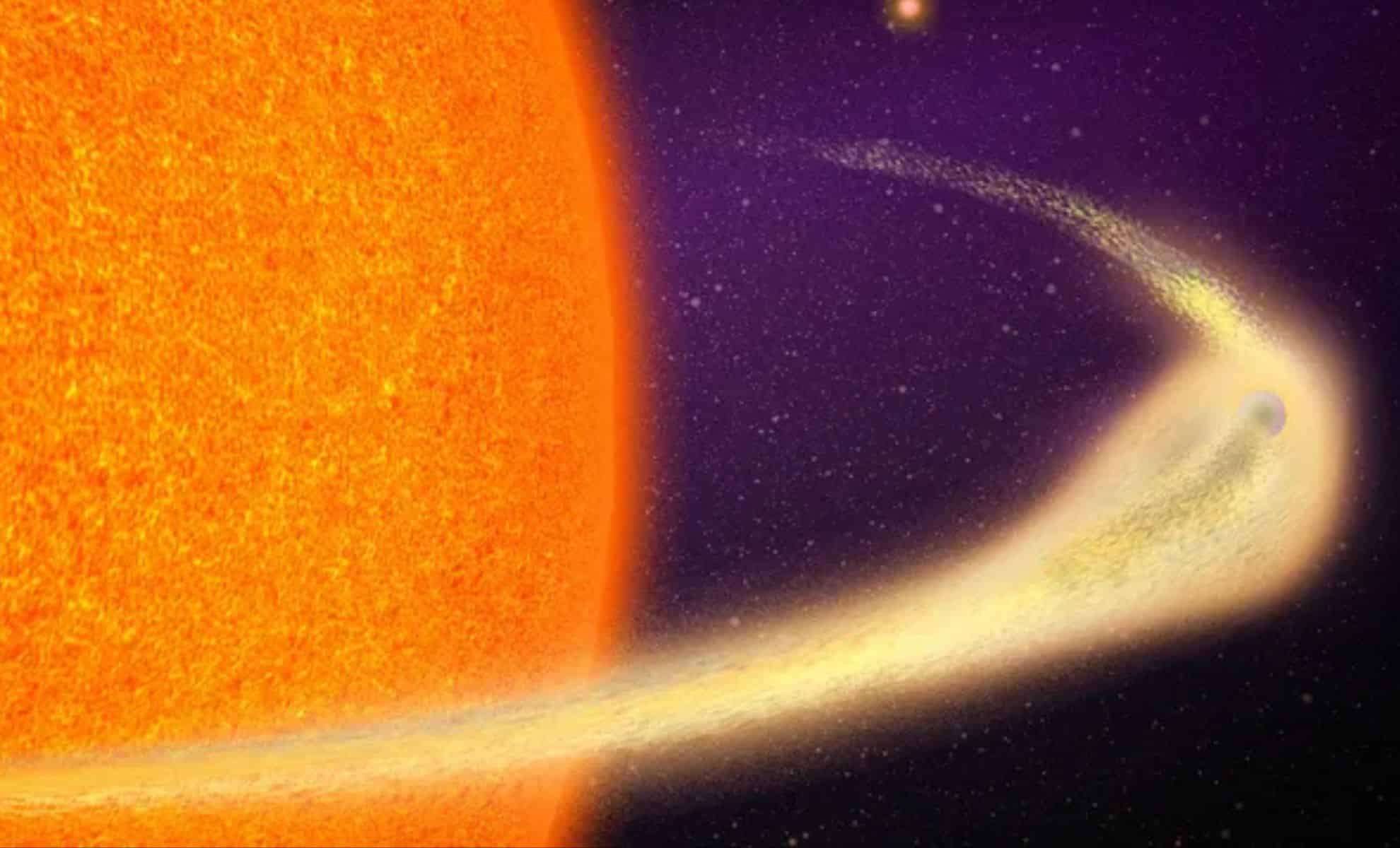
Astronomers have identified a catastrophic planetary event where a distant world is rapidly losing mass—equivalent to Mount Everest every orbit—according to Space.com. The exoplanet, designated BD+05 4868 Ab, lies approximately 140 light-years away in the constellation Pegasus. It whips around its star every 30.5 hours at such a close distance that its surface melts into magma, vaporizing and ejecting material into space. This process leaves behind a luminous, comet-like tail composed of molten rock, providing a rare glimpse at a planet in its death throes.
The scale of the trailing debris is particularly striking. Marc Hon, a postdoctoral researcher at MIT’s Kavli Institute for Astrophysics and Space Research, remarks, “The tail reaches an immense length of up to 9 million kilometers, nearly half of the planet’s orbital path.” The planet is losing mass so rapidly that scientists estimate it will vanish completely within one to two million years. Avi Shporer, a contributor to the research, describes it as being close to its "last breath."
A Rare Glimpse of a Dying Exoplanet
BD+05 4868 Ab joins a rare category of exoplanets known to be disintegrating. Out of the over 6,000 exoplanets discovered, only a handful show signs of such extreme loss. While all these planets exhibit comet-like tails, BD+05 4868 Ab stands apart due to the unprecedented magnitude and speed of its mass loss. The planet’s tail is notably the longest recorded among these disintegrating worlds, indicating the catastrophic scale of its evaporation. The extreme proximity to its star causes the surface rock to vaporize rapidly, releasing molten material into space and offering scientists a remarkable opportunity to study a planet's final lifecycle phase.

The Unique Comet-Like Tail: Insight into Planetary Demise
The expelled material forms a striking comet-like tail, yet differs from traditional comet tails composed mainly of volatile gases and ices. Instead, this tail consists of mineral particles vaporized from the planet’s molten surface, which persist long enough in space to be detected by Earth’s telescopes. As Marc Hon explains, “The transit shape resembles a comet’s long tail, but unlike typical comets, the tail here lacks volatile gases and ice.”
This remarkable phenomenon was uncovered utilizing data from NASA’s Transiting Exoplanet Survey Satellite (TESS), which noted irregular transit patterns as the planet crossed in front of its star. This unusual observation prompted further study, leading to the revelation of the planet’s rapid mass loss. The extensive tail and rapid material shedding make BD+05 4868 Ab an excellent subject for future investigation, particularly with the capabilities of NASA’s James Webb Space Telescope (JWST), which can detect subtle starlight variations and analyze the composition of the planet’s vaporized remnants.
The Role of Low Gravity in Planetary Disintegration
Experts suggest the exoplanet’s small size plays a significant role in its quick evaporation. Dr. Avi Shporer notes, “This tiny body, sized between Mercury and the moon, has weak gravity, making it easy to lose mass. As it sheds more material, its gravitational pull weakens further, accelerating mass loss.” This feedback loop results in a runaway effect hastening the planet’s destruction.
This discovery sheds light on planetary lifespans under extreme stellar conditions. Studying BD+05 4868 Ab helps researchers understand how mass and gravity influence a planet's survival odds. Its rapid disintegration offers a vivid example of how intense heat and stellar forces can ultimately obliterate a close-orbiting planet.
- Categories:
- News







0 comments
Sign in to Comment