
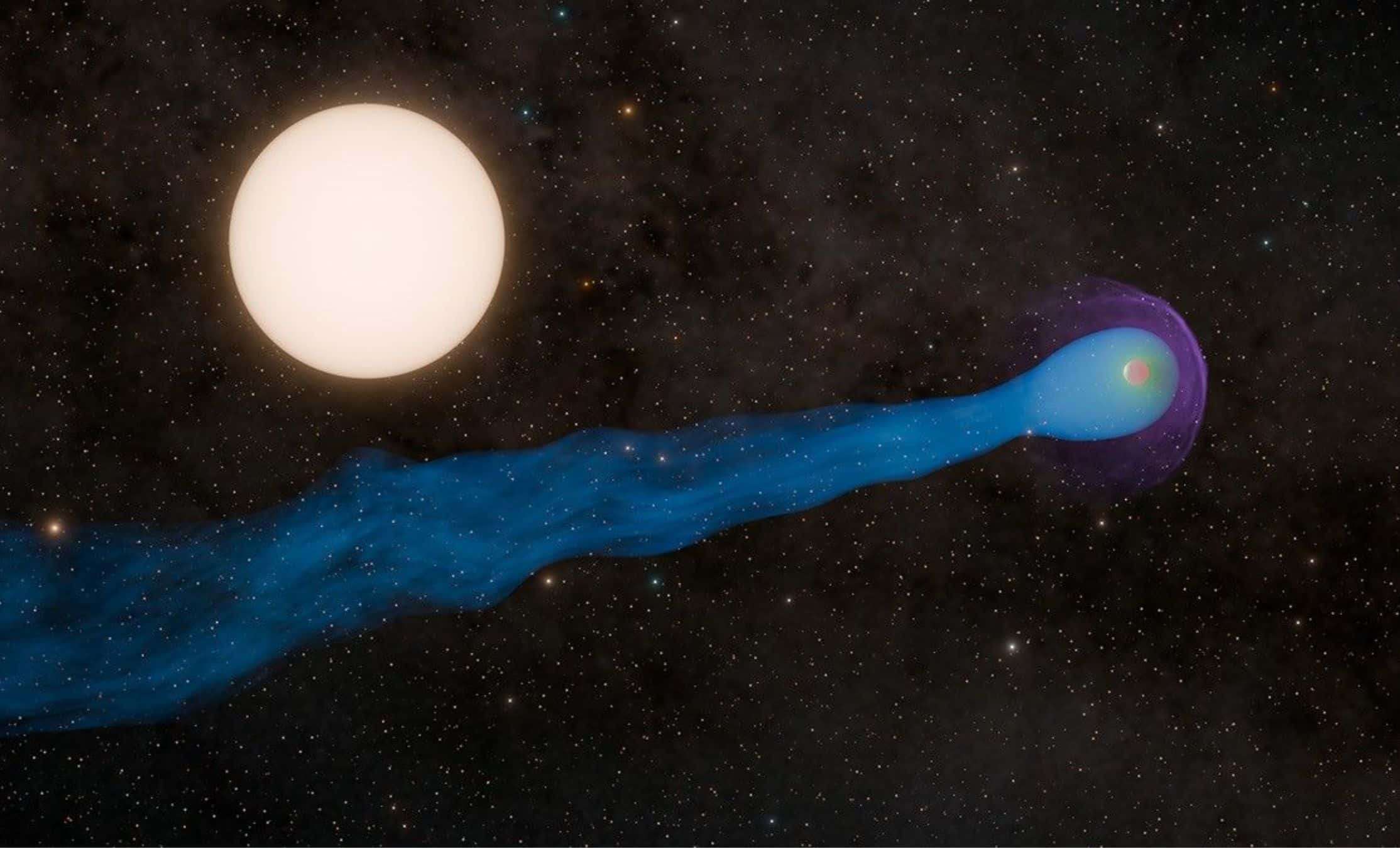
Astronomers have identified a stunning celestial event that challenges current views on planetary behavior. The gas giant WASP-69 b, situated about 163 light-years away, exhibits a remarkable comet-style tail formed from gases escaping its atmosphere. This captivating tail arises from vigorous stellar winds streaming from its parent star, providing a rare chance to explore how stars impact the evolution of orbiting planets.
WASP-69 b: A Gas Giant Shaped by Stellar Winds
WASP-69 b is categorized as a hot Jupiter, a gas giant that orbits very close to its star. Such close proximity exposes it to intense stellar radiation, triggering a process called photoevaporation where lighter atmospheric particles like hydrogen and helium are lost to space. Uniquely, the escaping gases interact with the powerful stellar wind emitted by the star, sculpting a glowing, extended tail behind the planet.
The tail stretches over 350,000 miles, more than seven times the planet’s radius. Lead author Dakotah Tyler of UCLA compares this feature to a comet’s tail, emphasizing how stellar winds actively mold the planet’s atmospheric outflow into this awe-inspiring shape.

Ever-Changing Shape of the Planetary Tail
The tail of WASP-69 b is dynamic, fluctuating with variations in the host star’s wind intensity. When stellar winds grow stronger, the tail becomes long and well-defined. If the winds weaken, the escaping gases spread evenly around the planet, losing the distinctive tail formation.
“If the stellar wind diminishes, then although the atmosphere is still escaping, it doesn't form a tail,” Tyler states. “Without the wind, the gas disperses symmetrically, but increasing wind strength sculpts it into a narrow tail.”
Tyler likens this to a windsock billowing more dramatically when the wind picks up—the tail responds similarly to the changing stellar gusts, offering scientists a live glimpse into atmospheric escape processes influenced by stellar forces.
Continuous Atmospheric Escape Over Billions of Years
WASP-69 b steadily loses about 200,000 tons of atmospheric gas every second. Despite this impressive rate, the process extends over immense timescales, leaving the planet’s core intact. Throughout its approximate 7-billion-year lifespan, the planet has shed gas equal in mass to about seven Earths. This resilience highlights the robustness of gas giants even under such intense stellar conditions.
The gradual atmospheric erosion reveals how external stellar influences gradually transform planets over billions of years, showcasing the delicate balance within evolving planetary systems.
New Perspectives on Star-Planet Interactions
The revealing tail on WASP-69 b acts as a beacon for scientists studying how stars and planets interact. Illuminated by the stellar radiation, the tail provides a natural marker to track stellar winds and deepen our understanding of their role in shaping planetary environments.
Studying such planetary tails could also enhance research into exoplanet habitability by improving models of atmospheric retention and loss under varying stellar activities. This insight is pivotal for assessing the potential for life on worlds orbiting diverse stars.
A Breakthrough in the Study of Exoplanets
The pioneering observations of WASP-69 b were detailed earlier this year in The Astrophysical Journal, led by Dakotah Tyler. Employing advanced spectroscopy with Keck/NIRSPEC, the team captured unprecedented details of the planet’s extensive tail. Their research elevates our understanding of atmospheric dynamics and star-planet relationships, paving the way for future explorations of exoplanetary atmospheres.
“This finding vividly illustrates how cosmic forces can reshape planets in surprising ways,” Tyler commented. “WASP-69 b tells a compelling story of planetary transformation driven by the persistent, shifting winds of its star.”
- Categories:
- News










0 comments
Sign in to Comment