
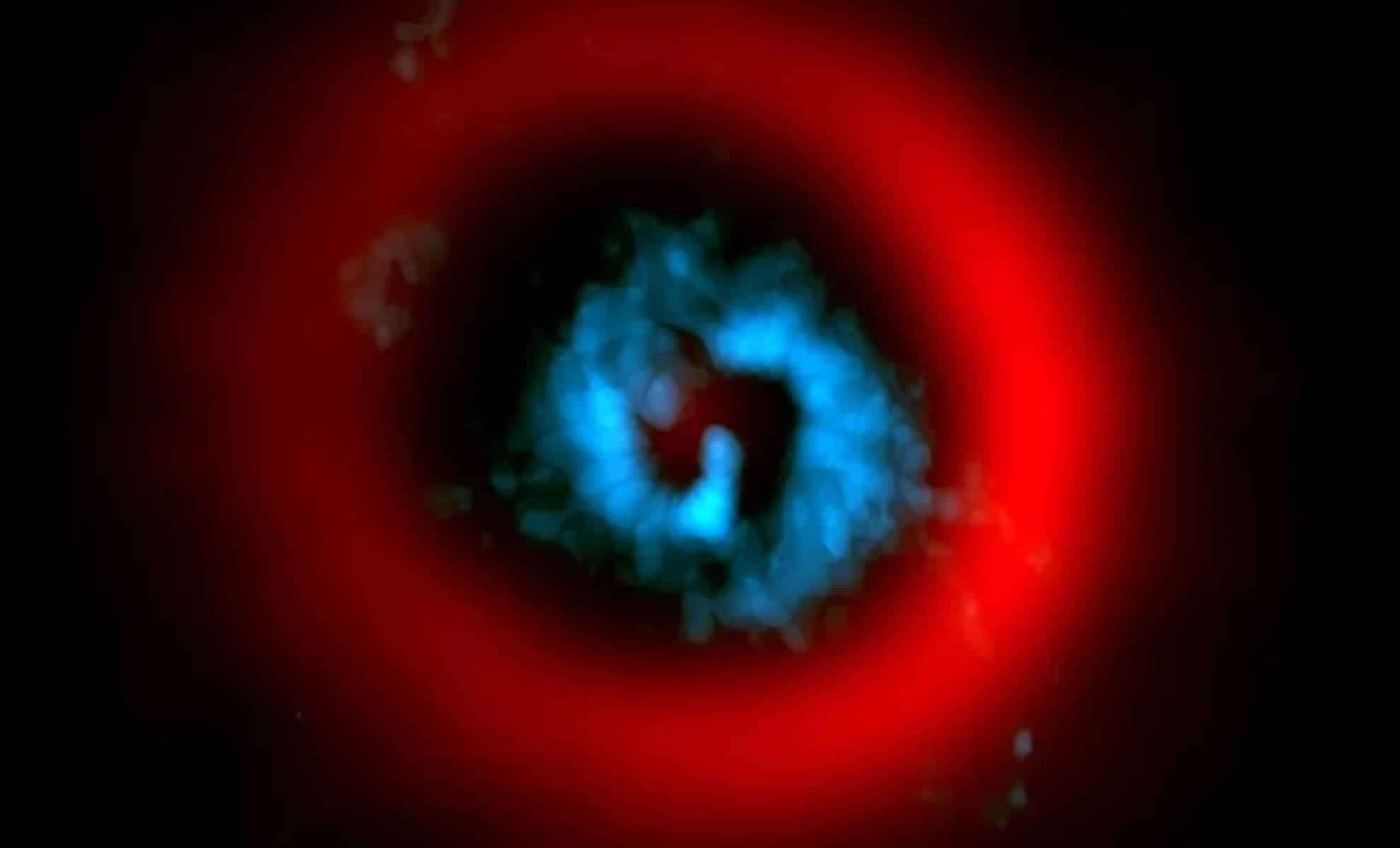
A global team of astronomers has gathered what might be the most convincing real-time observation of a planet forming. This discovery focuses on a nascent protoplanet named AB Aurigae b, still enveloped within the dense gas and dust encircling its young star about 531 light-years from Earth.
Captured using the Very Large Telescope (VLT) in Chile, as reported by Live Science, this finding offers an unparalleled glimpse of a planet in the midst of formation, actively gathering material from its surroundings.
Observations Reveal a Planet Still in Growth Phase
The protoplanet AB Aurigae b orbits a youthful star in the Auriga constellation, approximately 531 light-years away. What stands out is not only its youth but the fact that it remains in a growth stage, embedded in the protoplanetary disk rich with gas and dust from which it continues to draw mass.

Utilizing the MUSE spectrograph on the Very Large Telescope (VLT), scientists at the Astrobiology Center in Japan detected a hydrogen alpha emission, a light signature produced when hot gas accretes onto a massive body.
The spectral data revealed an “inverse P Cygni profile” with blue-shifted light signaling gas infall at about 100 kilometers per second towards the planet, alongside red-shifted absorption indicating gas outflow at near 75 kilometers per second. This pattern serves as direct proof of active accretion — a rare and detailed observation.
Deep Within Its Birth Cloud
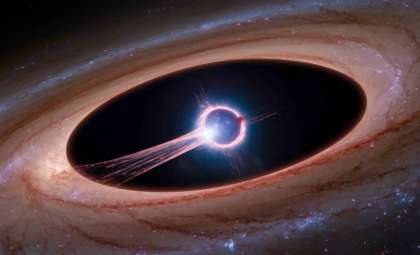
The protoplanet AB Aurigae b remains enshrouded by the thick cloud of its natal disk, offering astronomers a rare view of both the developing planet and the surrounding inflowing material feeding it.
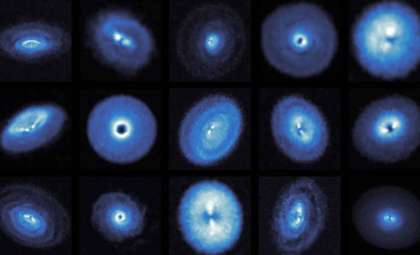
Observations combining the capabilities of ALMA and the Subaru Telescope revealed intricate spiral formations of gas and dust around the planet, embedded within these structures. Such features are indicative of the turbulent processes shaping massive planets like Jupiter during their birth.
With an estimated age of just 2 million years, the AB Aurigae system is extremely young by cosmic standards. Catching a planet forming at this stage provides scientists critical insight into the earliest growth of gas giants, typically obscured in older planetary systems.
Reexamining How Massive Gas Planets Form
The distant orbit of AB Aurigae b presents a conundrum. Positioned far from its star, current planet formation theories face challenges in explaining its formation. The classical core accretion model proposes slow planet growth through particle accumulation over millions of years, an inefficient mechanism in the outer, material-poor regions of a stellar system.
Researchers propose that AB Aurigae b formed via gravitational instability—a rapid process where a dense section of the gas disk collapses under its own gravity, forming a planet swiftly. This scenario aligns better with observed conditions and could clarify how other massive exoplanets exist at great distances from their stars.
Although these findings are promising, they mark only a first step. Upcoming investigations will focus on quantifying the fraction of hydrogen emission genuinely emanating from the planet rather than ambient reprocessed light.
- Categories:
- Space


0 comments
Sign in to Comment