
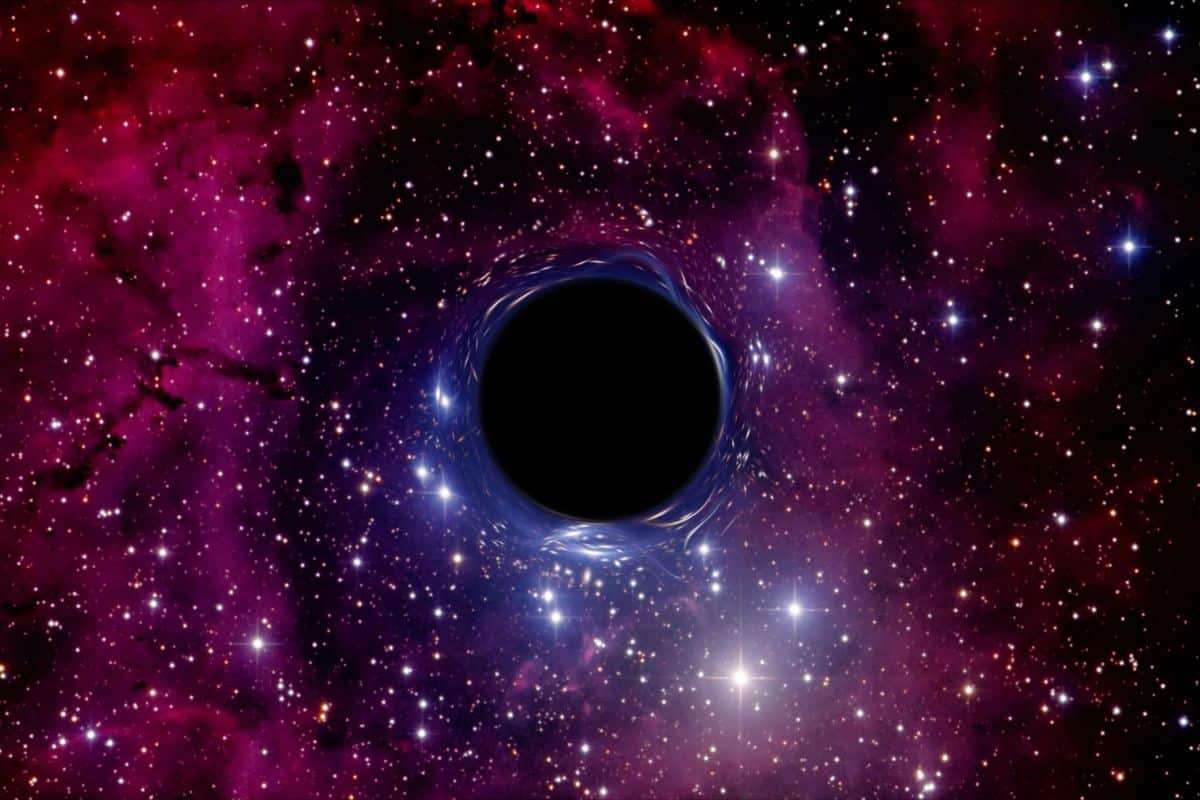
A groundbreaking observation has unveiled an ultra-massive black hole (UMBH) with a mass of approximately 36 billion solar masses, challenging existing theories on galaxy evolution.
This colossal black hole resides in the Cosmic Horseshoe, a gravitational lensing system situated about 5.5 billion light-years away, ranking it among the most massive black holes ever detected.
Its presence provokes important questions regarding the formation, growth, and galactic impact of such giant black holes.

The Cosmic Horseshoe: An Astounding Gravitational Lens
The Cosmic Horseshoe, discovered in 2007, is famed for its striking gravitational lensing, where the gravity of a massive foreground galaxy bends and amplifies the light from a more distant galaxy behind it.
The foreground galaxy, called LRG 3-757, is not only incredibly massive—about 100 times the mass of our Milky Way—but also hosts one of the most massive black holes ever identified.
Scientists determined the black hole’s size by examining the warping effect it has on light traveling near LRG 3-757, revealing a gravitational pull far beyond typical expectations.
The black hole surpasses the scale of many known supermassive black holes, including the one at the center of the Milky Way Galaxy.
A Black Hole That Breaks the Mold
Usually, black hole masses correlate with their host galaxies’ central star velocities, a relationship known as the MBH-sigma relation.
Yet, LRG 3-757’s colossal black hole defies this pattern, being much more massive than anticipated, implying it may have grown through alternative mechanisms.
Principal investigator Carlos Melo-Carneiro from Universidade Federal do Rio Grande do Sul remarked that such a discovery invites a reevaluation of how black holes and galaxies evolve together over cosmic time.
Could Galactic Collisions Have Forged This Titan?
One theory proposes that LRG 3-757 is part of an ancient fossil galaxy group, where smaller galaxies have been absorbed by a dominant central galaxy.
This “galactic cannibalism” could have gradually built up an exceptionally massive black hole across eons.
Alternatively, major mergers of large galaxies may have fueled this black hole’s extraordinary growth, as their central black holes collide and coalesce.
Such events can scatter outer stars into intergalactic space, while the black hole at the core continues expanding. The absence of ongoing star formation in LRG 3-757, commonly labeled as a “red and dead” galaxy, lends support to this scenario.
In addition, processes like active galactic nucleus (AGN) feedback, where energetic jets from black holes disrupt star formation, may have influenced this galaxy’s evolution.
Next-generation Observatories May Unlock More Mysteries
The identification of this 36-billion-solar-mass black hole marks only the beginning of new insights.
Future facilities, including the Extremely Large Telescope (ELT) and the Euclid space telescope, will enable detailed studies of galactic dynamics and black hole growth.
These upcoming missions promise to reveal whether LRG 3-757’s massive black hole emerged naturally or is the result of extraordinary cosmic phenomena. Euclid is expected to find hundreds of thousands of new gravitational lenses over the next five years, greatly expanding our understanding of the universe.
- Categories:
- Space





0 comments
Sign in to Comment