

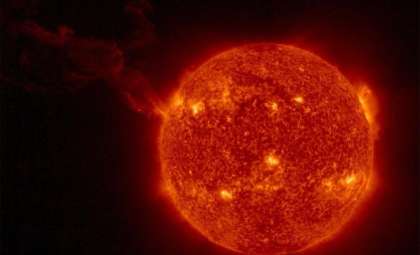
Meteorologists are keeping a close watch on sunspot region #3697, which recently sparked a breathtaking aurora spectacle visible throughout the United States.
In the wake of this event, the National Oceanic and Atmospheric Administration (NOAA) has released an alert about an ongoing “strong” Proton Event, a type of solar storm that may once more enable seeing the northern lights across various parts of the US this week.
This surge in solar activity is tied to Solar Cycle 25 reaching its apex, known as the “solar maximum,” a phase distinguished by heightened activity in the sun’s magnetic field and increased occurrences of sunspots and solar flares.

The ramifications of this active period extend beyond visual spectacles; space weather fluctuations can disrupt satellites, GPS, and electrical grids on Earth. The potential for auroras visible on Earth serves as a striking reminder of our planet’s link to solar dynamics. For more details, see northern lights viewing locations worldwide.
Where the Northern Lights Might Appear in the US
The notable sunspot region #3697 is still prominent and observable from our planet, offering a rare chance to see the aurora borealis. This sunspot stands out due to its vast size and complex magnetic properties, making it capable of generating powerful solar flares and coronal mass ejections (CMEs).
These CMEs play a vital role in creating auroras by releasing charged particles that interact with Earth’s magnetic field and upper atmosphere, producing the glowing light displays. Bryan Brasher, a project manager at NOAA’s Space Weather Prediction Center, confirms that region #3697 remains active and may trigger aurora-friendly conditions.

Forecasts suggest that Sunday and Monday nights could offer opportunities to view the northern lights near the Canadian border and in states such as Montana, Washington, Idaho, Minnesota, Michigan, and the Dakotas. Additionally, the northernmost regions of Maine and New York may also witness this natural light show. The broad potential visibility illustrates the sun’s powerful influence and its complex interaction with Earth.
Best Times and Places to Catch the Aurora
For optimal aurora observing, the hours between 10 PM and 2 AM provide the greatest chance, with peak brightness around midnight. It’s crucial to choose locations away from urban light pollution to enjoy the clearest sights.
Since the auroras can be unpredictable—appearing abruptly and varying in intensity—viewers should consider factors like weather, geography, and the strength of solar activity. Clear skies are essential, so checking weather forecasts ahead of time is highly recommended.
Helpful resources such as aurora tracking apps and websites offer real-time updates and alerts, enhancing the chance to catch these spectacular lights. Observing the aurora not only mesmerizes but also deepens our understanding of solar-terrestrial relationships and their cosmic significance.
Recent Events and What Lies Ahead
The last significant geomagnetic storm in May produced a rare aurora visible across all 50 states, an event unmatched since January 2005. This solar event involved an intense plasma eruption capable of affecting satellites and communications.
NOAA categorized the storm as “severe,” emphasizing the potential for serious disruptions, although no major problems were reported. This occurrence highlighted the critical importance of monitoring space weather and its possible effects on technology and infrastructure.
As Solar Cycle 25 moves toward its expected peak in July 2025, such geomagnetic storms are anticipated to continue. This sunspot cycle, approximately 11 years long, dictates the frequency and strength of solar activity, thereby influencing aurora visibility.
While increased solar activity promises more chances to witness auroras, it also demands ongoing vigilance to protect technological systems from adverse space weather impacts. Continued research and forecasting efforts are essential for balancing the enjoyment of these natural displays with safety considerations.
Growing Public Fascination and Scientific Communication
Last month saw a surge in public interest regarding the northern lights, with search activity reaching unprecedented levels. The widespread aurora visibility stirred excitement and drew attention to these remarkable natural phenomena.
Data from Space.com revealed that searches for “northern lights” were eight times higher in May than any previous record on Google. This trend indicates a growing enthusiasm for understanding and witnessing natural cosmic events.
The opportunity to experience the northern lights offers a tangible link between solar activity and Earth’s atmospheric response, delivering both an educational and awe-inspiring moment. As solar activity remains elevated, scientists and forecasters continue to provide updates so enthusiasts can prepare for upcoming displays.
Effective science communication plays a key role by translating complex solar and atmospheric science into accessible knowledge, fostering public awareness and participation. Staying informed enables people to appreciate the wonder of these cosmic light shows while grasping their broader scientific relevance.





0 comments
Sign in to Comment