

Jeff Bezos’ space venture, Blue Origin, has revealed an extensive initiative to launch a vast satellite system dubbed TeraWave. This network will include 5,400 satellites encircling the planet, aiming to provide lightning-fast and highly secure internet services tailored for enterprise and government sectors. Deployment is slated to begin near the end of 2027, positioning Blue Origin as a formidable rival to SpaceX’s Starlink and Amazon’s Project Kuiper.
Envisioning TeraWave: Crafting the Future of Space Connectivity
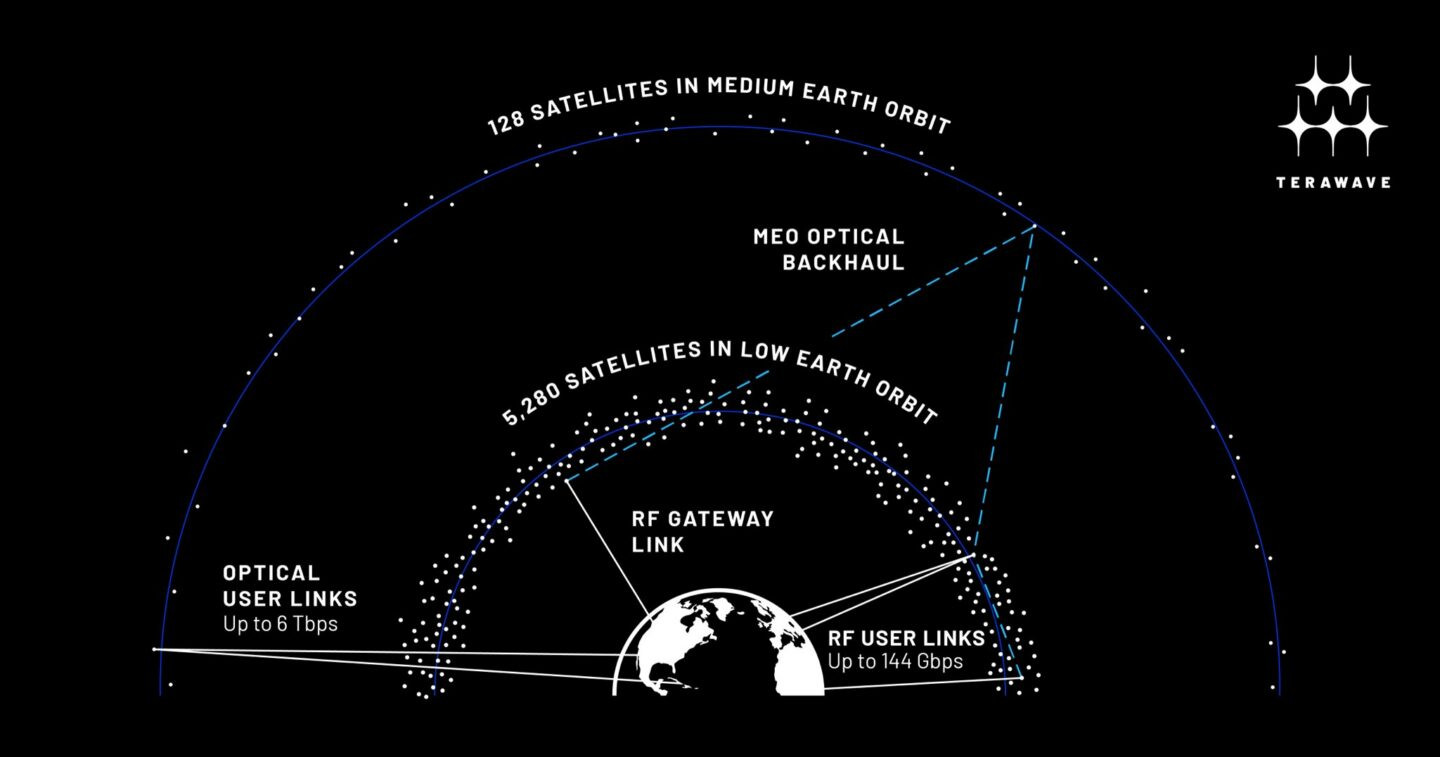
The backbone of Blue Origin’s strategy involves a sophisticated technological advancement. The TeraWave constellation will consist of 5,280 low Earth orbit (LEO) satellites alongside 128 medium Earth orbit (MEO) satellites, combining radio frequency (RF) and laser communication technologies. This dual-orbit setup aims to provide exceptional reliability and unprecedented data capacities.
In an official statement from Blue Origin,

“This network will service tens of thousands of enterprise, data center and government users who require reliable connectivity for critical operations.”
Blue Origin stresses that TeraWave is engineered not for consumer internet but for high-capacity professional and institutional uses, delivering speeds up to 144 gigabits per second for individuals in LEO, and reaching up to 6 terabits per second through specialized optical MEO channels.
The global reach and flexible scalability of this system make it especially valuable for sectors like defense, finance, and energy, where uninterrupted, high-speed communication is essential. In an increasingly congested orbital environment dominated by megaconstellations, Blue Origin’s focus on enterprise-level services represents a strategic departure from consumer-focused satellite internet solutions.
Enterprise Connectivity Takes Center Stage
Unlike rivals aiming at residential users, Blue Origin’s TeraWave prioritizes infrastructure for business and government clientele. This refined approach could secure a distinctive position within the satellite communications industry. According to Blue Origin’s release,
“TeraWave addresses the unmet needs of customers who are seeking higher throughput, symmetrical upload/download speeds, more redundancy and rapid scalability. It enables customers to choose throughput and physical presence in response to changes in their needs.”
The Washington-based team envisions TeraWave as a dynamic platform adaptable to evolving global client demands. This will allow users to flexibly expand or reduce their bandwidth consumption according to operational shifts, surpassing the limitations typical of traditional fiber networks.
Blue Origin confirmed that work on the satellite fleet and network infrastructure will commence in late 2027, heralding what could become one of the most sophisticated orbital communication systems ever created. While Starlink holds the lead in satellite quantity, Blue Origin aims to distinguish itself with enhanced security, redundancy, and bandwidth — features tailored for government and corporate sectors.
The Cosmic Contest for Data Supremacy
The surge in megaconstellations is reshaping global communication paradigms. Operational Starlink satellites exceed 9,500, Amazon’s Kuiper project targets 3,200 satellites, and Chinese initiatives like Guowang and Qianfan plan to launch over 13,000. Blue Origin’s TeraWave introduces a new dimension focused on data sovereignty and network governance instead of consumer volume.
By integrating RF with optical communication channels, Blue Origin aims to break conventional data limits, setting new performance standards for global data infrastructure. Experts suggest that successful deployment could position TeraWave as a pioneering orbital network infrastructure, underpinning future interplanetary communications and AI-driven data operations.
Combining advanced technology, a multi-layer orbital design, and a client-centric approach, Blue Origin is establishing TeraWave as a foundational element in the forthcoming era of space-based internet, emphasizing speed alongside strategic control of digital information.
- Categories:
- Space













0 comments
Sign in to Comment