

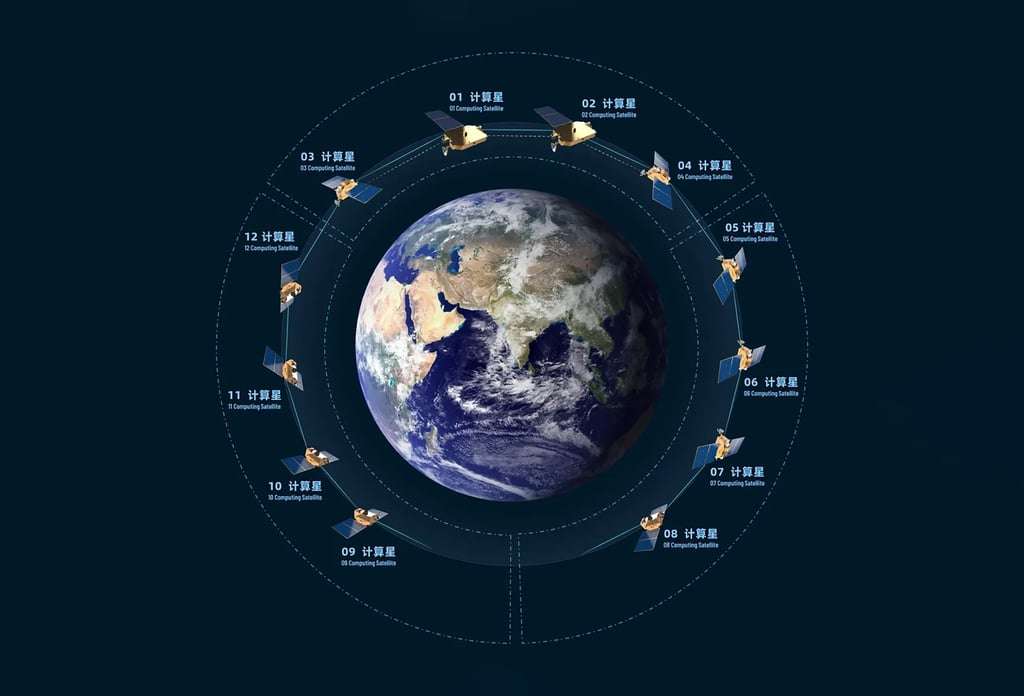
China has embarked on a groundbreaking project to create what it aims to be the planet’s most powerful supercomputer in orbit. On May 14, twelve satellites were successfully launched from the Jiuquan Satellite Launch Center located in the Gobi Desert of northwestern China. This initial batch is part of a much larger plan to deploy a 2,800-unit satellite network designed to perform advanced, space-based data computations fueled by artificial intelligence.
The program, called the Three-Body Computing Constellation, is a collaboration between ADA Space, a Chinese aerospace startup, and the government-backed Zhijiang Laboratory. Each satellite is equipped with a sophisticated AI model containing 8 billion parameters, as detailed by the South China Morning Post. The dozen satellites currently in orbit can collectively execute up to 5 peta operations per second (POPS), with the entire constellation projected to achieve a staggering 1,000 POPS once complete.
To put this in perspective, this equates to performing over a quintillion calculations every second, a scale that either rivals or surpasses the most powerful ground-based supercomputers today.

Innovative In-Orbit Computing Approach
Central to this initiative is a paradigm shift in handling data gathered from space. Typically, satellite data is sent down to Earth for processing, which introduces delays due to limited communication windows and bandwidth constraints. ADA Space and Zhijiang Laboratory are pioneering a model described as “processing in space for space data,” which allows for rapid and efficient computation of large datasets without dependence on terrestrial data centers.
Wang Jian, head of Zhijiang Lab and a member of the Chinese Academy of Engineering, highlighted the critical importance of bringing computational capabilities directly into orbit. “Artificial intelligence should not be held back from space due to limited computing resources,” he stated.
By performing intensive data processing in orbit, China aims to bypass bottlenecks of conventional systems while leveraging the unique environmental features of space such as the natural cooling provided by the space vacuum and constant availability of power from solar energy.
The satellites communicate through advanced laser links supporting data transmission speeds of up to 100 gigabits per second. Each unit offers shared storage capacity of 30 terabytes, forming a complex mesh network in low Earth orbit that operates collectively as a distributed supercomputer.
Diverse Scientific Instruments and Strategic Goals
In addition to their computational power, these satellites are outfitted with a variety of scientific tools. According to ADA Space, their instruments support real-time Earth monitoring, three-dimensional topographical mapping, and detection of cosmic X-ray bursts. These features aim to enhance applications ranging from disaster management to commercial analytics.
ADA Space explained that this system will enable the creation of “digital twins” of terrestrial environments with minimal delay and reduced data transmission costs, benefiting sectors like agriculture and defense. One satellite carries an X-ray polarization detector designed to observe energetic cosmic phenomena such as gamma-ray bursts, illustrating the constellation’s dual mission in both astrophysics and AI-driven tasks.
The project also supports China’s broader industrial ambitions. Insights derived from the satellite data will assist development efforts in areas like the Neijiang high-tech zone in Sichuan province, aiming to establish an ecosystem focused on intelligent satellite data applications. This reflects a clear government strategy to combine satellite technologies and AI on a massive scale, boosting China’s leadership in space infrastructure and digital innovation.
International Cooperation and Future Outlook
Though driven by national interests, Chinese representatives have indicated plans to welcome global collaborations. ADA Space stated, “Guoxing Aerospace looks forward to international partnerships, particularly with nations in the Global South.” They envision developing a “smart, interconnected, low-carbon, globally accessible and sustainable” orbital ecosystem.
At the Beyond Expo conference in Macau, Wang highlighted space as a vital frontier for advancing AI technologies, emphasizing a long-term perspective. “Space has once again opened new horizons for us to consider innovations for the coming decades,” he remarked. The constellation’s name pays homage to The Three-Body Problem, the acclaimed science fiction novel by Chinese writer Liu Cixin, which examines complex gravitational dynamics and interstellar cooperation.
This initiative stands out for both its scale and timing. While other space agencies and private companies in the U.S. and Europe have tested orbital computing concepts, China appears to be the first to pursue a fully operational supercomputing network of this magnitude in orbit.
Simultaneously, ex-Google CEO Eric Schmidt has suggested deploying large-scale orbital data centers through investments in ventures like Relativity Space. Speaking before the U.S. House Committee on Energy and Commerce earlier this year, Schmidt revealed projections estimating that global data centers might consume up to 96 gigawatts of electricity by 2030, underscoring the urgency for new computational strategies.
The launch of the Three-Body Computing Constellation firmly positions China at the forefront of space-based AI development, poised to transform the collection, processing, and utilization of data from orbit. Though the constellation will take years to fully materialize, its initial operational satellites mark a decisive step in the global race to harness orbital computing power.









0 comments
Sign in to Comment