
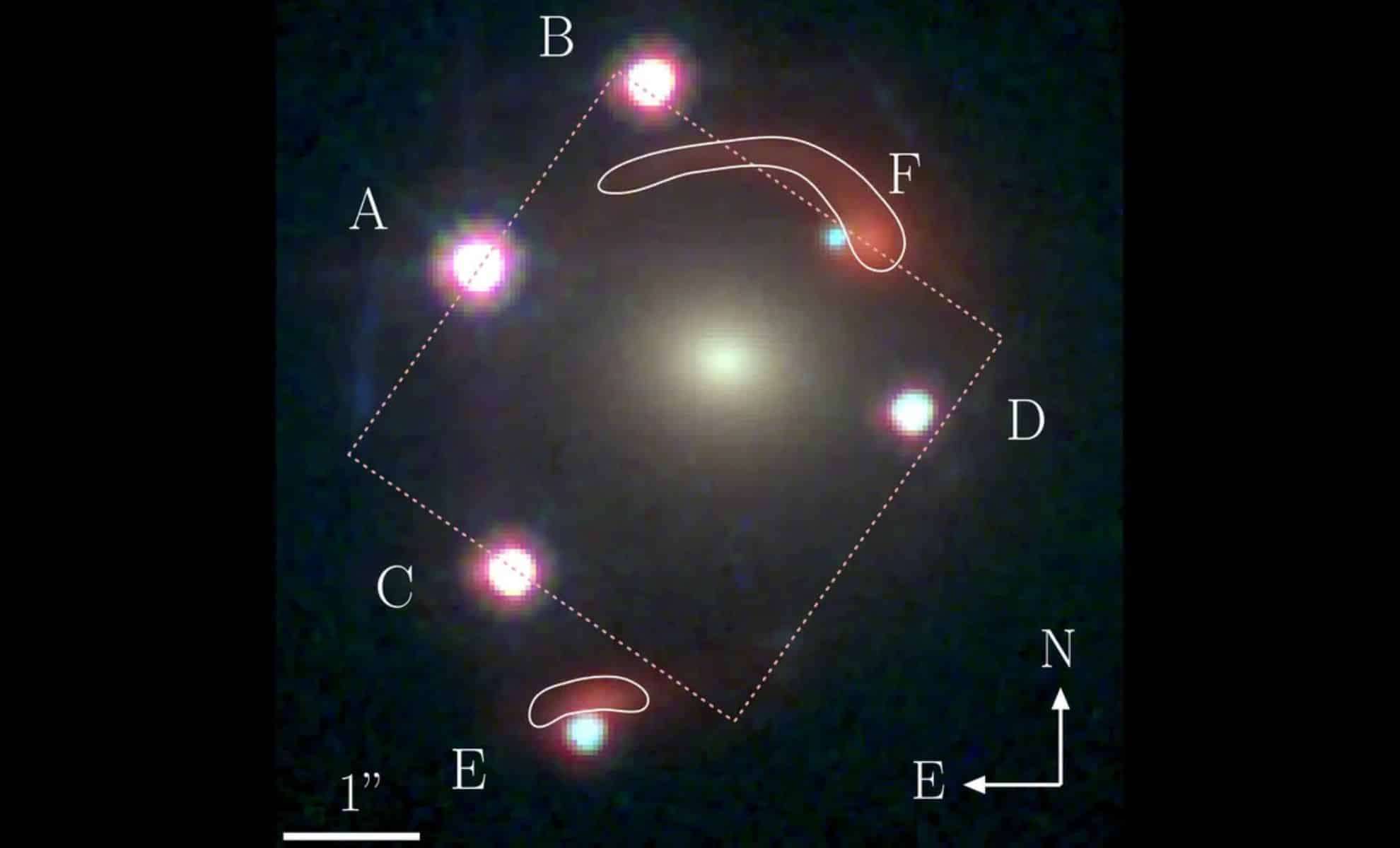
An international team of astronomers has uncovered a unique double gravitational lens system featuring an unusual “zig-zag” light pattern, challenging existing concepts about gravitational lensing and its application in cosmic research. This pioneering finding, dubbed the Einstein zig-zag lens, provides valuable new insights into the farthest reaches of the universe and presents promising opportunities to address the persistent Hubble tension related to how fast the universe is expanding.
Unveiling a Rare Double Gravitational Lens System
The lensing phenomenon named J1721+8842, initially detected in 2017, was originally thought to be a single galaxy distorting light from a distant quasar—an energetic galactic core powered by a supermassive black hole. Following extensive observations with both the Nordic Optical Telescope (NOT) and the James Webb Space Telescope (JWST), researchers have definitively identified it as a dual lensing system.
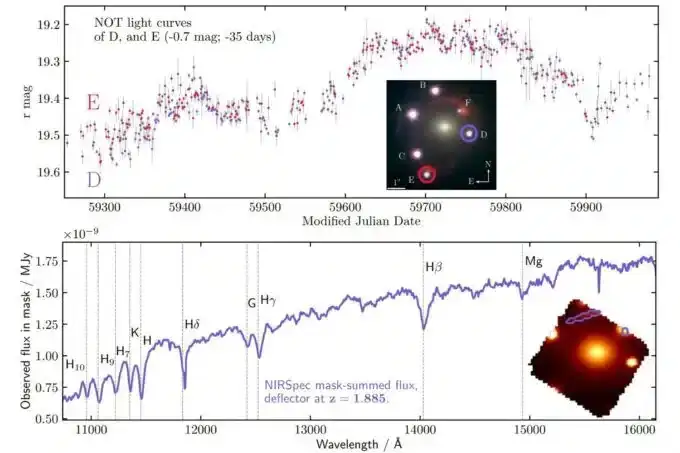
The light emitted by the quasar more than 10.5 billion years ago encounters two massive galaxies aligned along its path to Earth. This configuration causes the light to deflect back and forth—zig-zagging—between the galaxies, resulting in six separate images. The scientists wrote on arXiv, “Our data from the Nordic Optical Telescope's light curves, JWST Near InfraRed Spectrograph’s new redshift assessments, and updated lensing models confirm beyond doubt a single source being affected in J1721+8842.”

This finding marks the inaugural observation of a double gravitational lens. The second lens enhances the primary lens’s magnification and distorts it into arcs detected in the JWST imagery. Known as the Einstein zig-zag lens, this discovery highlights the complex and uncommon nature of gravitational alignments in the cosmos.
Significance of the Breakthrough
According to Einstein’s relativity, gravitational lenses—massive bodies capable of bending light—act as natural magnifying glasses for distant celestial sources like quasars. This enables astronomers to observe otherwise invisible areas of the universe.
The Einstein zig-zag lens is notable for revealing an unprecedented interaction of two precisely aligned galaxies. It presents a valuable chance to improve the accuracy of the Hubble constant, the measure of the universe’s expansion velocity. The team indicated, “Comprehensive lens models, time-delay data, and cosmological constraints from this system will be detailed in upcoming publications,” emphasizing its promise to help resolve current inconsistencies in Hubble constant measurements known as the Hubble tension.
Further, this discovery provides a window into the dark matter makeup inside the lensing galaxies. As reported by IFLScience, the system might also contribute to refining estimates on the universe’s expansion rate—a key debate among cosmologists.
An Exceptionally Uncommon Phenomenon
The Einstein zig-zag lens is an extraordinarily rare cosmic setup, with experts estimating the odds of such an occurrence at just one in 100 million. Light from a quasar situated 10.5 billion light-years away passes through two widely separated galaxies, generating six distinct images through this dual gravitational lensing. This phenomenon offers both stunning visuals and rich scientific data.
Its northern celestial location allows easy monitoring by terrestrial telescopes for continued analysis. Tracking the light’s zig-zag trajectory enables mapping of both visible and dark matter distributions, unveiling deeper knowledge of the unseen forces shaping the cosmos. The rarity of this alignment emphasizes its exceptional value for advancing astrophysical research.
Illuminating the Universe's Complexities
The Einstein zig-zag lens transcends mere novelty—it's a powerful tool for resolving key astrophysical puzzles. This system’s distinct geometry can sharpen measurements of the Hubble constant and expand our understanding of the universe’s accelerated growth. It also sheds light on the elusive dark energy propelling this expansion and the dark matter influencing gravitational lensing effects.
By amplifying the light from this ancient quasar, the lens offers a peek into the early universe, shedding light on galaxy formation and evolutionary processes. “This object promises an abundance of scientific breakthroughs,” the researchers stated, underlining its importance in decoding the universe’s hidden realms. Future investigations will focus on measuring time delays and refining lensing models to extract further revelations from this unique cosmic structure.
- Categories:
- News








0 comments
Sign in to Comment