
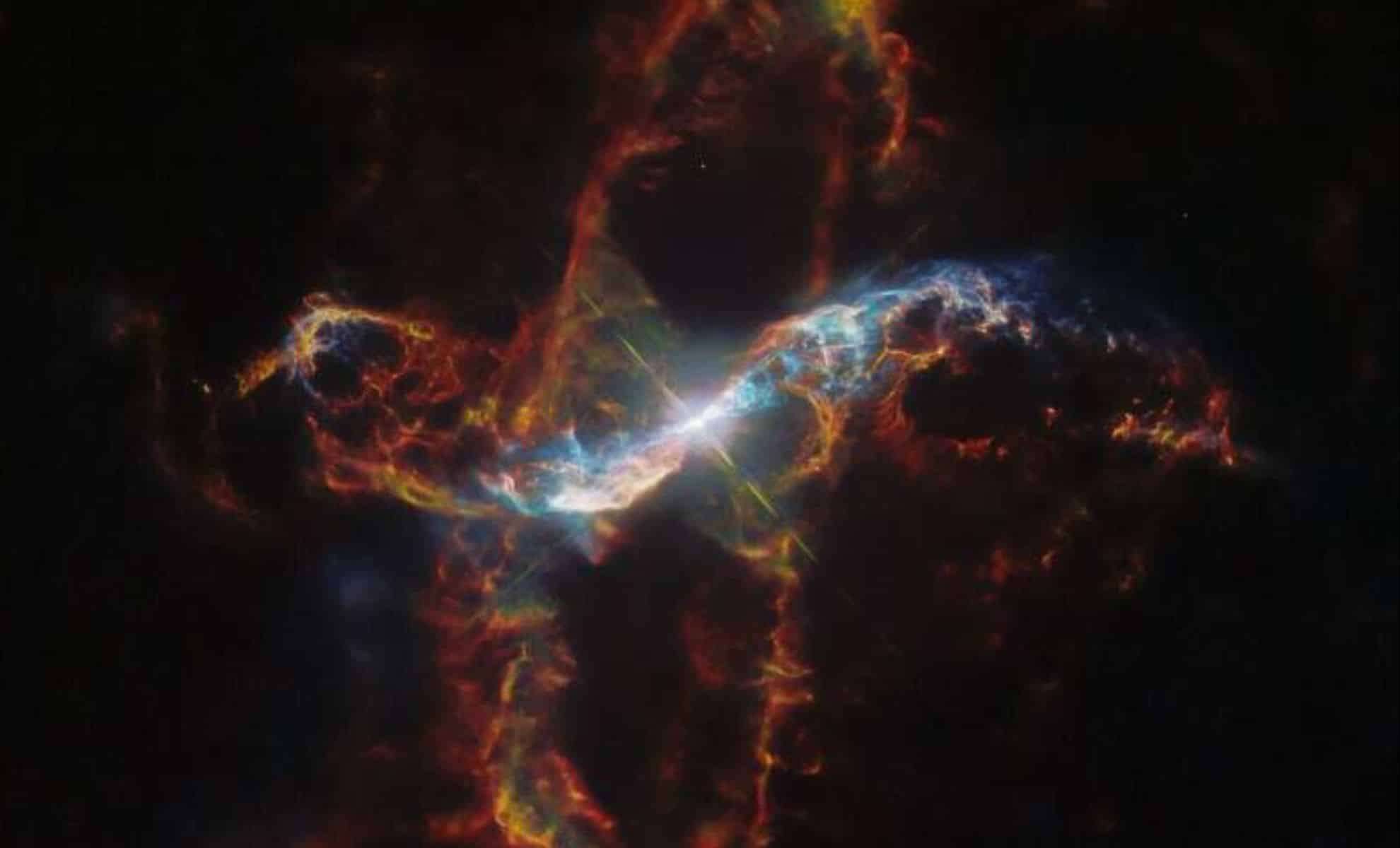
The Hubble Space Telescope has provided breathtaking new visuals of R Aquarii, an extraordinary and intricate symbiotic binary star system positioned roughly 700 light-years away. This remarkable pair, consisting of an aging red giant and a compact yet intense white dwarf, is renowned for its dramatic outbursts that propel vast amounts of gas and plasma into space, sculpting a dynamic and luminous nebula around these stellar companions.
A Tumultuous Pair of Stars
R Aquarii belongs to an uncommon class of celestial phenomena known as symbiotic binary stars, where two very different stars coexist and influence one another. The dominant star is a red giant, a sprawling star nearing the end of its life cycle, shedding its outer layers and forming a surrounding nebula. Its partner is a white dwarf, a dense stellar core left behind after a star has gone through nuclear exhaustion. The interplay between these two stars fuels the remarkable and unpredictable nature of R Aquarii.
The red giant in this system is classified as a Mira variable, characterized by significant brightness changes over a pulsation cycle lasting about 390 days. During this period, its luminosity can swing by a factor of 750, at peak radiance shining nearly 5,000 times brighter than the Sun. These pulsations reflect the complicated internal transformations occurring within the red giant as it approaches the final stages of stellar evolution.

Meanwhile, the white dwarf travels around the red giant in an elongated orbit spanning 44 years. As it nears its colossal companion, it draws in hydrogen gas from the red giant’s outer layers. This material accumulates on the white dwarf’s surface until igniting a powerful thermonuclear explosion. The resulting plasma eruptions blast away at velocities over 1 million miles per hour, producing the intricate filaments and loops of glowing gas captured in Hubble’s recent photography.
Decades of Insight From Hubble
The Hubble Space Telescope has tracked R Aquarii since 1990, assembling comprehensive imagery that chronicles the system’s explosive phenomena over time. The latest observations, from 2014 through 2023, have been compiled into a striking timelapse video by the ESA/Hubble team, illustrating the swift changes in the nebula enveloping R Aquarii. It showcases the luminous gas filaments spiraling outward, shaped by continuous eruptions from the white dwarf.
The timelapse also reveals the pulsating nature of the red giant, its brightness fluctuating as its atmosphere expands and contracts. These variations appear in the characteristic diffraction spikes around the stars in Hubble’s shots, with the red giant’s activity influencing the nebula’s overall glow. The expelled material forms winding trails and loops extending far from the binary pair, tracing pathways along magnetic field lines. The outflow can be followed to distances reaching 400 billion kilometers, roughly 2,500 times the Sun-Earth gap.
Hubble’s observations have further shed light on the Cederblad 211 nebula, a dense cloud of gas and dust encasing R Aquarii. This nebula is thought to be the residue of a previous nova event caused by earlier explosive activity from the white dwarf. The nebula’s intricate structure results from the complex interaction between the stars and is illuminated by the powerful radiation from recurrent white dwarf outbursts, demonstrating the ongoing recycling of stellar material into the cosmos.
The Significance of R Aquarii
Thanks to its frequent eruptions and relative proximity, R Aquarii provides an exceptional opportunity to explore the final evolutionary phases of stars. This system offers a rare observational window into the mechanisms by which stars like the Sun lose mass and enrich the space between stars with essential elements such as carbon, nitrogen, and oxygen. These heavy elements, forged inside stars, play critical roles in planet formation and the emergence of life.
The ferocious bursts from R Aquarii also illuminate the behavior of white dwarfs, which can undergo repeating cycles of matter accumulation and explosive reactions. Understanding these cycles is vital, as they may foreshadow even more intense events like supernovae, which disperse vast quantities of heavy elements throughout galaxies and influence the creation of new stellar systems.
Hubble’s high-resolution images have revolutionized our comprehension of these processes, revealing how the white dwarf’s plasma jets are twisted into a distinctive spiral formation by powerful magnetic forces. The radiant filaments, energized by the binary stars’ radiation, stretch across immense distances, presenting a breathtaking depiction of cosmic energy in motion.
Future Perspectives
Ongoing investigations into R Aquarii remain critical for astronomers striving to decode the intricate workings of symbiotic stars and their complex interactions. Looking ahead, the launch of the James Webb Space Telescope (JWST) promises even more profound insights, with its advanced infrared technology capable of penetrating the dense dust and gas around R Aquarii and unveiling hidden details.
Continued long-term monitoring by Hubble will further illuminate the evolution of this system, providing invaluable data on how the white dwarf and red giant’s relationship changes over time. These observations will enhance stellar evolution models and deepen our knowledge of stellar life cycles.
Through sustained study of R Aquarii and similar binary systems, scientists aim to build a clearer understanding of how such stars contribute to the chemical enrichment of the universe. Although these symbiotic stars are rare, they are key to revealing the cosmic processes that govern star and planet formation and the essential elements for life itself.
- Categories:
- Astronomy ,
- News ,
- Space ,
- Nasa









0 comments
Sign in to Comment