
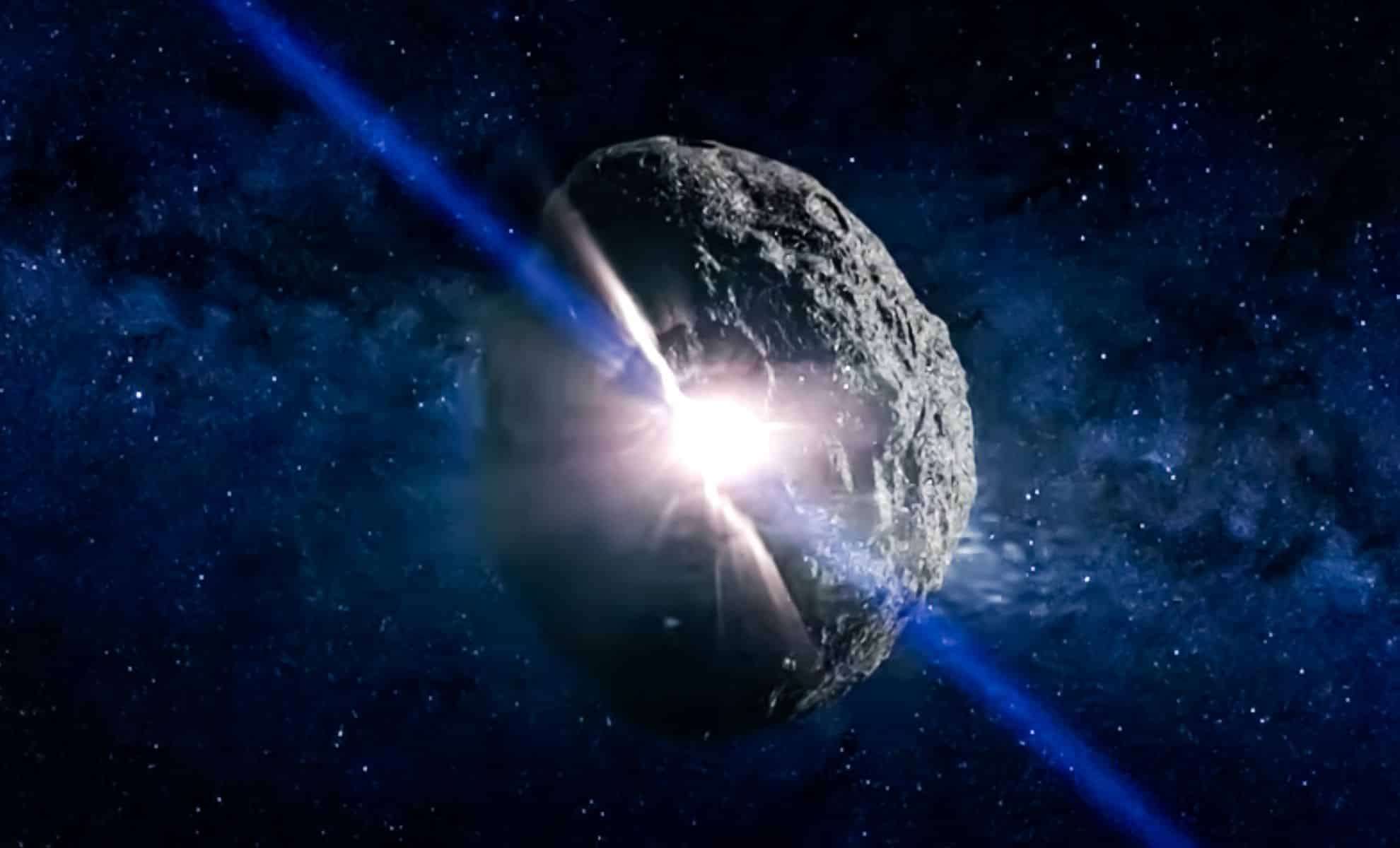
Researchers investigating the basic forces of nature have recently focused on a controversial idea: the possible existence of a fifth fundamental force. A new paper, published in Nature Communications Physics, explores this concept by examining the paths of asteroids to uncover any deviations hinting at this hidden force. The near-Earth asteroid Bennu, extensively monitored, provides a prime test case for this theory. While initial data from Bennu has not yet demonstrated signs of a fifth force, ongoing studies and the anticipated analysis of asteroid Apophis may soon bring clarity to this profound scientific mystery. Here, we review the implications of these investigations and their potential impact on our grasp of cosmic laws.
Reviving the Search for the Fifth Fundamental Force
Since the 1980s, the idea of a fifth force—which would extend beyond gravity, electromagnetism, and the strong and weak nuclear interactions—has intrigued physicists. This concept aims to account for anomalies unexplained by the four known forces. Despite attracting both interest and skepticism, experimental findings have so far been inconclusive. For example, MIT researchers in 1986 proposed a connection between antigravity effects and this unknown force, while the theory of quintessence was introduced in 2000 to offer insights into the nature of dark energy.
Progress continued in 2015 when scientists at the Hungarian Academy of Sciences detected a previously unknown, heavy particle that might be related to this enigmatic force. More recently, in 2023, Fermilab announced they were nearing a breakthrough in this search. Nevertheless, many in the physics community remain cautiously doubtful, emphasizing the necessity for deeper and broader investigations to fully validate or refute the fifth force hypothesis.

How Asteroid Tracking Can Illuminate New Physics
Near-Earth asteroids have served as valuable natural laboratories for astrophysics due to their well-mapped orbits, which allow precise observation for any unexpected variations. Bennu, discovered in 1999, has been studied extensively with data collected through optical telescopes, radar observations, and the OSIRIS-REx spacecraft mission. This comprehensive dataset has enabled scientists to model Bennu’s trajectory with exceptional accuracy.
The key aim is to identify if subtle irregularities in Bennu’s orbit could signify the action of a fifth force. Lead author Yu-Dai Tsai explained, “Analyzing Bennu’s motion allows us to test fundamental physics concepts, offering the potential to challenge or expand the Standard Model, and to deepen our understanding of gravity and dark matter. Unexplained orbital anomalies can be a window into new physics.”
Despite meticulous tracking, Bennu’s data has not revealed definitive evidence for the fifth force to date. However, this does not negate its possible existence, but rather highlights the need for further focused observation. The imminent 2029 close encounter of asteroid Apophis with Earth offers a promising chance to collect higher-precision measurements that could confirm or reject this possibility.
Looking Ahead: Apophis as a Crucial Testbed
The 2029 approach of Apophis, a well-studied asteroid known for its near-Earth trajectory, presents a unique occasion to gather highly accurate tracking data. The upcoming OSIRIS-APEX mission, following the success of OSIRIS-REx, will concentrate on collecting detailed information during Apophis’s flyby, playing a pivotal role in investigating any subtle perturbations potentially caused by a fifth force.
Scientists anticipate that Apophis’s size and unusually close passage will tighten constraints on gravitational anomalies and enhance search efforts for exotic physics. Co-author Sunny Vagnozzi from the University of Trento, Italy, commented, “Our findings underscore the potential of asteroid monitoring in probing ultralight bosons, dark matter, and various proposed extensions to the Standard Model.”
Apophis’s close distance during its Earth flyby will afford an unparalleled opportunity to refine orbital models and detect any deviations from expected physics, advancing our understanding of forces that shape the cosmos.
- Categories:
- News








0 comments
Sign in to Comment