
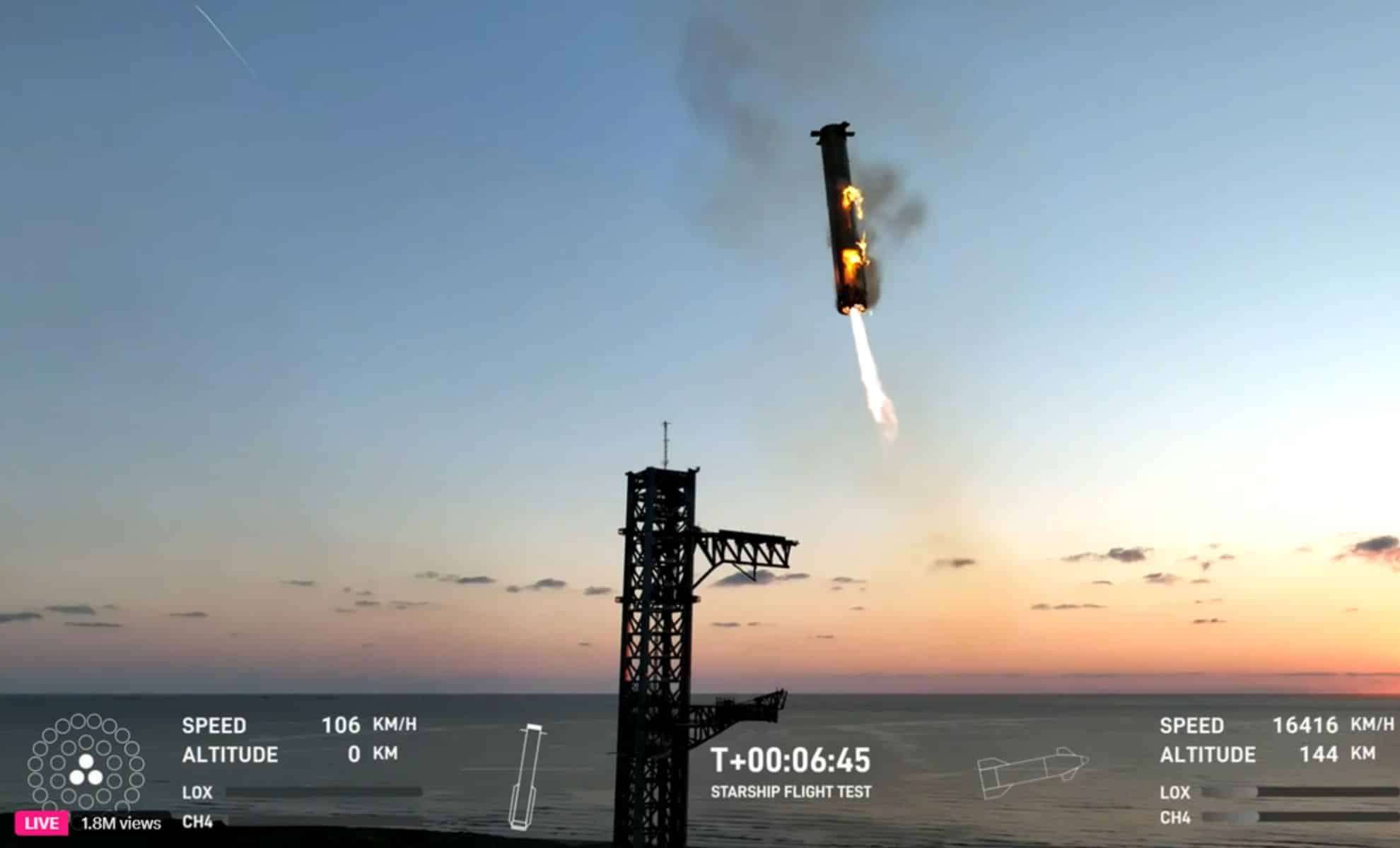
On October 13, 2024, SpaceX reached a groundbreaking achievement by successfully launching and recovering its Starship rocket during its fifth test flight from Starbase, Texas. The mission showcased the company's novel recovery approach for the Super Heavy booster, using the innovative “chopsticks” system—a crucial advancement toward enhanced reusability in spaceflight.
Innovative Advancement in Booster Retrieval
The Starship, the largest and most powerful rocket developed to date, launched at 8:25 a.m. EDT (7:25 a.m. local time), marking its fifth flight in the series of experimental launches. The objective was to demonstrate SpaceX’s cutting-edge technique for retrieving the rocket’s primary stage, the Super Heavy booster. Unlike previous methods where boosters were either abandoned or landed on floating platforms, this mission successfully demonstrated the capture of the booster using robotic “chopstick” arms attached to the launch tower.
Approximately seven minutes post liftoff, the giant booster hovered precisely close to the launch tower, where it was seized by the mechanical arms in what SpaceX described as a “bull’s-eye landing”. Kate Tice, SpaceX’s Quality Systems Engineering manager, conveyed the excitement at the company’s Hawthorne, California headquarters, stating, “This will be remembered as a milestone in engineering history… on the first attempt, we successfully caught the Super Heavy booster right at the tower.” Meanwhile, SpaceX representative Dan Huot called the maneuver “magic” due to the extraordinary precision it required.

Mission Focus on Starship’s Upper Stage
Besides the booster recovery, the flight tested the upper stage of Starship, referred to as Ship. Standing 165 feet (50 meters) tall, this segment was tasked with reaching orbit and then returning safely to Earth, targeting a controlled splashdown in the Indian Ocean. About 65 minutes after liftoff, the upper stage completed its engine burns before tipping and undergoing a managed explosion. Although SpaceX had not set out to recover this section during this test, the operation was nonetheless regarded as a success.
Reflecting the broader significance of the flight, Elon Musk, CEO of SpaceX, posted on Twitter, “Today marked a pivotal step toward becoming a multiplanetary species.” The success of Starship’s flight represents a key development in SpaceX’s ambitions to establish lunar and Martian colonization, alongside revolutionizing reusable rocket technology.
Enhancements and Hurdles in Engineering
This fifth launch featured substantial improvements over earlier tests, notably in the design of the Starship heat shield. SpaceX engineers invested more than 12,000 hours refining the shield, integrating a new generation of thermal protection tiles, a backup ablative layer, and reinforced protection around the vehicle’s flaps. These upgrades are intended to increase the vehicle’s resilience during atmospheric reentry.
The timeline for Flight 5 experienced delays attributed to regulatory review. The U.S. Federal Aviation Administration (FAA) took extra time to evaluate environmental impacts and safety due to adjustments to Starship’s flight trajectory. Though this postponed the test, it ensured that required safety standards were comprehensive.
Prospects for Starship and Space Exploration
The Starship vehicle stands at the core of SpaceX’s long-range strategy for sustainable space travel. Its fully reusable design is crucial for cutting turnaround time and costs between missions. Demonstrating the recovery of the Super Heavy booster at the launch site itself promises to dramatically accelerate readiness for subsequent launches. SpaceX’s iterative testing and upgrades are progressing rapidly to meet its ambitious goal of crewed lunar and Martian expeditions.
SpaceX’s advancements with Starship have attracted NASA’s attention, with the agency selecting the rocket to serve as the first manned lunar lander for the Artemis 3 mission, planned for 2026. This mission will mark humanity’s return to the Moon after five decades, positioning Starship as a vital enabler. The spacecraft’s payload capacity and reusability also make it a promising candidate for deep space voyages beyond the Moon, including future Mars exploration.
The achievement of Flight 5 represents a major leap forward for SpaceX’s vision to transform humanity into a multiplanetary civilization. As development continues, each successful test brings Starship closer to redefining the future of space travel and interplanetary adventure.










0 comments
Sign in to Comment