
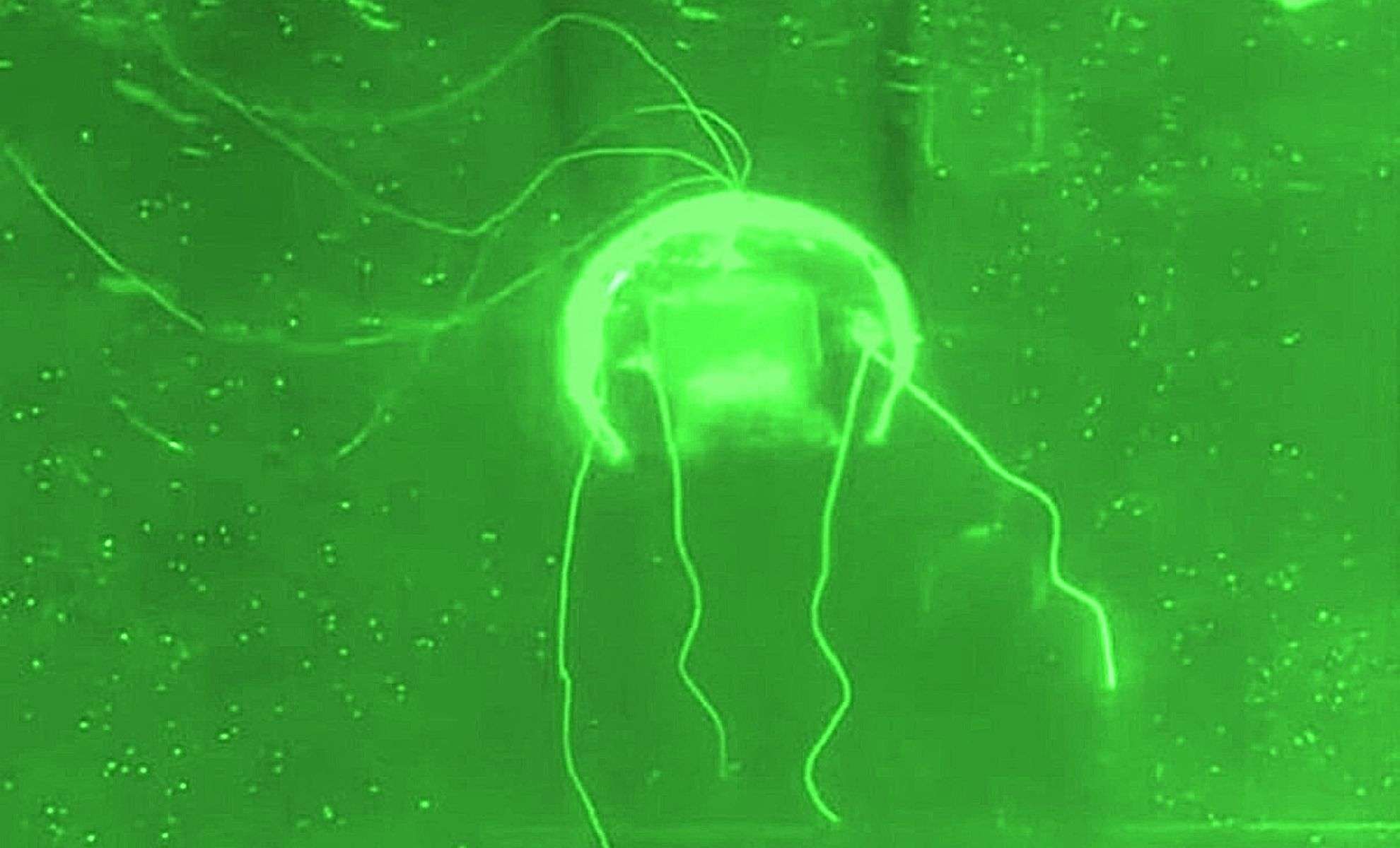
Soft robotics are rapidly emerging as a transformative technology in underwater autonomous exploration, offering innovative solutions where conventional devices fall short—especially in terms of maneuvering efficiently, conserving energy, and remaining undetected in aquatic environments. Recently, researchers in China have developed a remarkable bioinspired robot: a nearly invisible, jellyfish-like device that glides silently, senses its surroundings without sonar, and moves in harmony with ocean currents.
Engineered at Northwestern Polytechnical University in Xi’an, this creation closely replicates a jellyfish’s anatomy and motion through an electrostatic actuator mechanism that mimics muscle contractions. Composed of a custom hydrogel electrode material, its transparent form allows light and water movement to pass through with negligible visual impact. Its propulsion is silent and driven by rhythmic pulses, creating almost no noise, ideal for subtle environmental monitoring or discreet missions in sensitive maritime zones.
With a diameter of just 120 millimeters and tipping the scales under 60 grams, this underwater robot defies conventional expectations for autonomous underwater vehicles (AUVs). It operates without traditional propellers, external motors, or ballast tanks. Instead, it navigates by gently deforming its soft body, enabling smooth, biologically inspired movement that is both energy efficient and mechanically elegant. While similar designs have been explored at places like the Wyss Institute at Harvard and the Korea Advanced Institute of Science and Technology (KAIST), this model ranks among the smallest, AI-enabled jellyfish robots beyond early prototypes.

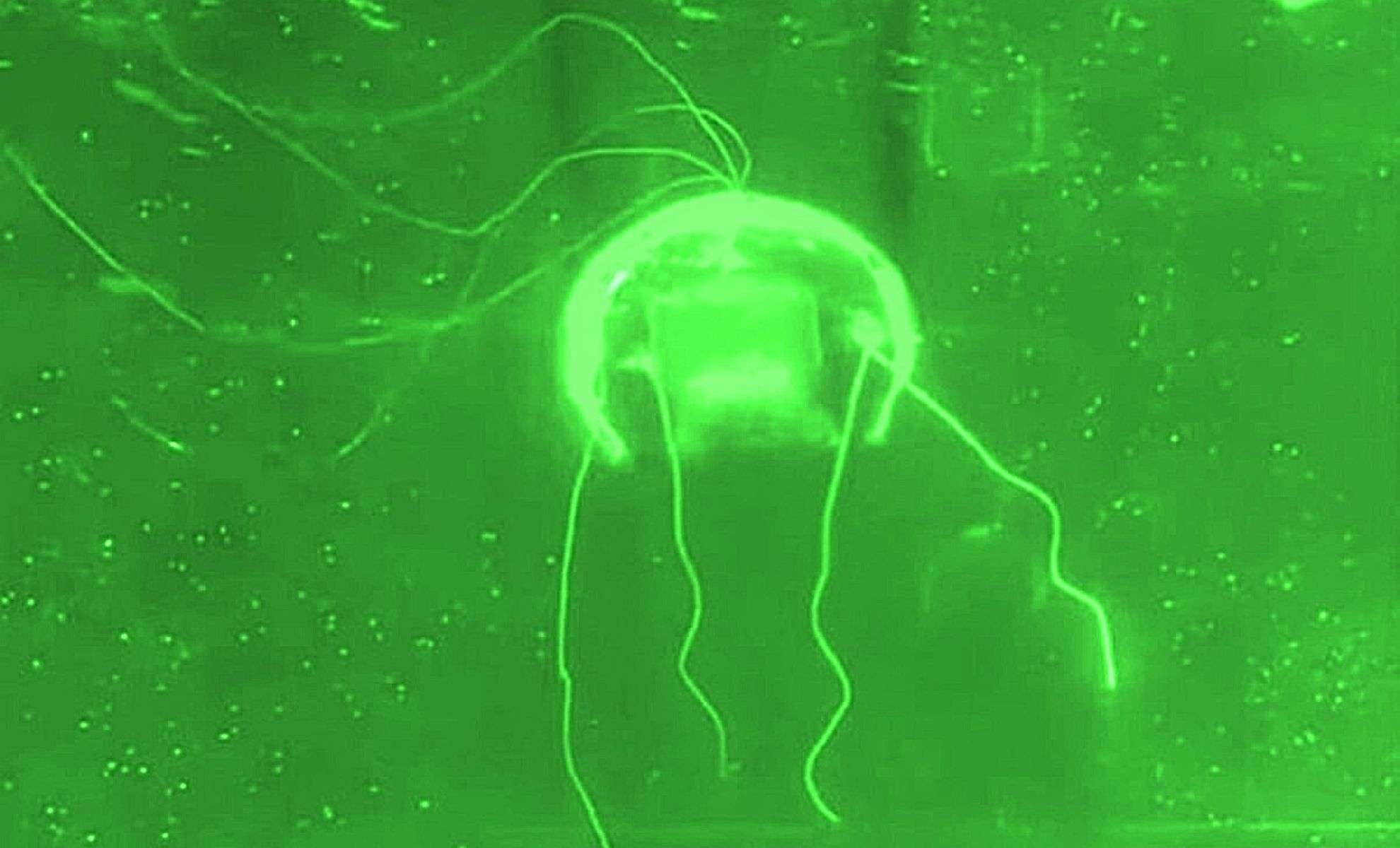
This innovation is more than a proof of concept. Featured on CCTV’s science show, the robot exhibited advanced real-time object recognition, accurately identifying different fish species and academic logos submerged in a tank. It uses an integrated microcamera paired with a lightweight AI processor to analyze visuals instantly, allowing it to navigate and react independently in environments where communication is limited or impossible, such as deep or hazardous waters.
China’s expanding focus on marine biomimicry robotics aligns with worldwide developments in ocean automation and also serves a strategic purpose. Unlike surface drones or satellite monitoring, soft robots operating underwater can unobtrusively inspect subsea infrastructure—like fiber-optic cables, pipelines, and underwater habitats—without triggering alarms or detection by nearby vessels. A 2023 report from the International Institute for Strategic Studies highlights that biologically inspired underwater systems are expected to become vital tools for naval intelligence, particularly in contested zones like the South China Sea.
Although still experimental, the jellyfish robot leverages genuine technological progress. It moves using a low-voltage electrostatic hydraulic actuator, known for producing fluid and continuous motions with low energy usage, as confirmed by a 2022 paper published in Science Robotics, which suggests these actuators enable more natural movement under high pressure or turbulent water than traditional rotary motors.

The research team has enhanced this approach by implementing AI capabilities. As explained in a detailed article from the South China Morning Post, the jellyfish drone runs sophisticated neural networks optimized for visual recognition, enabling it to accurately detect and categorize underwater items in real time. Future upgrades might include modular sensors for tasks such as environmental DNA analysis, monitoring pollution, or exploring submerged archaeological sites, thereby broadening its applications from covert surveillance to scientific investigation.
Though detailed technical papers have yet to appear in Western peer-reviewed journals, this technology has nevertheless sparked global interest. Its strategic relevance is heightened by China’s wider investments in marine robotics, which encompasses robotic fish swarms, automated aerial vehicles, and amphibious robots. For a nation prioritizing maritime security and resource protection, stealthy underwater reconnaissance could become a major strategic asset.
As innovation shifts focus from terrestrial and aerial domains toward oceanic depths, devices like the jellyfish-inspired robot hint at a future where discreet, gentle machines silently survey the seabed, gather intelligence, and vanish into the watery expanse like living marine creatures. Control over the underwater realm may ultimately favor those with the quietest and most unobtrusive technology.
- Categories:
- News












0 comments
Sign in to Comment