
Scientists from NASA’s Ames Research Center have suggested an innovative method to calculate the chance that life might have existed on Venus, sparking renewed discussion about our neighboring planet’s potential for past life.
The recently unveiled Venus Life Equation (VLE), revealed at the 2025 Lunar and Planetary Science Conference, presents a systematic framework to evaluate life's prospects on Venus, not only historically but also in current and future contexts.
Shifting Perspectives on Life Beyond Earth
As detailed in Science Alert, the majority of investigations into extraterrestrial life concentrate on Mars and the icy moons orbiting the outer planets. Meanwhile, Venus tends to be overlooked despite sharing notable characteristics with Earth.
Venus is a terrestrial planet similar in size, mass, and composition to Earth, located near the inner boundary of the so-called habitable zone, where liquid water might exist under suitable conditions.

The major difference is the development of their atmospheres. Earth's atmosphere stabilized, fostering conditions for life, whereas Venus succumbed to a runaway greenhouse effect, creating a toxic environment with extreme heat and pressure.
Details of the Venus Life Equation
Diana Gentry, who leads the Aerobiology Laboratory at NASA Ames, introduced the formula titled Probability of Planetary Life: The Venus Life Equation and Unknowns for Other Worlds. Inspired by the well-known Drake Equation, this model is not designed to predict life directly, but rather to provide a structured way to estimate life’s probability by quantifying observable and experimental factors.
The VLE is expressed as: L = O × R × C, where “O (origination)” represents the likelihood of life emerging and establishing before a given time; “R (robustness)” estimates the biosphere’s potential diversity and size; and “C (continuity)” gauges how likely life-friendly conditions persisted across space and time,” according to the research team.
Unlike the Drake Equation, which deals with probabilities across star systems, the VLE focuses intently on a single planet’s history and circumstances.
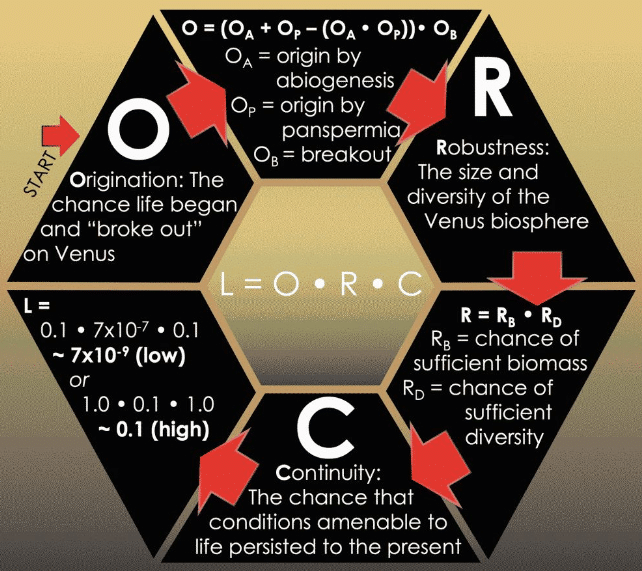
Diagram illustrating the components of the VLE. The example values reflect possible low and high estimates for each factor. (Izenberg et al. 2021)
Defining Variables Amidst Scientific Challenges
Each component of the equation presents unique complexities. Origination covers possibilities such as life forming through abiogenesis, via transfer from elsewhere (panspermia), or through multiple independent origins. One particularly difficult parameter to estimate is the “breakout” chance, or life gaining a significant foothold.
Robustness depends on nutrient access (notably CHNOPS elements), energy supplies, and the possible variety of organisms capable of thriving. A low “R” would imply a fragile biosphere prone to collapse under environmental stresses, as reflected in the continuity factor.
The continuity term assesses whether conditions supportive of life endured over geological time, accounting for factors like stable geology and orbit as well as threats such as volcanic eruptions and major impacts. Biological upheavals, like Earth’s Great Oxygenation Event, also influence this measure.
“A value of 0 for C indicates that there has been at least one total extinction event between the point in time of the origin event (including breakout) and the time being assessed,” the researchers write. Whether Earth has experienced complete wipeouts followed by life's resurgence is still an open question.
- Categories:
- News






0 comments
Sign in to Comment