
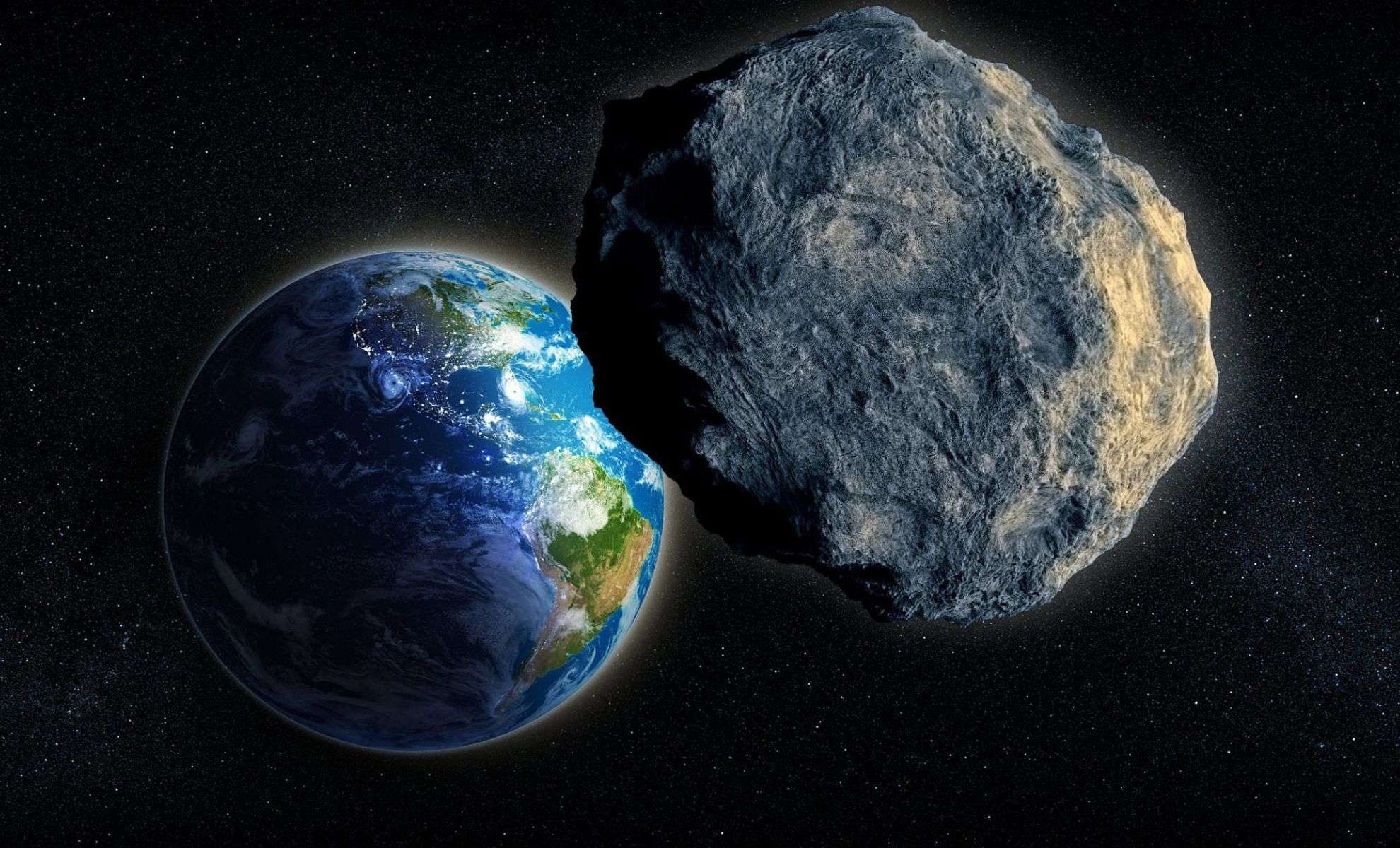
An immense space rock, roughly matching the size of the Great Pyramid of Giza, is scheduled to sweep past Earth today, NASA has announced.
The asteroid, designated 2024 JZ, measures around 120 meters (394 feet) across and will speed by at approximately 56,000 mph (90,123 km/h), which is about 65 times faster than a bullet.
Despite its impressive speed and size, experts confirm there is no cause for alarm, as the asteroid will maintain a safe distance of about 2.6 million miles (4.2 million kilometers) from our planet.

NASA Issues Advisory on Close Near-Earth Asteroid Approach
Classified as a ‘near-Earth object’ (NEO) by NASA, 2024 JZ is routinely tracked by astronomers. Dr. Edward Bloomer, a senior astronomer at the Royal Greenwich Observatory, reassured the public via MailOnline: “There is no reason for concern today; this event does not warrant any anxiety.”
NASA explains that ‘NEOs are comets and asteroids whose orbits have been altered by the gravitational forces of nearby planets, allowing them to approach Earth’s vicinity.’
‘Comets mainly consist of water ice mixed with dust, originating from the cold reaches of the outer solar system, while most rocky asteroids formed closer to the sun, between Mars and Jupiter.’
An object qualifies as a NEO if it orbits within 1.3 astronomical units (AU) from the sun — about 120.8 million miles — placing it within 0.3 AU (27.8 million miles) of Earth's orbital path.
Asteroids are labelled ‘potentially hazardous’ if they pass within 0.05 AU (4.65 million miles) and measure more than 140 meters (459 feet) in diameter.
Although 2024 JZ will come within just 0.028 AU of Earth—a close call on an astronomical scale—it poses no threat.
Later this evening, a smaller asteroid, 2024 JT3, is expected to pass significantly closer at approximately 12,000 miles (19,300 km) from Earth.
Juan Luis Cano from the European Space Agency’s Planetary Defence Office reassured MailOnline that Earth faces no danger from these flybys.
“There is absolutely no risk of an impact,” he stated.
He added, “Small objects between 5 and 10 meters usually burn up in the atmosphere, occasionally dropping tiny meteorites on the surface.”
Understanding the Distinctions Between NEOs and Meteors
Both professional and amateur astronomers collaborate to track NEOs as they orbit the sun.
Discoveries of new NEOs occur regularly, with dozens identified each month, allowing precise predictions of their paths.
Encounters like the passage of 2024 JZ are commonplace; the ESA considers such events a ‘very regular occurrence.’
Most NEOs disintegrate as they enter Earth's atmosphere, creating the shooting stars familiar to us.
Earth routinely traverses dense streams of comet debris, which give rise to meteor showers such as the Eta Aquariids seen this month.
Unlike meteors, which are typically smaller and burn up quickly, NEOs are large enough to survive atmospheric entry without disintegration.
While today's asteroid flyby is harmless, Dr. Bloomer cautions about possible impacts down the road: “Every day we’re essentially taking a gamble,” he acknowledged.
“If an asteroid like 2024 JZ were on a collision course, it could cause serious damage because it’s a substantial and fast-moving rock.”
The 1908 Tunguska event, triggered by an asteroid less than half the size of 2024 JZ, flattened 830 square miles of Siberian forest.
Similarly, the Chelyabinsk meteor, about 20 meters (65 feet) in diameter, damaged thousands of buildings and injured over 1,400 people in Russia.
Crucially, the Chelyabinsk rock struck Earth undetected beforehand, underscoring the importance of identification.
Mr. Cano emphasized that the ongoing challenge lies in discovering the many NEOs not yet found.
NASA’s Strategies to Protect Earth from Asteroid Threats
Thankfully, NASA has been proactive in developing defenses against potential asteroid impacts.
In November 2021, the agency’s DART mission tested a method by sending a spacecraft crashing into Dimorphos, a small asteroid orbiting approximately 6.8 million miles (10.9 million km) from Earth.
This trial proved that gently nudging an asteroid early can deflect its path, steering it away from Earth.
Dr. Bloomer explained, “The earlier you intervene, the smaller the impact needed to create a significant orbital shift.”
“If an object is detected late, greater effort is required to alter its trajectory in time.”
Though experimental, the DART mission confirmed Earth’s capability to prevent future asteroid collisions, provided sufficient lead time is given.





0 comments
Sign in to Comment