
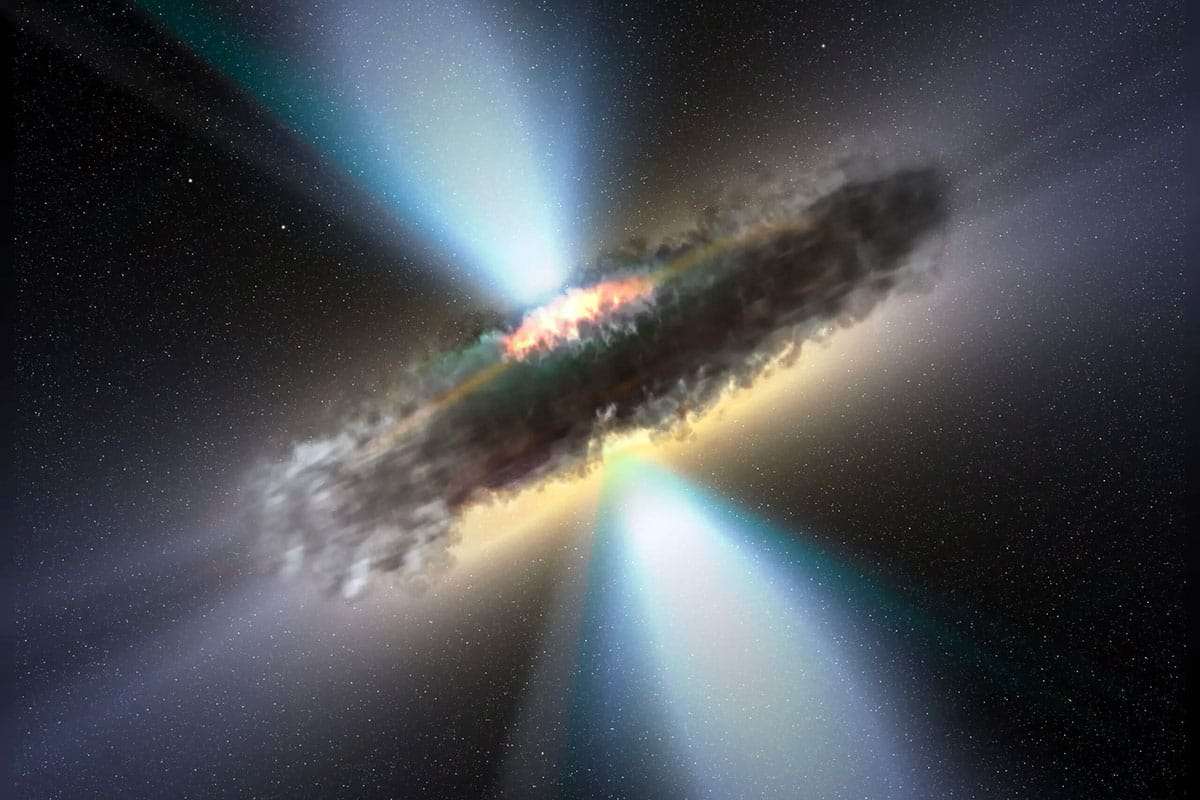
Scientists have pinpointed an extraordinary cosmic water reserve, marking a landmark achievement in space research. Matt Bradford from NASA’s Jet Propulsion Laboratory highlights the rarity of this find, noting, “The environment around this quasar is producing an unprecedented mass of water.” This discovery reveals water’s extensive reach across the universe and offers a glimpse into its distribution in the universe's earliest epochs.
At the heart of this phenomenon is the quasar named APM 08279+5255, energized by a monumental black hole. This black hole, weighing 20 billion times more than our sun, emits energy equal to that of a thousand trillion suns. Such immense power generates conditions ideal for abundant water vapor to form and persist.
Although water vapor exists within our Milky Way, the volume identified around this distant quasar is monumental. It exceeds the Milky Way’s vapor content by 4,000 times, given that much of our galaxy’s water remains frozen. This stark contrast highlights the unique environment surrounding the quasar and its potential to reshape our comprehension of cosmic development.

Water’s significance in the cosmic landscape
Water vapor acts as a pivotal marker, revealing detailed information about cosmic phenomena. Around APM 08279+5255, water vapor extends over a gaseous region measuring hundreds of light-years. This extensive reach indicates the quasar bathes nearby gas in X-ray and infrared radiation, fostering conditions much warmer and denser than found in typical galactic spaces.
Despite containing huge amounts of water vapor, the region’s temperature remains extremely cold by earthly standards, at approximately -63 degrees Fahrenheit. Yet, this is still about five times warmer and 10 to 100 times denser than most galactic environments, displaying the extreme nature of regions influenced by quasars.
The profusion of water and molecules like carbon monoxide points to an abundant gas supply capable of fueling the black hole’s growth for a prolonged duration. However, the ultimate destiny of this gas remains unknown. It might collapse to generate new stars or be blown away by the intense radiation and gravitational forces nearby.
Innovative technology behind the revelation
This incredible detection was enabled by state-of-the-art observation methods and devices. Two separate research teams, led by Matt Bradford and Dariusz Lis, used different observatories to confirm and study the abundant water vapor:
- Z-Spec instrument at Caltech’s Submillimeter Observatory
- Combined Array for Research in Millimeter-Wave Astronomy (CARMA)
- Plateau de Bure Interferometer located in the French Alps
These high-tech tools allowed researchers to identify multiple water spectral lines, enabling a precise understanding of its quantity and spread. Lis’s group originally stumbled upon the discovery in 2010, which Bradford’s team later verified and enhanced, illustrating the collaborative spirit of astronomy.
The utilization of these advanced facilities showcases the technological excellence necessary to investigate the distant cosmos and decode its mysteries. Continued improvements in our observational abilities promise more groundbreaking cosmic insights in the future.
Broader significance for cosmic knowledge
Uncovering this enormous water reservoir carries profound implications for how we understand the cosmos and its history. It challenges prior beliefs about water distribution in the universe’s infancy and raises important questions about water’s influence in shaping astronomical structures.
This discovery also supports emerging cosmological theories that contest conventional views of the universe’s origin and growth. The detection of such vast water quantities in the early universe suggests our models of cosmic chemistry and molecule formation might need revisiting.
Moreover, the finding accentuates the value of ongoing cosmic surveys and exploration. Peering ever deeper into the universe and further back in time grants us vital clues about primordial conditions and the cosmic processes that crafted the universe we observe today.
As our quest to decode the universe continues, discoveries like this immense reservoir of water remind us of the vast and wondrous nature of our universe. They motivate us to expand the limits of our knowledge and technology, propelling our exploration ever deeper into the cosmic expanse in search of answers to fundamental questions about existence.
- Categories:
- Astronomy








0 comments
Sign in to Comment