
Researchers have unveiled the detection of the universe's most powerful cosmic rays to date, originating from an enigmatic point surprisingly close to our planet. These particles, consisting of electrons and their antimatter analogs known as positrons, have been recorded at astonishing energies reaching 40 teraelectronvolts (TeV)—roughly 40,000 times more energetic than visible light. Published in Physical Review Letters on November 25, 2023, this discovery poses new questions about the origins and behavior of ultra-high-energy particles in space.
Decoding the Origins of Cosmic Rays
Cosmic rays are energetic particles that traverse the cosmos, generated by diverse astrophysical events like supernova detonations, pulsars, and possibly unidentified exotic phenomena. When these particles strike Earth’s atmosphere, they induce cascades of secondary particles detectable at the surface. Pinpointing their exact sources remains difficult because cosmic rays interact with magnetic fields and diminish in energy en route.
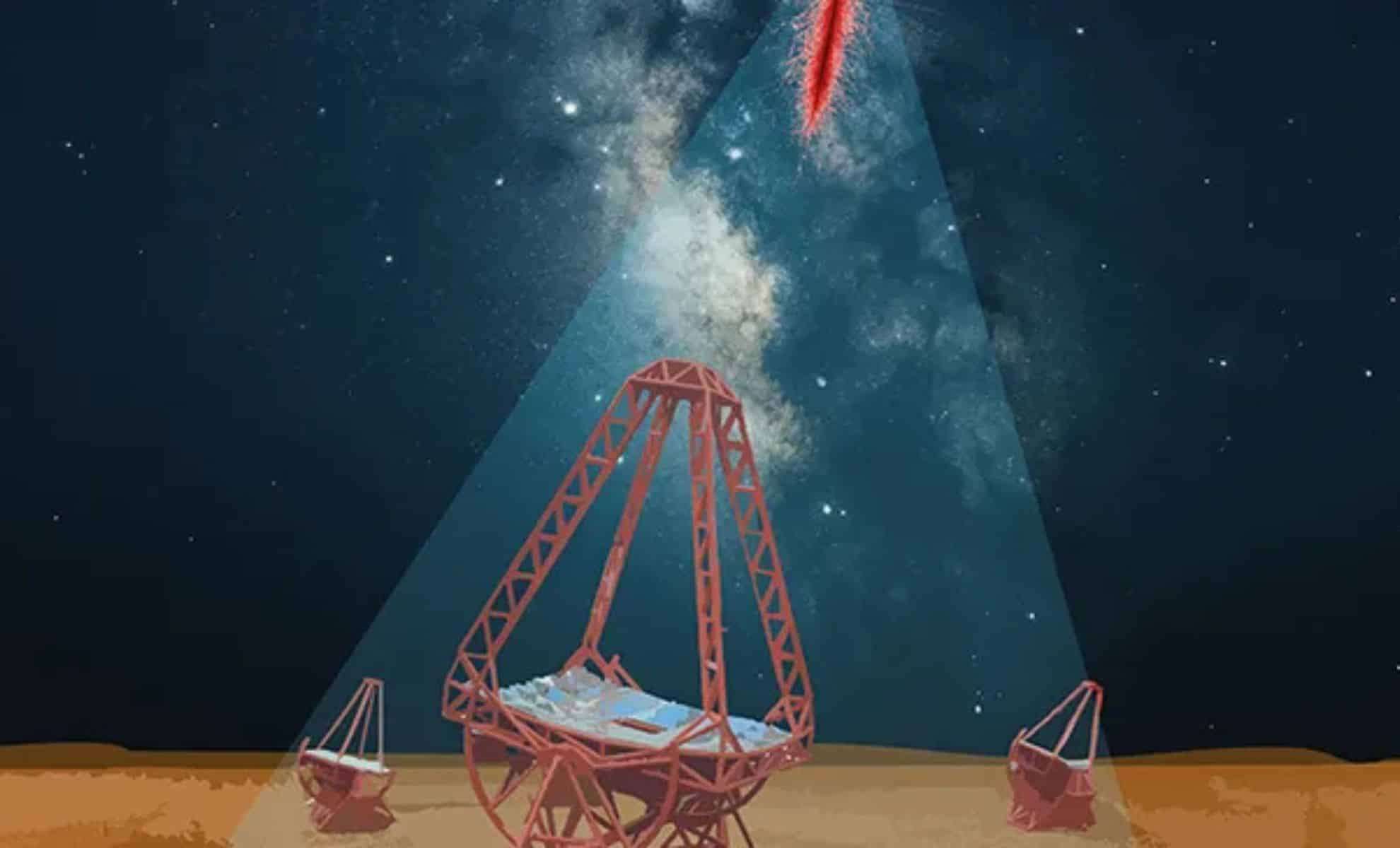
To investigate cosmic ray electrons (CRe) at such exceptional energies, scientists employed the HESS array—a network of five 12-meter telescopes located in Namibia’s Khomas Highlands. Over ten years, the observatory captured Cherenkov radiation, a subtle blue glow emitted when particles exceed light speed in air. Careful analysis enabled researchers to map the cosmic ray energy spectrum with unparalleled precision.

Kathrin Egberts, leading experimental astroparticle physics at the University of Potsdam, Germany, emphasized the importance of the findings: “Our results indicate that these high-energy cosmic ray electrons most likely arise from a very limited number of sources within a few thousand light years of the solar system, an incredibly close distance considering the vastness of our Galaxy.”
Adding further perspective, Mathieu de Naurois from the French National Centre for Scientific Research remarked, “Efficient electron accelerators are indeed present nearby. Many stars lie within hundreds of light years, with the closest just two light years from Earth. Consequently, remnants of dead stars like pulsars or supernova debris in this neighborhood are probable sources of these electrons.”
Challenging Existing Theories on Cosmic Ray Origins
The proximity of these high-energy cosmic ray electrons suggests intriguing astrophysical mechanisms at work close to Earth. Potential sources include nearby pulsars, remnants of supernovae, or other yet-undiscovered exotic accelerators. The relatively limited number of sources points to rare or extremely potent acceleration processes within this local region.
De Naurois explained the observational challenges, saying, “At such high energies, cosmic ray fluxes are incredibly low, making it difficult for space-based detectors to compete with ground-based measurements.” This highlights why the HESS observatory's terrestrial detection capabilities have been pivotal in capturing these rare, ultra-energetic particles, marking a landmark achievement for cosmic ray science.
HESS Observatory’s Critical Contribution
Since its commissioning more than a decade ago, the HESS observatory has played a vital role in recording these extreme cosmic rays by detecting Cherenkov light emitted when such particles interact with Earth’s atmosphere. The dataset from HESS provides invaluable insights into the energy and trajectories of cosmic rays, aiding efforts to locate their sources and comprehend the underlying acceleration mechanisms.
“H.E.S.S. features an enormous effective surface area, making it particularly adept at investigating the high-energy segment of the electron energy spectrum,” de Naurois stated. Such capabilities have led to the accumulation of critical data, advancing knowledge about cosmic ray phenomena.
Alongside HESS, forthcoming space missions and observatories are expected to deepen understanding of the astrophysical processes fueling cosmic rays. The current findings serve as an essential foundation for upcoming research in the field of high-energy astrophysics, potentially unveiling novel sources of energetic particles.
Future Directions in Astroparticle Research
This breakthrough sets the stage for new avenues in astroparticle physics by providing unprecedented data on cosmic rays at extreme energies. Continued investigation into these phenomena promises to illuminate the energetic forces shaping our universe. The discovery holds significant potential to transform perspectives on cosmic radiation and its origins.
De Naurois remarked, “Our measurements fill a crucial gap in a previously unexplored energy range, impacting our understanding of the local galactic neighborhood and forming a lasting reference point for future studies.”
As research into these ultra-high-energy cosmic rays and their enigmatic sources expands, the extensive data collected by HESS will be instrumental in shedding light on some of the universe’s most powerful and mysterious processes, raising new questions about the fundamental nature of cosmic particles and their role across the cosmos.
- Categories:
- Astronomy ,
- News ,
- Science ,
- Physics





0 comments
Sign in to Comment