
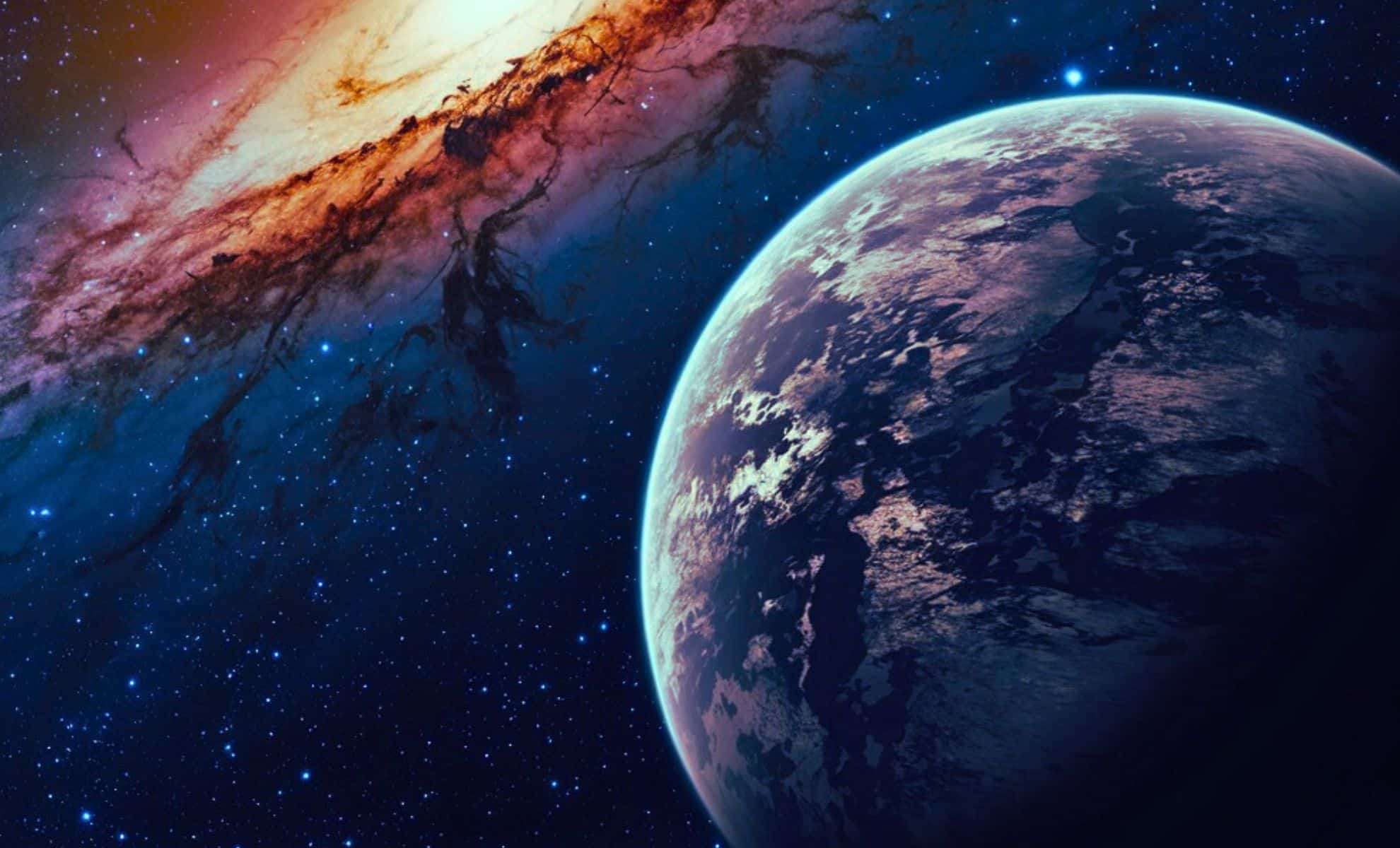
Envision a colossal planet, only slightly larger than Earth, positioned between Mars and Jupiter, causing turmoil within our Solar System. What impact would such a super-Earth have had on Earth’s habitability? Recent scientific studies suggest a chilling scenario that could have dramatically altered the trajectory of life on our planet.
Introducing ‘Phaedra’: The Super-Earth That Might Have Threatened Earth’s Existence
Scientists Emily Simpson and Howard Chen from the Florida Institute of Technology have put forward a provocative hypothesis: a super-Earth forming in the gap between Mars and Jupiter could have rendered Earth inhospitable. Their computational models reveal how this hypothetical world, dubbed Phaedra, might have triggered extreme shifts in Earth’s climate. Fierce winter freezes combined with intense summer heatwaves could have transformed our planet into a hostile environment, unable to sustain life.
- Lead Researchers: Emily Simpson and Howard Chen
- Affiliation: Florida Institute of Technology
- Hypothetical Body: Phaedra
- Proposed Location: Between Mars and Jupiter in the Solar System
The team explored multiple masses and orbital paths for Phaedra. Their findings indicate that a planet twice Earth’s mass would have caused unpredictable seasonal changes, destabilizing the climate but possibly allowing survival. However, a super-Earth with 10 to 20 times Earth’s mass would have led to a completely unlivable Earth.

Exploring the Effects of a Super-Earth Twice the Size of Earth
Simpson and Chen’s simulations extend beyond theory, suggesting that even a super-Earth with just double Earth’s mass could exert a chaotic gravitational influence. This tug could have thrown Earth’s orbit into upheaval, triggering drastic temperature fluctuations and creating conditions unfit for sustaining life, thereby threatening early living organisms.
Are Super-Earths a Threat in the Cosmic Neighborhood?
This study provokes deep reflection about the numerous super-Earths identified throughout the Milky Way. While our own Solar System lacks these massive planets, their prevalence around other stars indicates potential dangers. Could super-Earths pose a universal hazard to planets capable of supporting life?
Major Takeaways:
- Super-Earths rank among the most frequently discovered exoplanets but may have harmful effects on planetary neighbors.
- Their strong gravitational forces might disrupt the orbits of nearby worlds, reducing their chances of sustaining life.
Why Are Super-Earths Widespread Yet Potentially Hazardous?
Super-Earths are notably common across the cosmos, yet their size and mass—greater than Earth but less than Neptune—grant them significant gravitational power that can provoke orbital instability. This instability can trigger severe climate changes on adjacent planets, potentially making them lifeless. Perhaps Earth’s unique habitability owes itself to the absence of such a planet in our solar neighborhood.
Contrasting Earth, Mars, and the Hypothetical Super-Earth
Background Overview:
- Earth maintains an optimal balance of mass, gravity, and atmosphere necessary to sustain life.
- Mars, being smaller with reduced gravity and a thin atmosphere, is inhospitable to current life forms.
- The proposed super-Earth, Phaedra, due to its mass and orbit, would likely create extreme orbital disruptions and climate volatility, potentially eliminating habitability even with a modest mass increase.
The detection of these large planets orbiting other stars heightens concerns about planetary systems’ livability. Their existence prompts us to consider whether the presence of super-Earths elsewhere might drastically diminish the chances for life to endure beyond Earth.
- Categories:
- Astronomy ,
- Space








0 comments
Sign in to Comment